
Skip to content
Free Excel Tutorials
  • Home
  • Excel For Beginners
  • Excel Intermediate
  • Advanced Excel For Experts

Data Analysis

  • How to Use Solver Tool in Excel
  • Data Series in Excel
  • Reverse List in Excel
  • How to sum a total in multiple Excel tables
  • Managing Conditional Formatting Rules in Excel

References

  • How to use Excel FORMULATEXT function
  • Convert text string to valid reference in Excel using Indirect function
  • MATCH function: Description, Usage, Syntax, Examples and Explanation
  • Multi-criteria lookup and transpose in Excel
  • How to use Excel OFFSET function

Data Validations

  • Excel Data validation unique values only
  • Excel Data validation allow weekday only
  • How To Create Drop-down List in Excel
  • Excel Data validation date in next 30 days
  • Data validation must not exist in list

How to set check register balance in Excel

by

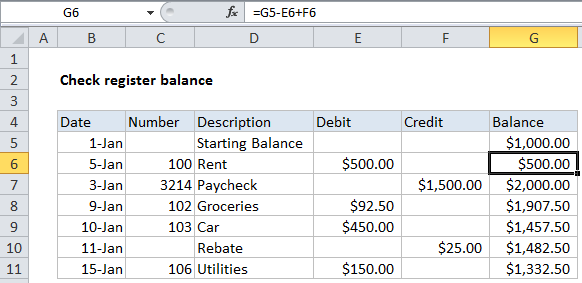
This tutorial shows how to set a check register formula that calculates a running balance and also, blank values using formula based on simple addition and subtraction.

See illustrations below:

Formula

=balance-debit+credit
Explanation

In the example shown, the formula in G6 is:

=G5-E6+F6

How this formula works

The value in G5 is hard-coded. The formula picks up the value in G5, then subtracts the value (if any) in E6 and adds the value (if any) in F6. When the credit or debit values are empty, they behave like zero and have no effect on the result.

When this formula is copied down column G, it will continue to calculate a running balance in each row.

Dealing with blank values

To display nothing in the balance column when the credit and debit columns are empty, you can use the IF function with AND and ISBLANK like this:

=IF(AND(ISBLANK(E6),ISBLANK(F6)),"",G5-E6+F6)

Note: this only handles bank credit and debit values at the end of the table, not rows in between.

This formula will return an empty string (“”) when both credit and debit cells are empty, and return the running balance if either number exists.

Post navigation

Previous Post:

How to calculate project complete percentage in Excel

Next Post:

Popularly Used Excel Functions and their examples

Leave a Reply Cancel reply

Your email address will not be published. Required fields are marked *

Learn Basic Excel

Ribbon
Workbook
Worksheets
Format Cells
Find & Select
Sort & Filter
Templates
Print
Share
Protect
Keyboard Shortcuts

Categories

  • Charts
  • Data Analysis
  • Data Validation
  • Excel Functions
    • Cube Functions
    • Database Functions
    • Date and Time Functions
    • Engineering Functions
    • Financial Functions
    • Information Functions
    • Logical Functions
    • Lookup and Reference Functions
    • Math and Trig Functions
    • Statistical Functions
    • Text Functions
    • Web Functions
  • Excel VBA
  • Excel Video Tutorials
  • Formatting
  • Grouping
  • Others

Logical Functions

  • OR function: Description, Usage, Syntax, Examples and Explanation
  • SWITCH function example in Excel
  • XOR function: Description, Usage, Syntax, Examples and Explanation
  • FALSE function: Description, Usage, Syntax, Examples and Explanation
  • How to use Excel AND Function

Date Time

  • Convert decimal seconds to Excel time
  • Sum through n months in Excel
  • How to calculate Quarter of Date in Excel
  • Calculate date overlap in days in Excel
  • TIME function: Description, Usage, Syntax, Examples and Explanation

Grouping

  • How to randomly assign people to groups in Excel
  • Map text to numbers in Excel
  • Map inputs to arbitrary values in Excel
  • Group arbitrary text values in Excel
  • How to randomly assign data to groups in Excel

General

  • How to calculate profit margin percentage in Excel
  • Count cells less than in Excel
  • Convert column letter to number in Excel
  • How to calculate percent change in Excel
  • How to generate random date between two dates in Excel
© 2026 xlsoffice . All Right Reserved. | Teal Smiles | Abbreviations And Their Meaning