Skip to content
Free Excel Tutorials
  • Home
  • Excel For Beginners
  • Excel Intermediate
  • Advanced Excel For Experts

Data Analysis

  • How to create dynamic reference table name in Excel
  • Subtotal function in Excel
  • How To Create Pareto Chart in Excel
  • How to Create Area Chart in Excel
  • Error Bars in Excel

References

  • Perform case-sensitive Lookup in Excel
  • How to get address of first cell in range in Excel
  • How to use Excel TRANSPOSE Function
  • How to use Excel MMULT Function
  • How to use Excel LOOKUP Function

Data Validations

  • Excel Data validation exists in list
  • Prevent invalid data entering in specific cells
  • Excel Data validation allow weekday only
  • Excel Data validation require unique number
  • Data validation must not exist in list

Excel Data validation only dates between

by

Set criteria to accept only dates in a particular period

Excel has several built-in data validation rules for dates. This page explains how to create a your own validation rule based on a custom formula in case you want or need more control and flexibility.

Formula

=AND(A1>=date1),A1<=date2)

Explanation

To allow a user to enter only dates between two dates, you can use data validation with a custom formula based on the AND function.

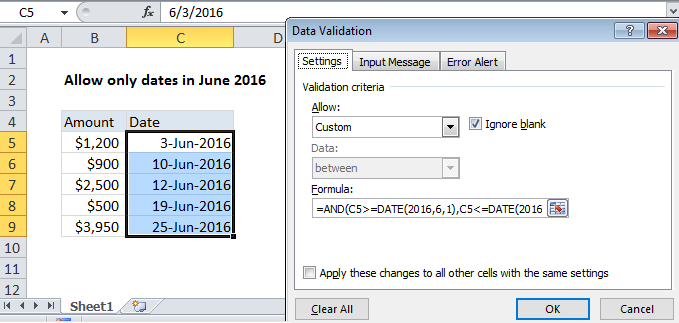
In the example shown, the data validation applied to C5:C9 is:

=AND(C5>=DATE(2016,6,1),C5<=DATE(2016,6,30))

How this formula works

Data validation rules are triggered when a user adds or changes a cell value.

The AND function takes multiple arguments (logicals) and returns TRUE only when all arguments return TRUE. The DATE function creates a proper Excel date with given year, month, and day values.

Because we want to allow only dates in the month of June 2016, we give AND with two logicals.

The first logical tests that input to C5 is greater than or equal to June 1, 2016:

C5>=DATE(2016,6,1)

The second logical tests that input to C5 is less than or equal to June 30, 2016:

C5<=DATE(2016,6,30)

If both conditions are TRUE, the AND function returns TRUE and input passes validation. If either condition is FALSE, AND returns FALSE and input fails data validation.

Post navigation

Previous Post:

COSH function: Description, Usage, Syntax, Examples and Explanation

Next Post:

Excel Data validation require unique number

Leave a Reply Cancel reply

Your email address will not be published. Required fields are marked *

Learn Basic Excel

Ribbon
Workbook
Worksheets
Format Cells
Find & Select
Sort & Filter
Templates
Print
Share
Protect
Keyboard Shortcuts

Categories

  • Charts
  • Data Analysis
  • Data Validation
  • Excel Functions
    • Cube Functions
    • Database Functions
    • Date and Time Functions
    • Engineering Functions
    • Financial Functions
    • Information Functions
    • Logical Functions
    • Lookup and Reference Functions
    • Math and Trig Functions
    • Statistical Functions
    • Text Functions
    • Web Functions
  • Excel VBA
  • Excel Video Tutorials
  • Formatting
  • Grouping
  • Others

Logical Functions

  • IFERROR function: Description, Usage, Syntax, Examples and Explanation
  • OR function: Description, Usage, Syntax, Examples and Explanation
  • SWITCH function: Description, Usage, Syntax, Examples and Explanation
  • NOT function: Description, Usage, Syntax, Examples and Explanation
  • TRUE function: Description, Usage, Syntax, Examples and Explanation

Date Time

  • How to get number of days, weeks, months or years between two dates in Excel
  • TODAY function: Description, Usage, Syntax, Examples and Explanation
  • Convert Excel time to decimal seconds
  • Get work hours between dates custom schedule in Excel
  • Get month name from date in Excel

Grouping

  • Map inputs to arbitrary values in Excel
  • Calculate conditional mode with criteria in Excel
  • Group numbers with VLOOKUP in Excel
  • Group times into 3 hour buckets in Excel
  • How to randomly assign data to groups in Excel

General

  • Create dynamic workbook reference to another workbook in Excel
  • How to calculate percent sold in Excel
  • How to calculate percent variance in Excel
  • Basic numeric sort formula in Excel
  • How to create dynamic worksheet reference in Excel
© 2025 xlsoffice . All Right Reserved. | Teal Smiles | Abbreviations And Their Meaning