
Skip to content
Free Excel Tutorials
  • Home
  • Excel For Beginners
  • Excel Intermediate
  • Advanced Excel For Experts

Data Analysis

  • Excel Frequency Function Example
  • Get column index in Excel Table
  • Conditional Formatting Data bars Examples in Excel
  • How To Filter Data in Excel
  • Data Series in Excel

References

  • How to get last row in text data in Excel
  • How to calculate two-way lookup VLOOKUP in Excel Table
  • Vlookup Examples in Excel
  • VLOOKUP function: Description, Usage, Syntax, Examples and Explanation
  • How to get address of named range in Excel

Data Validations

  • Excel Data validation date in specific year
  • Excel Data validation exists in list
  • Excel Data validation specific characters only
  • Excel Data validation allow weekday only
  • Excel Data validation don’t exceed total

Excel Data validation with conditional list

by

How to create a drop-down and multiple dependent drop-down lists.in Excel

To allow a user to switch between two or more lists, you can use the IF function to test for a value and conditionally return a list of values based on the result.

Formula

=IF(A1="See full list",long_list,short_list)
Explanation

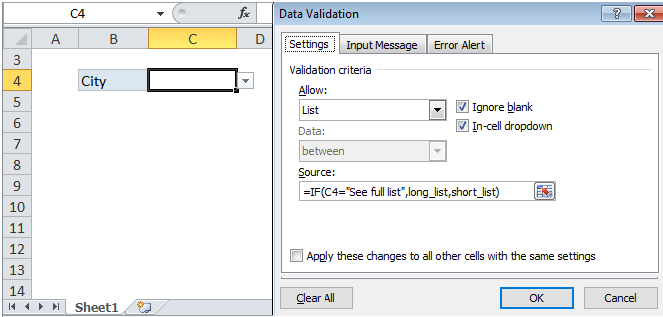
In the example shown above, the data validation applied to C4 is:

=IF(C4="See full list",long_list,short_list)

This allows a user to select a city from a short list of options by default, but also provides an easy way to view and select a city from a longer list of cities.

How this formula works

Data validation rules are triggered when a user adds or changes a cell value. This formula takes advantage of this behavior to provide a clever way for the user to switch between a short list of cities and a longer list of cities.

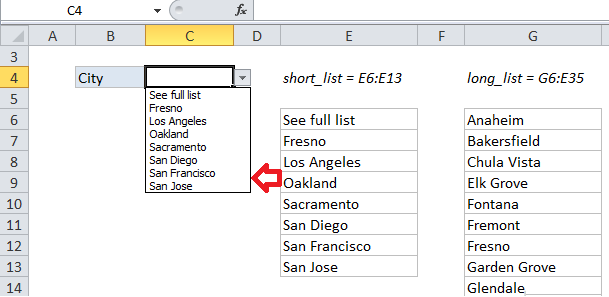
In this formula, the IF function is configured to test the value in cell C4. When C4 is empty or contains any value except “See full list”, the user sees a short list of cities, provided in the named range short_list (E6:E13):
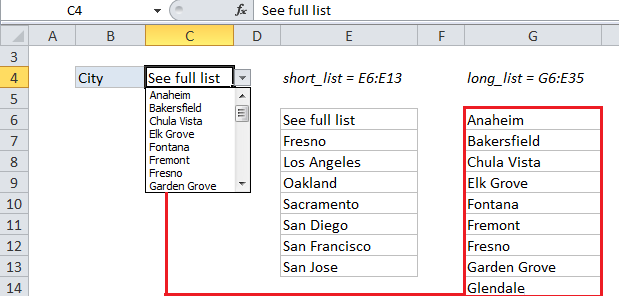
If the value in C4 is “See full list”, the user sees the long list of cities, provided in the named range long_list (G6:G35):
The named ranges used in the formula are not required, but they make the formula a lot easier to read and understand. If you are new to named ranges, this page provides a good overview.

Dependent dropdown lists

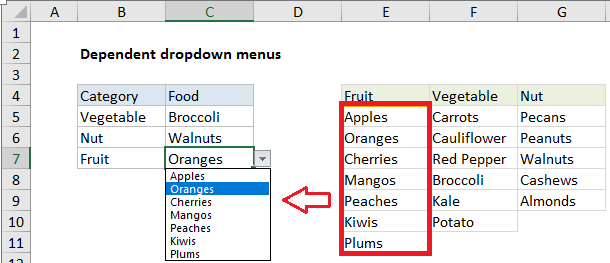
Expanding on the example above, you can create multiple dependent dropdown lists. For example, a user selects an item type of “fruit”, so they next see a list of fruits to select. If they first select “vegetable” they then see a list of vegetables.


Post navigation

Previous Post:

COSH function: Description, Usage, Syntax, Examples and Explanation

Next Post:

Excel Data validation require unique number

Leave a Reply Cancel reply

Your email address will not be published. Required fields are marked *

Learn Basic Excel

Ribbon
Workbook
Worksheets
Format Cells
Find & Select
Sort & Filter
Templates
Print
Share
Protect
Keyboard Shortcuts

Categories

  • Charts
  • Data Analysis
  • Data Validation
  • Excel Functions
    • Cube Functions
    • Database Functions
    • Date and Time Functions
    • Engineering Functions
    • Financial Functions
    • Information Functions
    • Logical Functions
    • Lookup and Reference Functions
    • Math and Trig Functions
    • Statistical Functions
    • Text Functions
    • Web Functions
  • Excel VBA
  • Excel Video Tutorials
  • Formatting
  • Grouping
  • Others

Logical Functions

  • Invoice status with nested if in Excel
  • SWITCH function: Description, Usage, Syntax, Examples and Explanation
  • Nested IF function example in Excel
  • IFERROR function: Description, Usage, Syntax, Examples and Explanation
  • IF with boolean logic in Excel

Date Time

  • Sum race time splits in Excel
  • Count birthdays by month in Excel
  • Get days between dates in Excel
  • Convert text date dd/mm/yy to mm/dd/yy in Excel
  • Add workdays to date custom weekends in Excel

Grouping

  • Map inputs to arbitrary values in Excel
  • Group times into unequal buckets in Excel
  • Map text to numbers in Excel
  • Group numbers with VLOOKUP in Excel
  • Group numbers at uneven intervals in Excel

General

  • How to set or clear a print area in Excel Worksheet
  • Basic text sort formula in Excel
  • Creating and Opening an existing file in Excel
  • How to Delete Cells, Row and Rows in Excel
  • Sum by group in Excel
© 2026 xlsoffice . All Right Reserved. | Teal Smiles | Abbreviations And Their Meaning