
Skip to content
Free Excel Tutorials
  • Home
  • Excel For Beginners
  • Excel Intermediate
  • Advanced Excel For Experts

Data Analysis

  • How To Perform and Interpret Regression Analysis in Excel
  • Use Data Form to input, edit and delete records in Excel
  • Conditional Formatting Icon Sets Examples in Excel
  • Error Bars in Excel
  • How to Create Gantt Chart in Excel

References

  • How to get address of first cell in range in Excel
  • Find Closest Match in Excel Using INDEX, MATCH, ABS and MIN functions
  • How to use Excel COLUMN Function
  • Find closest match in Excel
  • Two-way lookup with VLOOKUP in Excel

Data Validations

  • Data validation must not exist in list
  • Excel Data validation require unique number
  • Excel Data validation don’t exceed total
  • Excel Data validation only dates between
  • Excel Data validation allow weekday only

Data validation must not exist in list

by

Accept data that are not included in a specific range of records

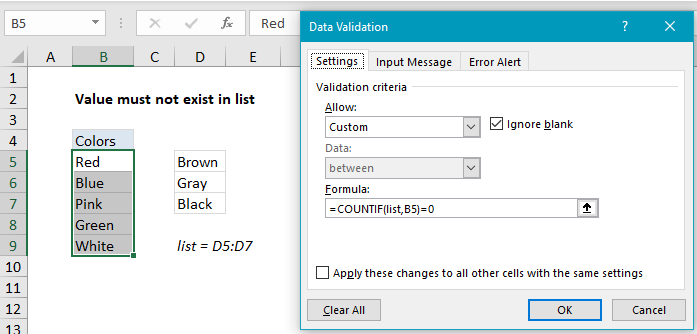
To allow only values that do not exist in a list, you can use data validation with a custom formula based on the COUNTIF function.

Note: Excel has a built-in data validation rules for dropdown lists. This page explains how to create a custom validation rule when you want to *prevent* a user from entering a value in a list.

Formula

=COUNTIF(list,A1)=0
Explanation

Based on the example above, the data validation applied to B5:B9 is:

=COUNTIF(list,B5)=0

where “list” is the named range D5:D7.

How this formula works

Data validation rules are triggered when a user adds or changes a cell value.

In this case, the COUNTIF function is part of an expression that returns TRUE when a value does not exist in a defined list. The COUNTIF function simply counts occurrences of the value in the list. As long as the count is zero, the entry will pass validation. If the count is not zero (i.e. the user entered a value from the list) validation will fail.

Post navigation

Previous Post:

COSH function: Description, Usage, Syntax, Examples and Explanation

Next Post:

Excel Data validation require unique number

Leave a Reply Cancel reply

Your email address will not be published. Required fields are marked *

Learn Basic Excel

Ribbon
Workbook
Worksheets
Format Cells
Find & Select
Sort & Filter
Templates
Print
Share
Protect
Keyboard Shortcuts

Categories

  • Charts
  • Data Analysis
  • Data Validation
  • Excel Functions
    • Cube Functions
    • Database Functions
    • Date and Time Functions
    • Engineering Functions
    • Financial Functions
    • Information Functions
    • Logical Functions
    • Lookup and Reference Functions
    • Math and Trig Functions
    • Statistical Functions
    • Text Functions
    • Web Functions
  • Excel VBA
  • Excel Video Tutorials
  • Formatting
  • Grouping
  • Others

Logical Functions

  • Not Equal To ‘<>‘ operator in Excel
  • How to use Excel OR Function
  • Return blank if in Excel
  • How to use Excel XOR Function
  • Excel If, Nested If, And/Or Criteria Examples

Date Time

  • How to calculate next day of week in Excel
  • Sum through n months in Excel
  • HOUR function: Description, Usage, Syntax, Examples and Explanation
  • Get days, hours, and minutes between dates in Excel
  • Get project midpoint in Excel

Grouping

  • Map text to numbers in Excel
  • How to randomly assign data to groups in Excel
  • Group arbitrary text values in Excel
  • Group numbers at uneven intervals in Excel
  • Running count group by n size in Excel

General

  • Advanced Number Formats in Excel
  • How to make excel worksheets print on one page?
  • Excel Autofill Cell Ranges, Copy, Paste
  • How to choose page/paper size in Excel before Printing
  • How to calculate profit margin percentage in Excel
© 2025 xlsoffice . All Right Reserved. | Teal Smiles | Abbreviations And Their Meaning