
Skip to content
Free Excel Tutorials
  • Home
  • Excel For Beginners
  • Excel Intermediate
  • Advanced Excel For Experts

Data Analysis

  • Excel Pie Chart
  • How to count table columns in Excel
  • Example of COUNTIFS with variable table column in Excel
  • How To Filter Data in Excel
  • How to Create Gantt Chart in Excel

References

  • CHOOSE function: Description, Usage, Syntax, Examples and Explanation
  • How to get address of first cell in range in Excel
  • Two-way lookup with VLOOKUP in Excel
  • To count total rows in a range in Excel
  • Perform case-sensitive Lookup in Excel

Data Validations

  • Excel Data validation don’t exceed total
  • Excel Data validation whole percentage only
  • Data validation must not exist in list
  • How To Create Drop-down List in Excel
  • Excel Data validation no punctuation

Customize Quick Access Toolbar in Excel

by

Quick Access Toolbar holds commands that a user uses frequently that is not in the ribbon.

By default, the Quick Access Toolbar, located above the ribbon, contains the Save, Undo and Redo button. If you use an Excel command frequently, you can add it to the Quick Access Toolbar.

You can even add commands to the Quick Access Toolbar that are not in the ribbon.

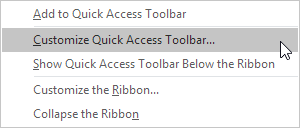
1. Right click anywhere on the ribbon, and then click Customize Quick Access Toolbar.
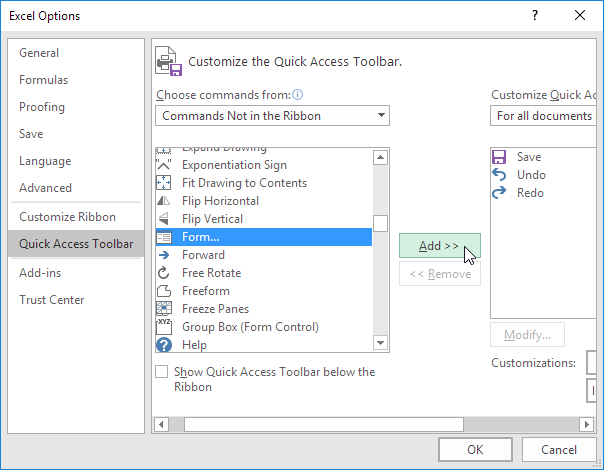
2. Under Choose commands from, select Commands Not in the Ribbon.

3. Select Form and click Add.

Note: by default, Excel customizes the Quick Access Toolbar for all documents. Under Customize Quick Access Toolbar, select the current saved workbook to only customize the Quick Access Toolbar for this workbook. For example, take a look at the quick access toolbar with the Form command in this Excel file: data-form.xlsx.

4. Click OK.

5. To remove a command from the Quick Access Toolbar, right click the command and then click Remove from Quick Access Toolbar.

Post navigation

Previous Post:

VLOOKUP without #N/A error in Excel

Next Post:

Manipulating text strings using Left, Mid, Right, Len, Substitute in Excel

Leave a Reply Cancel reply

Your email address will not be published. Required fields are marked *

Learn Basic Excel

Ribbon
Workbook
Worksheets
Format Cells
Find & Select
Sort & Filter
Templates
Print
Share
Protect
Keyboard Shortcuts

Categories

  • Charts
  • Data Analysis
  • Data Validation
  • Excel Functions
    • Cube Functions
    • Database Functions
    • Date and Time Functions
    • Engineering Functions
    • Financial Functions
    • Information Functions
    • Logical Functions
    • Lookup and Reference Functions
    • Math and Trig Functions
    • Statistical Functions
    • Text Functions
    • Web Functions
  • Excel VBA
  • Excel Video Tutorials
  • Formatting
  • Grouping
  • Others

Logical Functions

  • SWITCH function: Description, Usage, Syntax, Examples and Explanation
  • IFS function: Description, Usage, Syntax, Examples and Explanation
  • How to use Excel OR Function
  • IFNA function: Description, Usage, Syntax, Examples and Explanation
  • How to use Excel FALSE Function

Date Time

  • MINUTE function: Description, Usage, Syntax, Examples and Explanation
  • Convert time to time zone in Excel
  • How to determine year is a leap year in Excel
  • Custom weekday abbreviation in Excel
  • Add workdays to date custom weekends in Excel

Grouping

  • Group numbers with VLOOKUP in Excel
  • Map text to numbers in Excel
  • Group numbers at uneven intervals in Excel
  • If cell contains one of many things in Excel
  • Group times into unequal buckets in Excel

General

  • How to calculate profit margin percentage in Excel
  • How to calculate decrease by percentage in Excel
  • How to count total number of cells in a rectangular range in Excel
  • Transpose: Switch ‘Rows to Columns’ or ‘Columns to Rows’ in Excel
  • How to calculate percent of goal in Excel
© 2026 xlsoffice . All Right Reserved. | Teal Smiles | Abbreviations And Their Meaning