
Skip to content
Free Excel Tutorials
  • Home
  • Excel For Beginners
  • Excel Intermediate
  • Advanced Excel For Experts

Data Analysis

  • How to Create One and Two Variable Data Tables in Excel
  • How To Insert and Customize Sparklines in Excel
  • How to calculate current stock or inventory in Excel
  • How to create a Histogram in Excel
  • Data Series in Excel

References

  • How to use Excel MMULT Function
  • Basic INDEX MATCH approximate in Excel
  • Get nth match with INDEX / MATCH in Excel
  • How to use Excel TRANSPOSE Function
  • Two-column Lookup in Excel

Data Validations

  • Excel Data validation exists in list
  • Excel Data validation number multiple 100
  • Excel Data validation allow uppercase only
  • Excel Data validation must contain specific text
  • Excel Data validation whole percentage only

How to get first row number in range in Excel

by

You can get the first row (i.e. the starting row number) in a range with a formula based on the ROW function.

Formula

=MIN(ROW(range))
Explanation

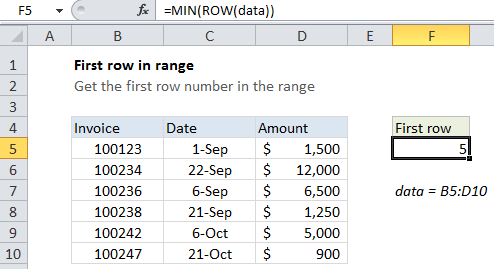
In the example shown, the formula in cell F5 is:

=MIN(ROW(data))

where data is a named range for B5:D10

How this formula works

When given a single cell reference, the ROW function returns the row number for that reference. However, when given a range that contains multiple rows, the ROW function will return an array that contains all row numbers for the range. In the example shown the array looks like this:

{5;6;7;8;9;10}

If you want only the first row number, you can use the MIN function to extract just the first row number, which will be the lowest number in the array.

Simple version

Entered in a single cell, the ROW function will display only the first row number, even though it returns an array. This means, in practice, you can often just use the ROW function alone:

=ROW(range)

However, inside formulas more complex formulas, it’s sometimes necessary to make sure you are dealing with only one item, and not an array. In that case, you’ll want to use MIN to pull out just the first item.

Index version

Since ROW (range) actually returns an array of every row number in the range, you can also use INDEX to fetch the first item:

=ROW(INDEX(data,1,1))

Not tested, but this may be slightly faster than the MIN(ROW) formula in very large ranges.

Post navigation

Previous Post:

How to calculate project complete percentage in Excel

Next Post:

Popularly Used Excel Functions and their examples

Leave a Reply Cancel reply

Your email address will not be published. Required fields are marked *

Learn Basic Excel

Ribbon
Workbook
Worksheets
Format Cells
Find & Select
Sort & Filter
Templates
Print
Share
Protect
Keyboard Shortcuts

Categories

  • Charts
  • Data Analysis
  • Data Validation
  • Excel Functions
    • Cube Functions
    • Database Functions
    • Date and Time Functions
    • Engineering Functions
    • Financial Functions
    • Information Functions
    • Logical Functions
    • Lookup and Reference Functions
    • Math and Trig Functions
    • Statistical Functions
    • Text Functions
    • Web Functions
  • Excel VBA
  • Excel Video Tutorials
  • Formatting
  • Grouping
  • Others

Logical Functions

  • IFS function: Description, Usage, Syntax, Examples and Explanation
  • OR function: Description, Usage, Syntax, Examples and Explanation
  • How to use Excel FALSE Function
  • How to use Excel NOT Function
  • How to use IFS function in Excel

Date Time

  • Assign points based on late time in Excel
  • Sum race time splits in Excel
  • Get month name from date in Excel
  • Add years to date in Excel
  • Get last working day in month in Excel

Grouping

  • How to randomly assign data to groups in Excel
  • If cell contains one of many things in Excel
  • Group times into unequal buckets in Excel
  • How to randomly assign people to groups in Excel
  • Group times into 3 hour buckets in Excel

General

  • Excel Operators
  • AutoRecover file that was never saved in Excel
  • Check if multiple cells have same value with case sensitive in Excel
  • Lock Cells in a Worksheet Excel
  • Flash Fill in Excel
© 2025 xlsoffice . All Right Reserved. | Teal Smiles | Abbreviations And Their Meaning