
Skip to content
Free Excel Tutorials
  • Home
  • Excel For Beginners
  • Excel Intermediate
  • Advanced Excel For Experts

Data Analysis

  • How to Create Column Chart in Excel
  • Conditional Formatting Rules in Excel
  • Remove Duplicates Example in Excel
  • How to Create One and Two Variable Data Tables in Excel
  • Excel Line Chart

References

  • How to get address of named range in Excel
  • Vlookup Examples in Excel
  • Offset in Excel
  • Basic INDEX MATCH approximate in Excel
  • How to use Excel INDIRECT Function

Data Validations

  • Prevent invalid data entering in specific cells
  • Excel Data validation date in specific year
  • Excel Data validation exists in list
  • Excel Data validation must contain specific text
  • Excel Data validation date in next 30 days

Get month name from date in Excel

by

If you need to get the month name (i.e. January, February, March, etc.) from a date, you have several options depending on your needs.

Formula

=TEXT(date,"mmmm")
Explanation

To convert the date into a month name

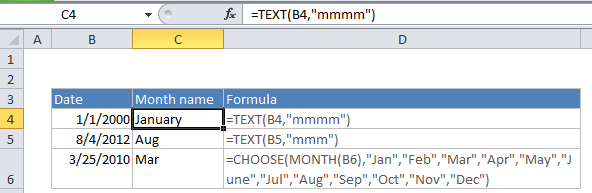
If you want to convert the date value to a text value, you can use the TEXT function with a custom number format like “mmm”. In the example, the formula looks like this:

=TEXT(B4,"mmmm")

The TEXT function converts values to text using the number format that you provide. Note that the date is lost in the conversion: only the text for the month name remains.

To display the month name

If you only want to display a month name, you don’t need a formula – you can use a custom number format. Select the date and navigate to Format cells (Ctrl + 1 or Cmd +1), then select Custom and enter one of these custom formats:

"mmm"  // "Jan"
"mmmm" // "January"

Excel will display only the month name, but it will leave the date value intact.

A more flexible way

If you want maximum flexibility, you can “map” the month to a month name directly in the CHOOSE function like so:

=CHOOSE(MONTH(B4),"Jan","Feb","Mar","Apr","May","Jun","Jul","Aug","Sep","Oct","Nov","Dec")

Enter the month names you want to return (abbreviated or not) as values in CHOOSE, after the first argument, which is entered as MONTH(date). MONTH will extract a month number, and CHOOSE will use this number to return the nth value in the list. This works because MONTH returns a number 1-12 that corresponds to the month name.

CHOOSE is more work to set up, but it is also more flexible, since it allows you to map a date to any values you want (i.e. you can use values that are custom, abbreviated, not abbreviated, in a different language, etc.)

Post navigation

Previous Post:

DECIMAL function: Description, Usage, Syntax, Examples and Explanation

Next Post:

AVERAGE function: Description, Usage, Syntax, Examples and Explanation

Leave a Reply Cancel reply

Your email address will not be published. Required fields are marked *

Learn Basic Excel

Ribbon
Workbook
Worksheets
Format Cells
Find & Select
Sort & Filter
Templates
Print
Share
Protect
Keyboard Shortcuts

Categories

  • Charts
  • Data Analysis
  • Data Validation
  • Excel Functions
    • Cube Functions
    • Database Functions
    • Date and Time Functions
    • Engineering Functions
    • Financial Functions
    • Information Functions
    • Logical Functions
    • Lookup and Reference Functions
    • Math and Trig Functions
    • Statistical Functions
    • Text Functions
    • Web Functions
  • Excel VBA
  • Excel Video Tutorials
  • Formatting
  • Grouping
  • Others

Logical Functions

  • Check multiple cells are equal in Excel
  • TRUE function: Description, Usage, Syntax, Examples and Explanation
  • Excel If, Nested If, And/Or Criteria Examples
  • OR function Examples in Excel
  • How to return blank in place of #DIV/0! error in Excel

Date Time

  • How to calculate Day of the Year in Excel
  • Count birthdays by month in Excel
  • How to join date and text together in Excel
  • Get project end date in Excel
  • Get last working day in month in Excel

Grouping

  • Group arbitrary text values in Excel
  • Map text to numbers in Excel
  • Map inputs to arbitrary values in Excel
  • Calculate conditional mode with criteria in Excel
  • Group numbers with VLOOKUP in Excel

General

  • Sum by group in Excel
  • Count cells that do not contain many strings in Excel
  • Freeze and Unfreeze Panes in Excel
  • Count cells less than in Excel
  • How to fill cell ranges with random text values in Excel
© 2026 xlsoffice . All Right Reserved. | Teal Smiles | Abbreviations And Their Meaning