
Skip to content
Free Excel Tutorials
  • Home
  • Excel For Beginners
  • Excel Intermediate
  • Advanced Excel For Experts

Data Analysis

  • Conditional Formatting Icon Sets Examples in Excel
  • How to conditionally sum numeric data in an Excel table using SUMIFS
  • Filter Data Based on Date in Excel
  • How to Use Solver Tool in Excel
  • Remove Duplicates Example in Excel

References

  • How to use Excel FORMULATEXT function
  • INDEX function: Description, Usage, Syntax, Examples and Explanation
  • How to get relative row numbers in a range in Excel
  • How to use Excel ROWS Function
  • Basic INDEX MATCH approximate in Excel

Data Validations

  • Excel Data validation require unique number
  • Excel Data validation no punctuation
  • Excel Data validation whole percentage only
  • Excel Data validation with conditional list
  • Excel Data validation must not contain

SWITCH function example in Excel

by

Excel SWITCH function compares an expression to a list of values and returns the corresponding result.

This example teaches you how to use the SWITCH function in Excel 2016 instead of the IFS function.

1a. For example, the IFS function below finds the correct states.
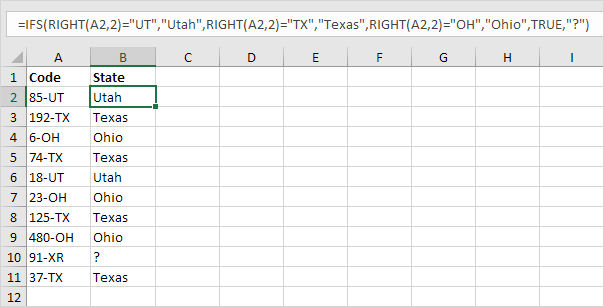
Explanation: cell A2 contains the string 85-UT. The RIGHT function extracts the 2 rightmost characters from this string (UT). As a result, the IFS function returns the correct state (Utah). If the 2 rightmost characters are not equal to UT, TX or OH, the IFS function returns a question mark. Instead of TRUE, you can also use 1=1 or something else that is always TRUE.

1b. The SWITCH function below produces the exact same result but is much easier to read.
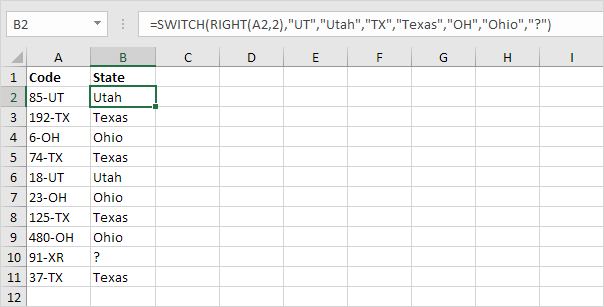
Explanation: if the first argument (RIGHT(A2,2) in this example) equals UT, the SWITCH function returns Utah. If TX, Texas. If OH, Ohio. The last argument (a question mark in this example) is always the default value (if there’s no match).

2. Why not always use the SWITCH function in Excel? There are many examples where you cannot use the SWITCH function instead of the IFS function.

Explanation: because we use”<” and “>=” symbols in this IFS function, we cannot use the SWITCH function.

Post navigation

Previous Post:

COSH function: Description, Usage, Syntax, Examples and Explanation

Next Post:

Excel Data validation require unique number

Leave a Reply Cancel reply

Your email address will not be published. Required fields are marked *

Learn Basic Excel

Ribbon
Workbook
Worksheets
Format Cells
Find & Select
Sort & Filter
Templates
Print
Share
Protect
Keyboard Shortcuts

Categories

  • Charts
  • Data Analysis
  • Data Validation
  • Excel Functions
    • Cube Functions
    • Database Functions
    • Date and Time Functions
    • Engineering Functions
    • Financial Functions
    • Information Functions
    • Logical Functions
    • Lookup and Reference Functions
    • Math and Trig Functions
    • Statistical Functions
    • Text Functions
    • Web Functions
  • Excel VBA
  • Excel Video Tutorials
  • Formatting
  • Grouping
  • Others

Logical Functions

  • Invoice status with nested if in Excel
  • FALSE function: Description, Usage, Syntax, Examples and Explanation
  • IF with wildcards in Excel
  • How to use Excel FALSE Function
  • How to use Excel NOT Function

Date Time

  • Count day of week between dates in Excel
  • Display the current date in Excel
  • Add years to date in Excel
  • Convert Unix time stamp to Excel date
  • WORKDAY.INTL function: Description, Usage, Syntax, Examples and Explanation

Grouping

  • If cell contains one of many things in Excel
  • How to randomly assign people to groups in Excel
  • Group times into 3 hour buckets in Excel
  • Map inputs to arbitrary values in Excel
  • Map text to numbers in Excel

General

  • Subtotal by color in Excel
  • Excel Autofill Cell Ranges, Copy, Paste
  • Basic error trapping example in Excel
  • How to calculate percentage of total in Excel
  • How to get amount with percentage in Excel
© 2026 xlsoffice . All Right Reserved. | Teal Smiles | Abbreviations And Their Meaning