
Skip to content
Free Excel Tutorials
  • Home
  • Excel For Beginners
  • Excel Intermediate
  • Advanced Excel For Experts

Data Analysis

  • Conditional Formatting Icon Sets Examples in Excel
  • How To Create Frequency Distribution in Excel
  • Filter Data Based on Date in Excel
  • How to add Trendline to a chart in Excel
  • How to count table columns in Excel

References

  • How to get first column number in range in Excel
  • How to use Excel MMULT Function
  • How to create dynamic named range with OFFSET in Excel
  • Count rows that contain specific values in Excel
  • Convert text string to valid reference in Excel using Indirect function

Data Validations

  • Excel Data validation with conditional list
  • Excel Data validation allow weekday only
  • Excel Data validation unique values only
  • Excel Data validation require unique number
  • Excel Data validation must contain specific text

Get days, months, and years between dates in Excel

by

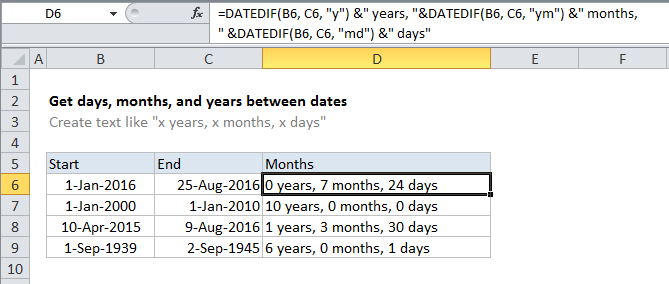
This tutorial show how to Get days, months, and years between dates in Excel using the example below.

To calculate and display the time between dates in days, months, and years, you can use the a formula based on the DATEDIF function.

Note: The DATEDIF function is designed to calculate the difference between dates in years, months, and days. There are several variations available (e.g. time in months, time in months ignoring days and years, etc.) and these are set by the “unit” argument in the function. See this page on the DATEDIF function for a full list of available units.

Formula

=DATEDIF(start,end,"y") &" years,"&DATEDIF(start,end,"ym") &" months," &DATEDIF(start,end,"md") &" days"
Explanation of how this formula works

In the example shown, the formula in D6 is:

=DATEDIF(B6,C6,"y") &" years,"&DATEDIF(B6,C6,"ym") &" months," &DATEDIF(B6,C6,"md") &" days"

where start dates are in column B, and end dates are in column C.

Using DATEDIF function;

In the example shown, we calculate years, months, and days separately, then “glue” the results together with concatenation. To get whole years, we use:

DATEDIF(B6,C6,"y")&" years,"

To get whole months, we use:

DATEDIF(B6,C6,"ym")&" months,"

And we calculate days with:

DATEDIF(B6,C6,"md")&" days"

The rest of the formula is simply the required text joined together with the concatenation operator (&).

Without zero values

To prevent the output of days, months, or years with zero values, you can wrap each DATEDIF function inside IF, as shown here (line breaks added for readability):

=
IF(DATEDIF(B6,C6,"y"), DATEDIF(B6,C6,"y")&"yr ","")&
IF(DATEDIF(B6,C6,"ym"), DATEDIF(B6,C6,"ym")&" mo ","")&
IF(DATEDIF(B6,C6,"md"), DATEDIF(B6,C6,"md") &" dy","")

To prevent extra commas from appearing in the final result, commas have been replaces by spaces. Using the original DATEDIF formula as the “logical test” inside IF works because IF treats any non-zero result as true.

Post navigation

Previous Post:

DECIMAL function: Description, Usage, Syntax, Examples and Explanation

Next Post:

AVERAGE function: Description, Usage, Syntax, Examples and Explanation

Leave a Reply Cancel reply

Your email address will not be published. Required fields are marked *

Learn Basic Excel

Ribbon
Workbook
Worksheets
Format Cells
Find & Select
Sort & Filter
Templates
Print
Share
Protect
Keyboard Shortcuts

Categories

  • Charts
  • Data Analysis
  • Data Validation
  • Excel Functions
    • Cube Functions
    • Database Functions
    • Date and Time Functions
    • Engineering Functions
    • Financial Functions
    • Information Functions
    • Logical Functions
    • Lookup and Reference Functions
    • Math and Trig Functions
    • Statistical Functions
    • Text Functions
    • Web Functions
  • Excel VBA
  • Excel Video Tutorials
  • Formatting
  • Grouping
  • Others

Logical Functions

  • How to use IFS function in Excel
  • Not Equal To ‘<>‘ operator in Excel
  • IF with boolean logic in Excel
  • IF with wildcards in Excel
  • IFERROR function: Description, Usage, Syntax, Examples and Explanation

Date Time

  • DAYS360 function: Description, Usage, Syntax, Examples and Explanation
  • Convert Excel time to Unix time in Excel
  • How to calculate workdays per month in Excel
  • DATE function: Description, Usage, Syntax, Examples and Explanation
  • Get day from date in Excel

Grouping

  • How to randomly assign data to groups in Excel
  • Running count group by n size in Excel
  • How to randomly assign people to groups in Excel
  • Group times into 3 hour buckets in Excel
  • Map text to numbers in Excel

General

  • How to calculate profit margin percentage in Excel
  • 3D SUMIF for multiple worksheets in Excel
  • Hide and Unhide Columns or Rows in Excel
  • Find Most Frequently Occurring Word in Excel Worksheet
  • Count cells that do not contain many strings in Excel
© 2026 xlsoffice . All Right Reserved. | Teal Smiles | Abbreviations And Their Meaning