
Skip to content
Free Excel Tutorials
  • Home
  • Excel For Beginners
  • Excel Intermediate
  • Advanced Excel For Experts

Data Analysis

  • Excel Line Chart
  • How to Create Gantt Chart in Excel
  • Remove Duplicates Example in Excel
  • How to Use Solver Tool in Excel
  • How to calculate current stock or inventory in Excel

References

  • Lookup entire row in Excel
  • Count rows that contain specific values in Excel
  • Extract data with helper column in Excel
  • Basic INDEX MATCH approximate in Excel
  • Get nth match with INDEX / MATCH in Excel

Data Validations

  • Prevent invalid data entering in specific cells
  • Excel Data validation date in specific year
  • Excel Data validation must not contain
  • Excel Data validation exists in list
  • Excel Data validation unique values only

Add line break based on OS in Excel

by

To add a line break taking into account the current OS (Mac or Windows), you can use the INFO function to test the system and then return the correct break character — CHAR(10) for Windows, CHAR(13) for Mac.

Note: make sure you have text wrap enabled on cells that contain line breaks.

Formula

=IF(INFO("system")="mac",CHAR(13),CHAR(10))
Explanation

The character used for line breaks is different depending on whether Excel is running on Mac or Windows: CHAR(10) for Windows, CHAR(13) for Mac. This makes it tricky to write a single formula that will work as expected on both platforms.

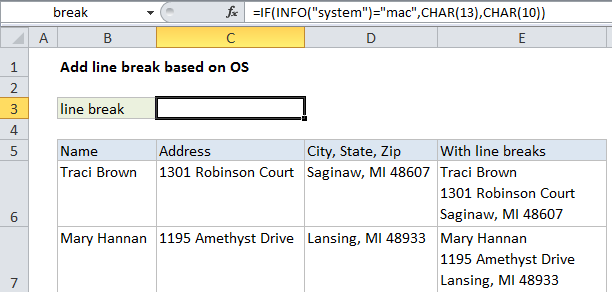
The solution is to use the INFO function to test the current environment, then adjust the line break character accordingly. We do this by adding this formula to C3:

=IF(INFO("system")="mac",CHAR(13),CHAR(10))

Then we we name C3 “break” so we can use the word break like a variable later. If Excel is running on a Mac, break will equal CHAR(13), if not, break will equal CHAR(10).

In column E, we concatenate the address information that appears in B, C, and D with a formula like this:

=B6&break&C6&break&D6

The result of the concatenation is text with line breaks:

Traci Brown¬
1301 Robinson Court¬
Saginaw, MI 48607


Post navigation

Previous Post:

DECIMAL function: Description, Usage, Syntax, Examples and Explanation

Next Post:

AVERAGE function: Description, Usage, Syntax, Examples and Explanation

Leave a Reply Cancel reply

Your email address will not be published. Required fields are marked *

Learn Basic Excel

Ribbon
Workbook
Worksheets
Format Cells
Find & Select
Sort & Filter
Templates
Print
Share
Protect
Keyboard Shortcuts

Categories

  • Charts
  • Data Analysis
  • Data Validation
  • Excel Functions
    • Cube Functions
    • Database Functions
    • Date and Time Functions
    • Engineering Functions
    • Financial Functions
    • Information Functions
    • Logical Functions
    • Lookup and Reference Functions
    • Math and Trig Functions
    • Statistical Functions
    • Text Functions
    • Web Functions
  • Excel VBA
  • Excel Video Tutorials
  • Formatting
  • Grouping
  • Others

Logical Functions

  • Return blank if in Excel
  • How to use Excel TRUE Function
  • NOT function: Description, Usage, Syntax, Examples and Explanation
  • AND function: Description, Usage, Syntax, Examples and Explanation
  • IF with boolean logic in Excel

Date Time

  • Add workdays no weekends in Excel
  • Calculate series of dates by workdays in Excel
  • SECOND function: Description, Usage, Syntax, Examples and Explanation
  • Create date range from two dates in Excel
  • Count holidays between two dates in Excel

Grouping

  • Group times into 3 hour buckets in Excel
  • How to randomly assign people to groups in Excel
  • Map text to numbers in Excel
  • If cell contains one of many things in Excel
  • Map inputs to arbitrary values in Excel

General

  • Index and match on multiple columns in Excel
  • Spell Check in Excel
  • How to calculate total from percentage in Excel
  • How to calculate percentage of total in Excel
  • Share Excel data with Word documents
© 2026 xlsoffice . All Right Reserved. | Teal Smiles | Abbreviations And Their Meaning