
Skip to content
Free Excel Tutorials
  • Home
  • Excel For Beginners
  • Excel Intermediate
  • Advanced Excel For Experts

Data Analysis

  • Data Series in Excel
  • Working With Tables in Excel
  • How to create Checklist in Excel
  • Calculate Conditional Percentile ‘IF’ in table in Excel
  • Excel Frequency Function Example

References

  • How to use Excel COLUMN Function
  • How to use Excel TRANSPOSE Function
  • How to use Excel OFFSET function
  • Vlookup Examples in Excel
  • Approximate match with multiple criteria in Excel

Data Validations

  • Excel Data validation only dates between
  • Excel Data validation date in specific year
  • Excel Data validation exists in list
  • Excel Data validation allow weekday only
  • Excel Data validation number multiple 100

nth smallest value with criteria in Excel

by

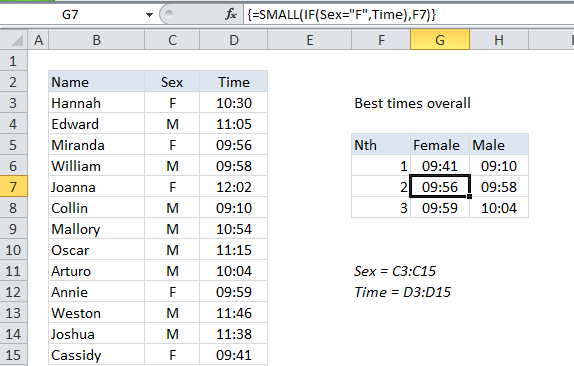
This tutorial shows how to calculate nth smallest value with criteria in Excel using the example below;

To get the 2nd smallest value, 3rd smallest value, 4th smallest value, and so on, where each value matches supplied criteria, you can use an array formula that uses the SMALL and IF functions.

Formula

{=SMALL(IF(criteria,values),n)}
Explanation

In the example shown, the formula in G7 is:

{=SMALL(IF(Sex="F",Time),F7)}

Where “Sex” is a named range for C3:C15 and “Time” is the named range D3:D15.

Note: this is an array formula and must be entered using Control + Shift + Enter.

How this formula works

The SMALL function is fully automatic — you just need to supply a range and an integer for”nth” to specify the ranked value you want.

The problem in this case is that we don’t want SMALL to operate on every value in the range, just values that are either male or female (M or F). To apply this criteria, we use the IF function, which provides a logical test for either “M” or ‘F”. Because we are applying the test to an array of values, the result will also be an array. In the example shown, the resulting array looks like this:

{0.00729166666666667;FALSE;0.00689814814814815;FALSE;0.00835648148148148;FALSE; FALSE;FALSE;FALSE;0.00693287037037037;FALSE;FALSE;0.00672453703703704}

Where FALSE represents male times and numbers represent female times. (Times like this are fractional values, which is why we have so many decimal places for some times).

The SMALL function will automatically ignore TRUE and FALSE values, so the result will be the nth smallest value from the set of actual numbers in the array.

Error with no nth

You’ll get an error if there is no nth smallest value based on supplied criteria. You can trap this error with IFERROR and replace with whatever value makes sense like this:

{=IFERROR(SMALL(IF(Sex="F",Time),F8),"-")}

Multiple criteria

To handle multiple criteria, you can extend the formula with boolean logic in a form like this:

=SMALL(IF((criteria1)*(criteria2),values),n)

Where criteria1 and criteria2 and represent an expression to test values in a criteria range, as shown in the original example above.

Post navigation

Previous Post:

How to use Excel CHOOSE Function

Next Post:

Customize Ribbon In Excel

Leave a Reply Cancel reply

Your email address will not be published. Required fields are marked *

Learn Basic Excel

Ribbon
Workbook
Worksheets
Format Cells
Find & Select
Sort & Filter
Templates
Print
Share
Protect
Keyboard Shortcuts

Categories

  • Charts
  • Data Analysis
  • Data Validation
  • Excel Functions
    • Cube Functions
    • Database Functions
    • Date and Time Functions
    • Engineering Functions
    • Financial Functions
    • Information Functions
    • Logical Functions
    • Lookup and Reference Functions
    • Math and Trig Functions
    • Statistical Functions
    • Text Functions
    • Web Functions
  • Excel VBA
  • Excel Video Tutorials
  • Formatting
  • Grouping
  • Others

Logical Functions

  • XOR function: Description, Usage, Syntax, Examples and Explanation
  • Complete List of Excel Logical Functions, References and Examples
  • How to use Excel TRUE Function
  • Nested IF function example in Excel
  • IF with boolean logic in Excel

Date Time

  • Steps to create Dynamic calendar grid in Excel
  • How to get number of days, weeks, months or years between two dates in Excel
  • How to calculate percent of year complete in Excel
  • Display the current date in Excel
  • Add years to date in Excel

Grouping

  • How to randomly assign data to groups in Excel
  • Group arbitrary text values in Excel
  • Map text to numbers in Excel
  • Group times into unequal buckets in Excel
  • Categorize text with keywords in Excel

General

  • How to test a range for numbers in Excel
  • How to Create Calendar in Excel
  • Check if range contains a value not in another range in Excel
  • Excel Default Templates
  • How to fill cell ranges with random text values in Excel
© 2025 xlsoffice . All Right Reserved. | Teal Smiles | Abbreviations And Their Meaning