
Skip to content
Free Excel Tutorials
  • Home
  • Excel For Beginners
  • Excel Intermediate
  • Advanced Excel For Experts

Data Analysis

  • Number and Text Filters Examples in Excel
  • How to Create Gantt Chart in Excel
  • How To Filter Data in Excel
  • How to Use Solver Tool in Excel
  • How To Create Frequency Distribution in Excel

References

  • Basic INDEX MATCH approximate in Excel
  • How to use Excel ROW Function
  • How to get address of last cell in range in Excel
  • How to get first column number in range in Excel
  • Get nth match with INDEX / MATCH in Excel

Data Validations

  • How To Create Drop-down List in Excel
  • Excel Data validation with conditional list
  • Excel Data validation unique values only
  • Excel Data validation allow weekday only
  • Excel Data validation don’t exceed total

Creating and Opening an existing file in Excel

by

A workbook is another word for your Excel file as referred by Microsoft.. And, also a workbook comprises of several worksheets depending on the user.

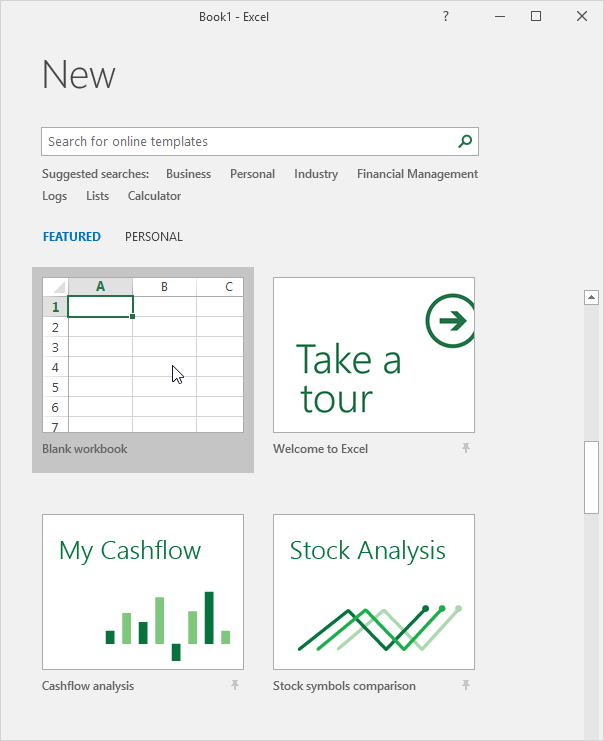
When you start Excel, click Blank workbook to create an Excel workbook from scratch.

Open an Existing Workbook

To open a workbook you’ve created in the past, execute the following steps.

1. On the File tab, click Open.

2. Recent shows you a list of your recently used workbooks. You can quickly open a workbook from here.
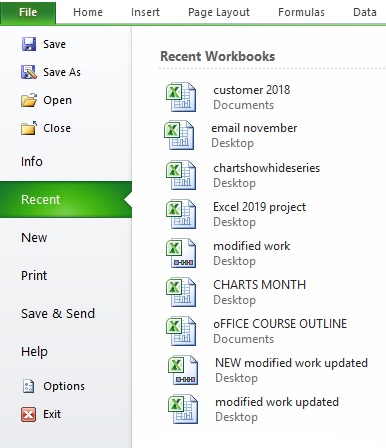
3. Click Browse to open a workbook that is not on the list.

How to Create a New Workbook in Excel

Sometimes you want to start all over again. To create a new workbook, execute the following steps.

1. On the File tab, click New.

2. Click Blank workbook.
Close a Workbook

To close a workbook (and Excel), click the upper right X. If you have multiple workbooks open, clicking the upper right X closes the active workbook.

Turn off the Start screen

When you start Excel, it shows a start screen that lists recently used Excel files and templates. To skip the start screen and always start with a blank workbook, execute the following steps.

1. On the File tab, click Options.

2. Uncheck ‘Show the Start screen when this application starts’.
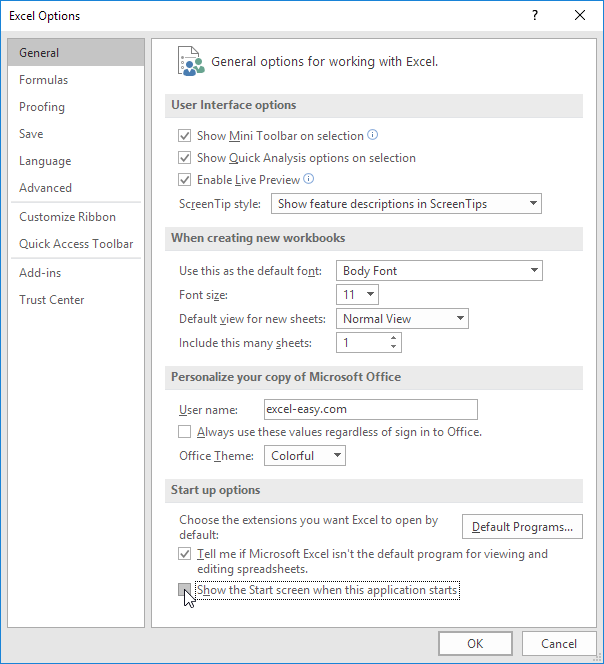
3. Click OK.

Ensure you hit Ctrl+S on your keyboard to save changes made in workbook.

Post navigation

Previous Post:

TRUE function: Description, Usage, Syntax, Examples and Explanation

Next Post:

Excel Pie Chart

Leave a Reply Cancel reply

Your email address will not be published. Required fields are marked *

Learn Basic Excel

Ribbon
Workbook
Worksheets
Format Cells
Find & Select
Sort & Filter
Templates
Print
Share
Protect
Keyboard Shortcuts

Categories

  • Charts
  • Data Analysis
  • Data Validation
  • Excel Functions
    • Cube Functions
    • Database Functions
    • Date and Time Functions
    • Engineering Functions
    • Financial Functions
    • Information Functions
    • Logical Functions
    • Lookup and Reference Functions
    • Math and Trig Functions
    • Statistical Functions
    • Text Functions
    • Web Functions
  • Excel VBA
  • Excel Video Tutorials
  • Formatting
  • Grouping
  • Others

Logical Functions

  • Check multiple cells are equal in Excel
  • Complete List of Excel Logical Functions, References and Examples
  • How to use Excel OR Function
  • NOT function: Description, Usage, Syntax, Examples and Explanation
  • XOR function: Description, Usage, Syntax, Examples and Explanation

Date Time

  • Calculate years between dates in Excel
  • EDATE function: Description, Usage, Syntax, Examples and Explanation
  • How to show last updated date stamp in Excel
  • How to calculate next day of week in Excel
  • How to Calculate Age in Excel

Grouping

  • Calculate conditional mode with criteria in Excel
  • How to randomly assign people to groups in Excel
  • Group arbitrary text values in Excel
  • Group times into 3 hour buckets in Excel
  • Map text to numbers in Excel

General

  • How to test a range for numbers in Excel
  • Count cells that contain errors in Excel
  • How to get original number from percent change in Excel
  • How to calculate decrease by percentage in Excel
  • Create dynamic workbook reference to another workbook in Excel
© 2026 xlsoffice . All Right Reserved. | Teal Smiles | Abbreviations And Their Meaning