
Skip to content
Free Excel Tutorials
  • Home
  • Excel For Beginners
  • Excel Intermediate
  • Advanced Excel For Experts

Data Analysis

  • Understanding Anova in Excel
  • Working With Tables in Excel
  • Conditional Formatting Data bars Examples in Excel
  • How to calculate average last N values in a table in Excel
  • Remove Duplicates Example in Excel

References

  • INDEX function: Description, Usage, Syntax, Examples and Explanation
  • How to get last row in mixed data with blanks in Excel
  • Convert text string to valid reference in Excel using Indirect function
  • How to get address of last cell in range in Excel
  • Perform case-sensitive Lookup in Excel

Data Validations

  • Excel Data validation with conditional list
  • Excel Data validation must not contain
  • Excel Data validation only dates between
  • Excel Data validation whole percentage only
  • Excel Data validation no punctuation

How to extract word containing specific text in Excel

by

To extract a word that contains specific text,you can use a formula based on several functions, including TRIM, LEFT, SUBSTITUTE, MID, MAX, and REPT. You can use this formula to extract things like email addresses, or other substrings with a unique id.

Formula

=TRIM(MID(SUBSTITUTE(A1," ",REPT(" ",99)),
MAX(1,FIND("@",SUBSTITUTE
(A1," ",REPT(" ",99)))-50),99))
How to extract word containing specific text in Excel

Explanation

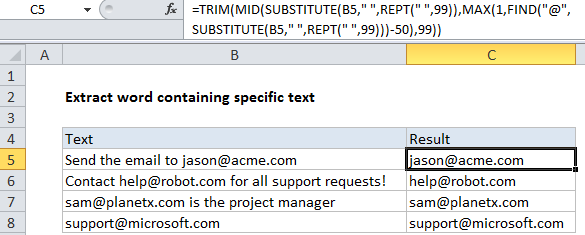
In the example shown, the formula in C5 is:

=TRIM(MID(SUBSTITUTE(B5," ",REPT(" ",99)),MAX(1,FIND
("@",SUBSTITUTE(B5," ",REPT(" ",99)))-50),99))

How this formula works

The gist: this formula “floods” the space between words in a text string with a large number of spaces, finds and extracts the substring of interest, and uses the TRIM function to clean up the mess.

Working from the inside out, the original text in B5 is flooded with spaces using SUBSTITUTE:

SUBSTITUTE(B5," ",REPT(" ",99))

This replaces each single space with 99 spaces.

Note: 99 is just an arbitrary number that represents the longest word you need to extract.

Next, the FIND function locates the specific character (in this case, “@”) inside the flooded text:

FIND("@",SUBSTITUTE(B5," ",REPT(" ",99)))-50

FIND returns the position of the “@” in this text, from which 50 is subtracted. Subtracting 50 effectively “walks back” the position to someplace in the middle of the spaces preceding the substring of interest. In the example shown, the calculated position is 366.

The MAX function is used to handle the problem of the substring appearing first in the text. In that case, the position will be negative, and MAX is used to reset to 1.

With a starting positing established , MID is used to extract 99 characters of text, starting at 366 from the text in B5, again flooded with space:

MID(SUBSTITUTE(B5," ",REPT(" ",99)),366,99)

This extracts the substring of interest, with a lot of space characters before and after.

Finally, the TRIM function is used to trim leading and trailing space, and returns substring containing the special character.

Post navigation

Next Post:

Create One-dimensional and Two-dimensional Array

Leave a Reply Cancel reply

Your email address will not be published. Required fields are marked *

Learn Basic Excel

Ribbon
Workbook
Worksheets
Format Cells
Find & Select
Sort & Filter
Templates
Print
Share
Protect
Keyboard Shortcuts

Categories

  • Charts
  • Data Analysis
  • Data Validation
  • Excel Functions
    • Cube Functions
    • Database Functions
    • Date and Time Functions
    • Engineering Functions
    • Financial Functions
    • Information Functions
    • Logical Functions
    • Lookup and Reference Functions
    • Math and Trig Functions
    • Statistical Functions
    • Text Functions
    • Web Functions
  • Excel VBA
  • Excel Video Tutorials
  • Formatting
  • Grouping
  • Others

Logical Functions

  • OR function: Description, Usage, Syntax, Examples and Explanation
  • Not Equal To ‘<>‘ operator in Excel
  • AND function: Description, Usage, Syntax, Examples and Explanation
  • Nested IF function example in Excel
  • How to use IFS function in Excel

Date Time

  • Convert time to time zone in Excel
  • Count dates in current month in Excel
  • YEAR function: Description, Usage, Syntax, Examples and Explanation
  • Count holidays between two dates in Excel
  • Get first Monday before any date in Excel

Grouping

  • Group times into 3 hour buckets in Excel
  • If cell contains one of many things in Excel
  • Map text to numbers in Excel
  • Group numbers at uneven intervals in Excel
  • Map inputs to arbitrary values in Excel

General

  • AutoRecover file that was never saved in Excel
  • Lock Cells in a Worksheet Excel
  • How to generate random times at specific intervals in Excel
  • How to calculate percentage discount in Excel
  • How to generate random number between two numbers in Excel
© 2026 xlsoffice . All Right Reserved. | Teal Smiles | Abbreviations And Their Meaning