
Skip to content
Free Excel Tutorials
  • Home
  • Excel For Beginners
  • Excel Intermediate
  • Advanced Excel For Experts

Data Analysis

  • How To Remove Duplicates In Excel Column Or Row?
  • How to conditionally sum numeric data in an Excel table using SUMIFS
  • How to create a Histogram in Excel
  • How to Create Column Chart in Excel
  • How To Create Pareto Chart in Excel

References

  • To count total rows in a range in Excel
  • Count rows that contain specific values in Excel
  • Perform case-sensitive Lookup in Excel
  • How to use Excel VLOOKUP Function
  • How to get last row in numeric data in Excel

Data Validations

  • Excel Data validation specific characters only
  • Excel Data validation allow uppercase only
  • Excel Data validation must not contain
  • Excel Data validation date in specific year
  • Excel Data validation must begin with

Get position of 2nd 3rd and more instance of character in Excel

by

To get the position of the 2nd, 3rd, 4th, etc. instance of a specific character inside a text string, you can use the FIND and SUBSTITUTE functions.

Note: we use “~” in this case only because it rarely occurs in other text. You can use any character that you know won’t appear in the text.

Formula

=FIND("~",SUBSTITUTE(text,char,"~",instance))
Explanation

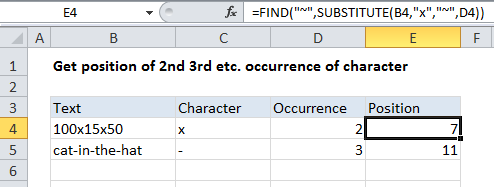
In the example shown, the formula in E4 is:

=FIND("~",SUBSTITUTE(B4,"x","~",D4))

How this formula works

At the core, this formula uses the fact that the SUBSTITUTE function understands “instance”, supplied as an optional forth argument called “instance_num”. This means you can use the SUBSTITUTE function to replace a specific instance of a character in a text string.  So:

SUBSTITUTE(B4,"x","~",D4)

replaces only the 2nd instance (2 comes from D4) of “x” in text in B4, with “~” character. The result looks like this:

100×15~50

Next, FIND locates the “~” inside this string and returns the position, which is 7 in this case.

Post navigation

Next Post:

Create One-dimensional and Two-dimensional Array

Leave a Reply Cancel reply

Your email address will not be published. Required fields are marked *

Learn Basic Excel

Ribbon
Workbook
Worksheets
Format Cells
Find & Select
Sort & Filter
Templates
Print
Share
Protect
Keyboard Shortcuts

Categories

  • Charts
  • Data Analysis
  • Data Validation
  • Excel Functions
    • Cube Functions
    • Database Functions
    • Date and Time Functions
    • Engineering Functions
    • Financial Functions
    • Information Functions
    • Logical Functions
    • Lookup and Reference Functions
    • Math and Trig Functions
    • Statistical Functions
    • Text Functions
    • Web Functions
  • Excel VBA
  • Excel Video Tutorials
  • Formatting
  • Grouping
  • Others

Logical Functions

  • SWITCH function: Description, Usage, Syntax, Examples and Explanation
  • TRUE function: Description, Usage, Syntax, Examples and Explanation
  • FALSE function: Description, Usage, Syntax, Examples and Explanation
  • How to use Excel NOT Function
  • Not Equal To ‘<>‘ operator in Excel

Date Time

  • NETWORKDAYS function: Description, Usage, Syntax, Examples and Explanation
  • Convert Excel time to Unix time in Excel
  • Convert Unix time stamp to Excel date
  • How to join date and text together in Excel
  • Get days before a date in Excel

Grouping

  • Running count group by n size in Excel
  • Map text to numbers in Excel
  • If cell contains one of many things in Excel
  • Group numbers with VLOOKUP in Excel
  • How to randomly assign data to groups in Excel

General

  • List sheet names with formula in Excel
  • Basic error trapping example in Excel
  • Basic text sort formula in Excel
  • How to calculate percentage discount in Excel
  • How to calculate project complete percentage in Excel
© 2025 xlsoffice . All Right Reserved. | Teal Smiles | Abbreviations And Their Meaning