
Skip to content
Free Excel Tutorials
  • Home
  • Excel For Beginners
  • Excel Intermediate
  • Advanced Excel For Experts

Data Analysis

  • How to Use Solver Tool in Excel
  • Chart Axes in Excel
  • What-If Analysis: Scenarios and Goal Seek in Excel
  • Understanding Pivot Tables in Excel
  • Number and Text Filters Examples in Excel

References

  • LOOKUP function: Description, Usage, Syntax, Examples and Explanation
  • How to get relative column numbers in a range in Excel
  • To count total rows in a range in Excel
  • Last row number in range
  • How to use Excel VLOOKUP Function

Data Validations

  • Excel Data validation specific characters only
  • Excel Data validation no punctuation
  • Excel Data validation date in next 30 days
  • Excel Data validation number multiple 100
  • How To Create Drop-down List in Excel

Convert text string to valid reference in Excel using Indirect function

by

Applying Excel  INDIRECT function to Cell Reference, Range Reference, Named Range, Worksheet Reference.

Use the INDIRECT function in Excel to convert a text string into a valid reference. You can use the & operator to create text strings.

Cell Reference

Use the INDIRECT function in Excel to convert a text string into a valid cell reference.

1. For example, take a look at the INDIRECT function below.

indirect function Convert text string to valid reference in Excel using Indirect function

Explanation: =INDIRECT(A1) reduces to =INDIRECT(“D1”). The INDIRECT function converts the text string “D1” into a valid cell reference. In other words, =INDIRECT(“D1”) reduces to =D1.

2. The simple INDIRECT function below produces the exact same result.

simple indirect function Convert text string to valid reference in Excel using Indirect function

3. Do we really need the INDIRECT function? Yes. Without using the INDIRECT function, this would be the result.

without indirect function Convert text string to valid reference in Excel using Indirect function

4. Use the & operator to concatenate “D” with the value in cell A1.

cell referencing Convert text string to valid reference in Excel using Indirect function

Explanation: the formula above reduces to =INDIRECT(“D1”). Again, =INDIRECT(“D1”) reduces to =D1.

Range Reference

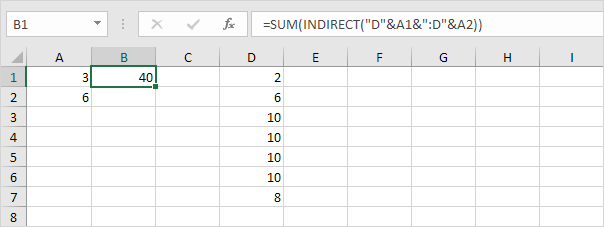
Use the INDIRECT function in Excel to convert a text string into a valid range reference. For example, combine the SUM function and the INDIRECT function.
sum indirect function Convert text string to valid reference in Excel using Indirect function

Explanation: the formula above reduces to =SUM(INDIRECT(“D3:D6”)). The INDIRECT function converts the text string “D3:D6” into a valid range reference. In other words, =SUM(INDIRECT(“D3:D6”)) reduces to =SUM(D3:D6).

Named Range

Use the INDIRECT function in Excel to convert a text string into a valid named range.

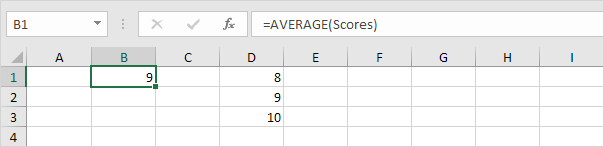
1. For example, the AVERAGE function below uses the named range Scores.
simple named ranged Convert text string to valid reference in Excel using Indirect function

Explanation: the named range Scores refers to the range D1:D3.

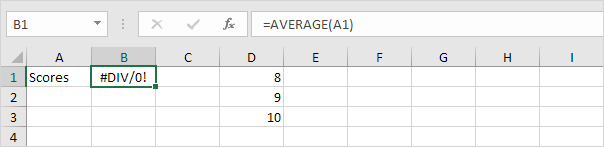
2. However, the AVERAGE function below returns an error.
div error Convert text string to valid reference in Excel using Indirect function

Explanation: =AVERAGE(“Scores”) returns an error because Excel cannot calculate the average of a text string!

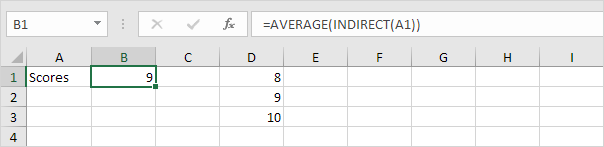
3. The INDIRECT function below does the trick.
average indirect function Convert text string to valid reference in Excel using Indirect function

Explanation: =AVERAGE(INDIRECT(“Scores”)) reduces to =AVERAGE(Scores).

Worksheet Reference

Use the INDIRECT function in Excel to create a dynamic worksheet reference.

1. This is what a simple worksheet reference looks like.
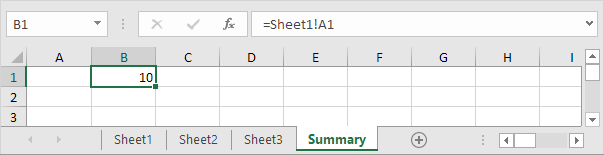
worksheet reference Convert text string to valid reference in Excel using Indirect function

Note: cell A1 on Sheet1 contains the value 10. Cell A1 on Sheet2 contains the value 20. Cell A1 on Sheet3 contains the value 30.

2. On the Summary sheet, enter the INDIRECT function shown below. Use the & operator to concatenate the sheet name in cell A1 with “!A1”.
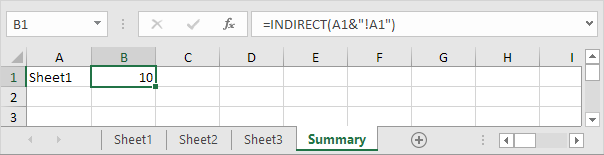
dynamic worksheet reference Convert text string to valid reference in Excel using Indirect function

Explanation: the formula above reduces to =INDIRECT(“Sheet1!A1”). The INDIRECT function converts the text string “Sheet1!A1” into a valid worksheet reference. In other words, =INDIRECT(“Sheet1!A1”) reduces to =Sheet1!A1.

3. If your sheet names contain spaces or other special characters, enclose the sheet name in single quotation marks. Modify the INDIRECT function as shown below.
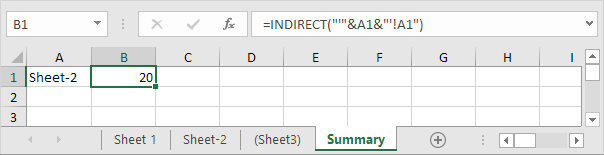
add-single-quotation-marks Convert text string to valid reference in Excel using Indirect function

Post navigation

Previous Post:

VLOOKUP without #N/A error in Excel

Next Post:

Manipulating text strings using Left, Mid, Right, Len, Substitute in Excel

Leave a Reply Cancel reply

Your email address will not be published. Required fields are marked *

Learn Basic Excel

Ribbon
Workbook
Worksheets
Format Cells
Find & Select
Sort & Filter
Templates
Print
Share
Protect
Keyboard Shortcuts

Categories

  • Charts
  • Data Analysis
  • Data Validation
  • Excel Functions
    • Cube Functions
    • Database Functions
    • Date and Time Functions
    • Engineering Functions
    • Financial Functions
    • Information Functions
    • Logical Functions
    • Lookup and Reference Functions
    • Math and Trig Functions
    • Statistical Functions
    • Text Functions
    • Web Functions
  • Excel VBA
  • Excel Video Tutorials
  • Formatting
  • Grouping
  • Others

Logical Functions

  • IF with wildcards in Excel
  • How to use Excel XOR Function
  • IF with boolean logic in Excel
  • IFS function: Description, Usage, Syntax, Examples and Explanation
  • Extract multiple matches into separate rows in Excel

Date Time

  • Calculate total hours that fall between two times in Excel
  • Extract time from a date and time in Excel
  • How to calculate quarter from date in Excel
  • Get days between dates ignoring years in Excel
  • WORKDAY function: Description, Usage, Syntax, Examples and Explanation

Grouping

  • Group times into 3 hour buckets in Excel
  • Calculate conditional mode with criteria in Excel
  • Group numbers at uneven intervals in Excel
  • Map text to numbers in Excel
  • Group numbers with VLOOKUP in Excel

General

  • Count cells that contain errors in Excel
  • How to fill cell ranges with random text values in Excel
  • How to increase by percentage in Excel
  • Select, Insert, Rename, Move, Delete Worksheets in Excel
  • How to get original number from percent change in Excel
© 2025 xlsoffice . All Right Reserved. | Teal Smiles | Abbreviations And Their Meaning