
Skip to content
Free Excel Tutorials
  • Home
  • Excel For Beginners
  • Excel Intermediate
  • Advanced Excel For Experts

Data Analysis

  • How to Create Area Chart in Excel
  • How To Perform and Interpret Regression Analysis in Excel
  • Chart Axes in Excel
  • How To Load Analysis ToolPak in Excel
  • How to create Checklist in Excel

References

  • How to reference named range different sheet in Excel
  • How to calculate two-way lookup VLOOKUP in Excel Table
  • How to use Excel COLUMN Function
  • LOOKUP function: Description, Usage, Syntax, Examples and Explanation
  • MATCH function: Description, Usage, Syntax, Examples and Explanation

Data Validations

  • Excel Data validation date in specific year
  • Excel Data validation must not contain
  • Excel Data validation must begin with
  • Excel Data validation require unique number
  • Excel Data validation with conditional list

Convert text to numbers using VALUE function in Excel

by

To convert simple text values to numbers, you can use the the VALUE function, or simply add zero as described below.

Formula

=VALUE(A1)
Explanation

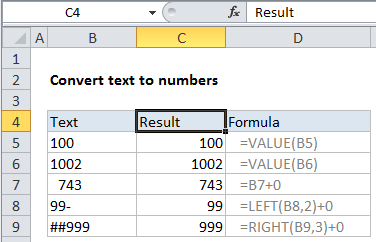
In the example shown, the formula in C5 is:

=VALUE(B5)

Background

Sometimes Excel ends up with text in a cell, when you really want a number. There are many reasons this might happen, and many ways to fix. This article describes a formula-based approach convert text values to numbers.

How this formula works

In this example, the values in column A are “stored as text”. This means if you try to SUM column A, you’ll get a result of zero.

The VALUE function will try to “coerce” a number stored as text to a true number. In simple cases, it will just work and you’ll get a numeric result. If it doesn’t work, you’ll get a #VALUE error.  Visit Convert Text to Numbers to see other examples.

Add zero instead

Another common trick is to simply add zero to the text value to convert. This forces Excel to try and convert the text value to a number to handle the math operation. This has the same functionality as VALUE. Cell C7 uses this formula.

Stripping other characters

If a cell contains non-numeric characters like dashes, punctuation, and so on, you’ll need to apply more effort.

The formulas in C8 and C9 show how to use the LEFT and RIGHT functions to strip non-numeric characters from a value before it’s converted to a number. You can also use the MID function in more complicated situations.

If you need to strip extra spaces or other non-printing characters, see the TRIM and CLEAN functions.

Finally, the SUBSTITUTE function will let you strip other characters that appear in random locations inside a value.

Post navigation

Previous Post:

DECIMAL function: Description, Usage, Syntax, Examples and Explanation

Next Post:

AVERAGE function: Description, Usage, Syntax, Examples and Explanation

Leave a Reply Cancel reply

Your email address will not be published. Required fields are marked *

Learn Basic Excel

Ribbon
Workbook
Worksheets
Format Cells
Find & Select
Sort & Filter
Templates
Print
Share
Protect
Keyboard Shortcuts

Categories

  • Charts
  • Data Analysis
  • Data Validation
  • Excel Functions
    • Cube Functions
    • Database Functions
    • Date and Time Functions
    • Engineering Functions
    • Financial Functions
    • Information Functions
    • Logical Functions
    • Lookup and Reference Functions
    • Math and Trig Functions
    • Statistical Functions
    • Text Functions
    • Web Functions
  • Excel VBA
  • Excel Video Tutorials
  • Formatting
  • Grouping
  • Others

Logical Functions

  • FALSE function: Description, Usage, Syntax, Examples and Explanation
  • Complete List of Excel Logical Functions, References and Examples
  • XOR function: Description, Usage, Syntax, Examples and Explanation
  • IF, AND, OR and NOT Functions Examples in Excel
  • How to use Excel FALSE Function

Date Time

  • Get days, hours, and minutes between dates in Excel
  • WEEKNUM function: Description, Usage, Syntax, Examples and Explanation
  • Get month name from date in Excel
  • DATE function: Description, Usage, Syntax, Examples and Explanation
  • EDATE function: Description, Usage, Syntax, Examples and Explanation

Grouping

  • Group arbitrary text values in Excel
  • If cell contains one of many things in Excel
  • Group times into unequal buckets in Excel
  • Map text to numbers in Excel
  • Categorize text with keywords in Excel

General

  • How to calculate percent variance in Excel
  • 44 Practical Excel IF function Examples
  • Check if multiple cells have same value with case sensitive in Excel
  • AutoFit Column Width, AutoFit Row Height in Excel
  • How to calculate percent sold in Excel
© 2026 xlsoffice . All Right Reserved. | Teal Smiles | Abbreviations And Their Meaning