
Skip to content
Free Excel Tutorials
  • Home
  • Excel For Beginners
  • Excel Intermediate
  • Advanced Excel For Experts

Data Analysis

  • Managing Conditional Formatting Rules in Excel
  • How to Create Gantt Chart in Excel
  • How to Sort by Color in Excel
  • How to Create Column Chart in Excel
  • Get column name from index in Excel Table

References

  • Count rows that contain specific values in Excel
  • Two-column Lookup in Excel
  • How to use Excel VLOOKUP Function
  • How to reference named range different sheet in Excel
  • How to get last row in mixed data with blanks in Excel

Data Validations

  • Excel Data validation specific characters only
  • Excel Data validation exists in list
  • Excel Data validation require unique number
  • Excel Data validation date in next 30 days
  • Data validation must not exist in list

Not Equal To ‘<>‘ operator in Excel

by

In Excel, <> means not equal to. The <> operator in Excel checks if two values are not equal to each other. Let’s take a look at a few examples.

1. The formula in cell C1 below returns TRUE because the text value in cell A1 is not equal to the text value in cell B1.

2. The formula in cell C1 below returns FALSE because the value in cell A1 is equal to the value in cell B1.

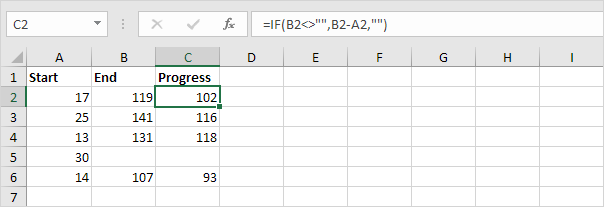
3. The IF function below calculates the progress between a start and end value if the end value is not equal to an empty string (“”), else it displays an empty string (see row 5).
Note: visit our page about the IF function for more information about this Excel function.

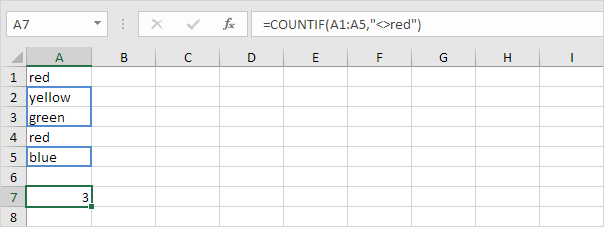
4. The COUNTIF function below counts the number of cells in the range A1:A5 that are not equal to “red”.
Note: visit our page about the COUNTIF function for more information about this Excel function.

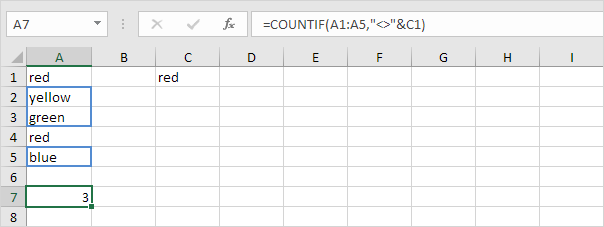
5. The COUNTIF function below produces the exact same result. The & operator concatenates the ‘not equal to’ operator and the text value in cell C1.
6. The COUNTIFS function below counts the number of cells in the range A1:A5 that are not equal to “red” and not equal to “blue”.
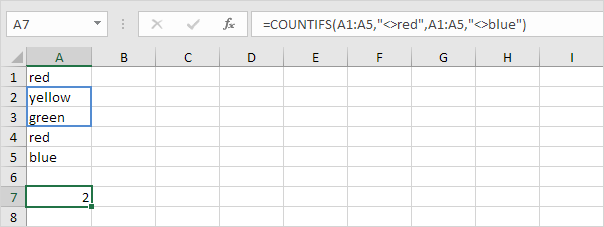
Explanation: the COUNTIFS function in Excel counts cells based on two or more criteria. This COUNTIFS function has 2 range/criteria pairs.

7. The AVERAGEIF function below calculates the average of the values in the range A1:A5 that are not equal to 0.
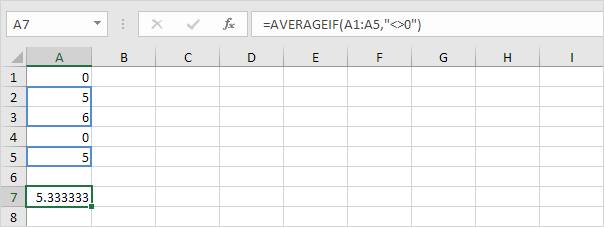
Note: in other words, the AVERAGEIF function above calculates the average excluding zeros.

Post navigation

Previous Post:

VLOOKUP without #N/A error in Excel

Next Post:

Manipulating text strings using Left, Mid, Right, Len, Substitute in Excel

Leave a Reply Cancel reply

Your email address will not be published. Required fields are marked *

Learn Basic Excel

Ribbon
Workbook
Worksheets
Format Cells
Find & Select
Sort & Filter
Templates
Print
Share
Protect
Keyboard Shortcuts

Categories

  • Charts
  • Data Analysis
  • Data Validation
  • Excel Functions
    • Cube Functions
    • Database Functions
    • Date and Time Functions
    • Engineering Functions
    • Financial Functions
    • Information Functions
    • Logical Functions
    • Lookup and Reference Functions
    • Math and Trig Functions
    • Statistical Functions
    • Text Functions
    • Web Functions
  • Excel VBA
  • Excel Video Tutorials
  • Formatting
  • Grouping
  • Others

Logical Functions

  • IF function: Description, Usage, Syntax, Examples and Explanation
  • Not Equal To ‘<>‘ operator in Excel
  • How to use Excel NOT Function
  • IF, AND, OR and NOT Functions Examples in Excel
  • IF with wildcards in Excel

Date Time

  • How to calculate Day of the Year in Excel
  • Calculate date overlap in days in Excel
  • Get month from date in Excel
  • Get days before a date in Excel
  • Convert Unix time stamp to Excel date

Grouping

  • Categorize text with keywords in Excel
  • Running count group by n size in Excel
  • Group times into unequal buckets in Excel
  • Group numbers at uneven intervals in Excel
  • Group numbers with VLOOKUP in Excel

General

  • How to Create Calendar in Excel
  • With vs Without Array Formula in Excel
  • How to calculate decrease by percentage in Excel
  • How to calculate percentage discount in Excel
  • Advanced Number Formats in Excel
© 2026 xlsoffice . All Right Reserved. | Teal Smiles | Abbreviations And Their Meaning