
Skip to content
Free Excel Tutorials
  • Home
  • Excel For Beginners
  • Excel Intermediate
  • Advanced Excel For Experts

Data Analysis

  • Excel Line Chart
  • Understanding Anova in Excel
  • How to Sort by Color in Excel
  • Error Bars in Excel
  • How to calculate correlation coefficient Correlation in Excel

References

  • Count rows that contain specific values in Excel
  • How to get last column number in range in Excel
  • Offset in Excel
  • How to use Excel TRANSPOSE Function
  • Count unique text values with criteria

Data Validations

  • Excel Data validation with conditional list
  • Excel Data validation specific characters only
  • How To Create Drop-down List in Excel
  • Data validation must not exist in list
  • Excel Data validation exists in list

Forecast vs Trend Function in Excel

by

The FORECAST and TREND function give the exact same result.

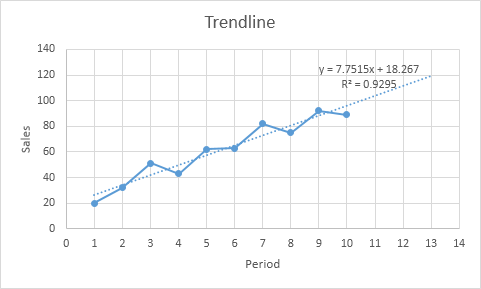
When you add a trendline to an Excel chart, Excel can display the equation in a chart (see below). You can use this equation to calculate future sales.
trendline Forecast vs Trend Function in Excel

Explanation: Excel uses the method of least squares to find a line that best fits the points. The R-squared value equals 0.9295, which is a good fit. The closer to 1, the better the line fits the data.

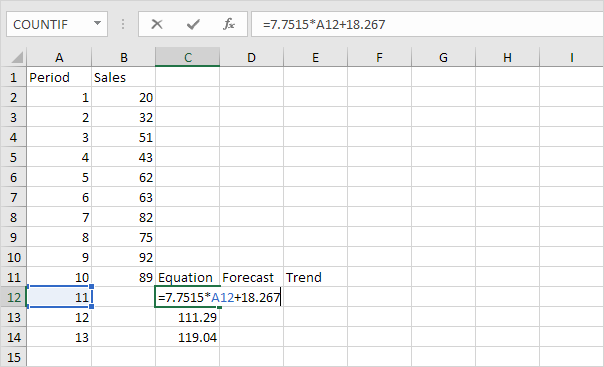
1. Use the equation to calculate future sales.
equation Forecast vs Trend Function in Excel

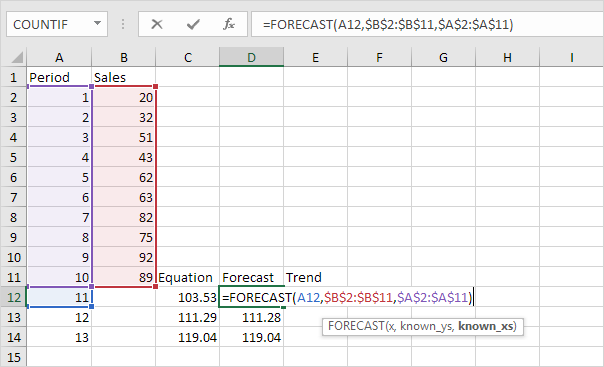
2. Use the FORECAST function to calculate future sales.
forecast function Forecast vs Trend Function in Excel

Note: when we drag the FORECAST function down, the absolute references ($B$2:$B$11 and $A$2:$A$11) stay the same, while the relative reference (A12) changes to A13 and A14.

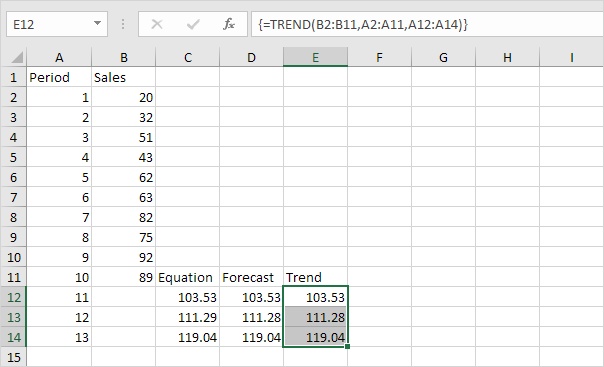
3. If you prefer to use an array formula, use the TREND function to calculate future sales.
trend function Forecast vs Trend Function in Excel

Note: first, select the range E12:E14. Next, type =TREND(B2:B11,A2:A11,A12:A14). Finish by pressing CTRL + SHIFT + ENTER. The formula bar indicates that this is an array formula by enclosing it in curly braces {}. To delete this array formula, select the range E12:E14 and press Delete.

Post navigation

Previous Post:

VLOOKUP without #N/A error in Excel

Next Post:

Manipulating text strings using Left, Mid, Right, Len, Substitute in Excel

Leave a Reply Cancel reply

Your email address will not be published. Required fields are marked *

Learn Basic Excel

Ribbon
Workbook
Worksheets
Format Cells
Find & Select
Sort & Filter
Templates
Print
Share
Protect
Keyboard Shortcuts

Categories

  • Charts
  • Data Analysis
  • Data Validation
  • Excel Functions
    • Cube Functions
    • Database Functions
    • Date and Time Functions
    • Engineering Functions
    • Financial Functions
    • Information Functions
    • Logical Functions
    • Lookup and Reference Functions
    • Math and Trig Functions
    • Statistical Functions
    • Text Functions
    • Web Functions
  • Excel VBA
  • Excel Video Tutorials
  • Formatting
  • Grouping
  • Others

Logical Functions

  • IF, AND, OR and NOT Functions Examples in Excel
  • Complete List of Excel Logical Functions, References and Examples
  • How to return blank in place of #DIV/0! error in Excel
  • Invoice status with nested if in Excel
  • Return blank if in Excel

Date Time

  • Convert Excel time to decimal hours in Excel
  • Convert Unix time stamp to Excel date
  • Basic Overtime Calculation Formula in Excel
  • Count birthdays by month in Excel
  • Extract date from a date and time in Excel

Grouping

  • How to randomly assign people to groups in Excel
  • Group numbers at uneven intervals in Excel
  • Map inputs to arbitrary values in Excel
  • Map text to numbers in Excel
  • Group times into unequal buckets in Excel

General

  • How to calculate total from percentage in Excel
  • Customize Ribbon In Excel
  • Subtotal by invoice number in Excel
  • Convert column letter to number in Excel
  • With vs Without Array Formula in Excel
© 2026 xlsoffice . All Right Reserved. | Teal Smiles | Abbreviations And Their Meaning