
Skip to content
Free Excel Tutorials
  • Home
  • Excel For Beginners
  • Excel Intermediate
  • Advanced Excel For Experts

Data Analysis

  • Subtotal function in Excel
  • How to combine 2 or more chart types in a single chart in Excel
  • How to create running total in an Excel Table
  • Remove Duplicates Example in Excel
  • Randomize/ Shuffle List in Excel

References

  • Find closest match in Excel
  • How to get last row in mixed data with blanks in Excel
  • LOOKUP function: Description, Usage, Syntax, Examples and Explanation
  • How to reference named range different sheet in Excel
  • How to get last column number in range in Excel

Data Validations

  • Excel Data validation allow weekday only
  • Excel Data validation require unique number
  • Excel Data validation allow uppercase only
  • Excel Data validation whole percentage only
  • Excel Data validation date in next 30 days

Roll back weekday to Friday base on a particular date in Excel

by

Case study:

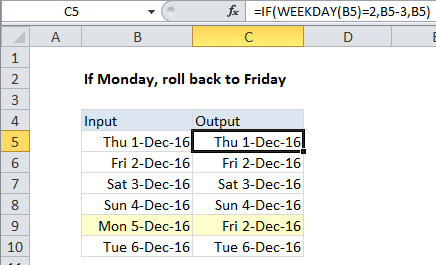
If Monday, roll back to Friday

To check the weekday of a date, and roll back to Friday when the date is a Monday, you can use the IF and WEEKDAY functions.

Formula

=IF(WEEKDAY(date)=2,date-3,date)
If-Monday-roll-back-to-Friday Roll back weekday to Friday base on a particular date in Excel

Explanation

In the example shown, the formula in C5 is

=IF(WEEKDAY(B5)=2,B5-3,B5)

How this formula works

The WEEKDAY function returns a number, 1-7, that corresponds to particular days of the week. By default, WEEKDAY assumes a Sunday-based week, and assigns 1 to Sunday, 2 to Monday, and so on, with 7 assigned to Saturday.

In this case, we only want to take action if the date in question is Monday. To test, we use this expression inside the IF function:

WEEKDAY(B5)=2

If the logical expression returns TRUE, we know the date is a Monday, so we subtract 3 to “roll back” to Friday. If the expression returns FALSE, we simply return the original date.

Post navigation

Previous Post:

DECIMAL function: Description, Usage, Syntax, Examples and Explanation

Next Post:

AVERAGE function: Description, Usage, Syntax, Examples and Explanation

Leave a Reply Cancel reply

Your email address will not be published. Required fields are marked *

Learn Basic Excel

Ribbon
Workbook
Worksheets
Format Cells
Find & Select
Sort & Filter
Templates
Print
Share
Protect
Keyboard Shortcuts

Categories

  • Charts
  • Data Analysis
  • Data Validation
  • Excel Functions
    • Cube Functions
    • Database Functions
    • Date and Time Functions
    • Engineering Functions
    • Financial Functions
    • Information Functions
    • Logical Functions
    • Lookup and Reference Functions
    • Math and Trig Functions
    • Statistical Functions
    • Text Functions
    • Web Functions
  • Excel VBA
  • Excel Video Tutorials
  • Formatting
  • Grouping
  • Others

Logical Functions

  • How to use Excel NOT Function
  • Extract multiple matches into separate rows in Excel
  • NOT function: Description, Usage, Syntax, Examples and Explanation
  • AND function: Description, Usage, Syntax, Examples and Explanation
  • How to use IFS function in Excel

Date Time

  • Extract date from a date and time in Excel
  • Convert Unix time stamp to Excel date
  • How to enter Today’s Date or Static Date and Time in Excel
  • ISOWEEKNUM function: Description, Usage, Syntax, Examples and Explanation
  • Convert Excel time to decimal minutes

Grouping

  • Group times into 3 hour buckets in Excel
  • How to randomly assign data to groups in Excel
  • If cell contains one of many things in Excel
  • Calculate conditional mode with criteria in Excel
  • Group numbers with VLOOKUP in Excel

General

  • Excel Autofill Cell Ranges, Copy, Paste
  • How to Insert Cells, Row and Rows in Excel
  • How to calculate profit margin percentage in Excel
  • How to get amount with percentage in Excel
  • Subtotal by color in Excel
© 2025 xlsoffice . All Right Reserved. | Teal Smiles | Abbreviations And Their Meaning