

Skip to content
Free Excel Tutorials
  • Home
  • Excel For Beginners
  • Excel Intermediate
  • Advanced Excel For Experts

Data Analysis

  • How to create a Histogram in Excel
  • Conflicting Multiple Conditional Formatting Rules in Excel
  • How to do a t-Test in Excel?
  • Randomize/ Shuffle List in Excel
  • How To Remove Duplicates In Excel Column Or Row?

References

  • Last row number in range
  • Left Lookup in Excel
  • Merge tables with VLOOKUP in Excel
  • Count rows with at least n matching values
  • Excel Advanced Lookup using Index and Match Functions

Data Validations

  • Excel Data validation no punctuation
  • How To Create Drop-down List in Excel
  • Excel Data validation allow weekday only
  • Excel Data validation with conditional list
  • Excel Data validation specific characters only

Calculating Percentages in Excel

by

Percentage simply means ‘out of 100′, so 72% is ’72 out of 100’ and 4% is ‘4 out of 100’, etc.

  • Enter a Percentage
  • Percentage of Total
  • Increase by Percentage
  • Percentage Change

Calculating percentages in Excel is easy.

Enter a Percentage

To enter a percentage in Excel, execute the following steps.

1. First, enter a decimal number.

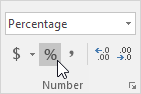
2. On the Home tab, in the Number group, click the percentage symbol to apply a Percentage format.
Result.

Note: to change the percentage in cell A1, simply select cell A1 and type a new percentage (do not type a decimal number).

Percentage of Total

To calculate the percentage of a total in Excel, execute the following steps.

1. Enter the formula shown below. This formula divides the value in cell A1 by the value in cell B1. Simply use the forward slash (/) as the division operator. Don’t forget, always start a formula with an equal sign (=).

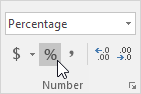
2. On the Home tab, in the Number group, click the percentage symbol to apply a Percentage format.
Result.

3. On the Home tab, in the Number group, click the Increase Decimal button once.

Result.

Note: Excel always uses the underlying precise value in calculations, regardless of how many decimals you choose to display.

Increase by Percentage

To increase a number by a percentage in Excel, execute the following steps.

1. Enter a number in cell A1. Enter a decimal number (0.2) in cell B1 and apply a Percentage format.

2. To increase the number in cell A1 by 20%, multiply the number by 1.2 (1+0.2). The formula below does the trick.

Percentage Increase

Note: Excel uses a default order in which calculations occur. If a part of the formula is in parentheses, that part will be calculated first.

3. To decrease a number by a percentage, simply change the plus sign to a minus sign.

Percentage Change

To calculate the percentage change between two numbers in Excel, execute the following steps.

1. Enter an old number in cell A1 and a new number in cell B1.

2. First, calculate the difference between new and old.

3. Next, divide this result by the old number in cell A1.

Note: Excel uses a default order in which calculations occur. If a part of the formula is in parentheses, that part will be calculated first.

4. On the Home tab, in the Number group, click the percentage symbol to apply a Percentage format.

Result.

5. The (New-Old)/Old formula always works.

For more practical example on percent change formula

Post navigation

Previous Post:

TRUE function: Description, Usage, Syntax, Examples and Explanation

Next Post:

Excel Pie Chart

Leave a Reply Cancel reply

Your email address will not be published. Required fields are marked *

Learn Basic Excel

Ribbon
Workbook
Worksheets
Format Cells
Find & Select
Sort & Filter
Templates
Print
Share
Protect
Keyboard Shortcuts

Categories

  • Charts
  • Data Analysis
  • Data Validation
  • Excel Functions
    • Cube Functions
    • Database Functions
    • Date and Time Functions
    • Engineering Functions
    • Financial Functions
    • Information Functions
    • Logical Functions
    • Lookup and Reference Functions
    • Math and Trig Functions
    • Statistical Functions
    • Text Functions
    • Web Functions
  • Excel VBA
  • Excel Video Tutorials
  • Formatting
  • Grouping
  • Others

Logical Functions

  • How to use Excel TRUE Function
  • IF with boolean logic in Excel
  • TRUE function: Description, Usage, Syntax, Examples and Explanation
  • How to return blank in place of #DIV/0! error in Excel
  • Return blank if in Excel

Date Time

  • NOW function: Description, Usage, Syntax, Examples and Explanation
  • Basic timesheet formula with breaks in Excel
  • DAYS360 function: Description, Usage, Syntax, Examples and Explanation
  • How to calculate next scheduled event in Excel
  • Convert decimal seconds to Excel time

Grouping

  • Group arbitrary text values in Excel
  • Running count group by n size in Excel
  • If cell contains one of many things in Excel
  • Group times into unequal buckets in Excel
  • Group numbers with VLOOKUP in Excel

General

  • Find, Select, Replace and Go To Special in Excel
  • Select, Insert, Rename, Move, Delete Worksheets in Excel
  • AutoRecover file that was never saved in Excel
  • Check if range contains a value not in another range in Excel
  • With vs Without Array Formula in Excel
© 2026 xlsoffice . All Right Reserved. | Teal Smiles | Abbreviations And Their Meaning