
Skip to content
Free Excel Tutorials
  • Home
  • Excel For Beginners
  • Excel Intermediate
  • Advanced Excel For Experts

Data Analysis

  • How to count table columns in Excel
  • Excel Pie Chart
  • How to create Gauge Chart in Excel
  • Filter Data Based on Date in Excel
  • How to Sort by Color in Excel

References

  • How to get relative column numbers in a range in Excel
  • Vlookup Examples in Excel
  • Lookup entire row in Excel
  • Complete List of Excel Lookup and Reference Functions, References and Examples
  • How to use Excel TRANSPOSE Function

Data Validations

  • Excel Data validation don’t exceed total
  • Excel Data validation unique values only
  • Excel Data validation allow uppercase only
  • Excel Data validation with conditional list
  • Excel Data validation number multiple 100

Calculate Compound Interest in Excel

by

What’s compound interest and what’s the formula for compound interest in Excel?

How to Calculate Compound Interest in Excel

This example gives you the answers to these questions.

1. Assume you put $100 into a bank. How much will your investment be worth after one year at an annual interest rate of 8%?

The answer is $108.
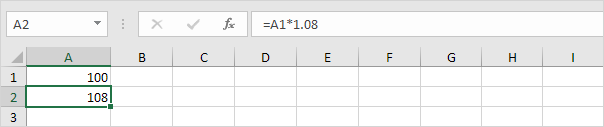
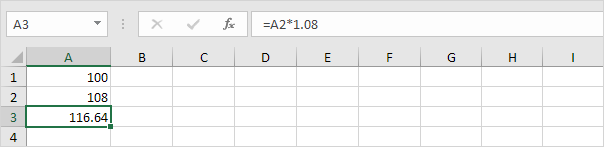
2. Now this interest ($8) will also earn interest (compound interest) next year. How much will your investment be worth after two years at an annual interest rate of 8%? The answer is $116.64.
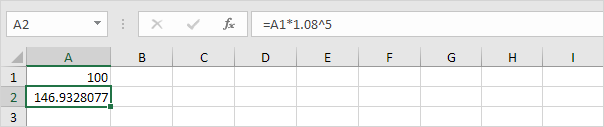
3. How much will your investment be worth after 5 years? Simply drag the formula down to cell A6.
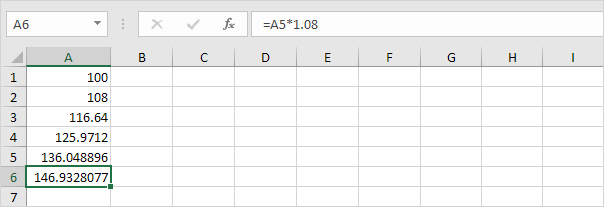
The answer is $146.93.

4. All we did was multiplying 100 by 1.08, 5 times. So we can also directly calculate the value of the investment after 5 years.
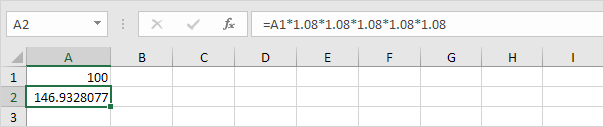
which is the same as:
Note: there is no special function for compound interest in Excel. However, you can easily create a compound interest calculator to compare different rates and different durations.

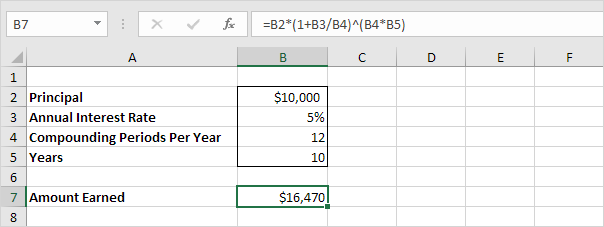
5. Assume you put $10,000 into a bank. How much will your investment be worth after 10 years at an annual interest rate of 5% compounded monthly? The answer is $16,470.
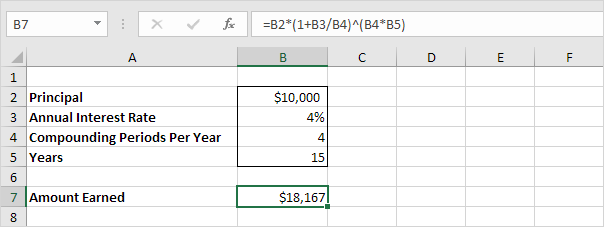
6. Assume you put $10,000 into a bank. How much will your investment be worth after 15 years at an annual interest rate of 4% compounded quarterly? The answer is $18,167.
Post navigation

Previous Post:

VLOOKUP without #N/A error in Excel

Next Post:

Manipulating text strings using Left, Mid, Right, Len, Substitute in Excel

Leave a Reply Cancel reply

Your email address will not be published. Required fields are marked *

Learn Basic Excel

Ribbon
Workbook
Worksheets
Format Cells
Find & Select
Sort & Filter
Templates
Print
Share
Protect
Keyboard Shortcuts

Categories

  • Charts
  • Data Analysis
  • Data Validation
  • Excel Functions
    • Cube Functions
    • Database Functions
    • Date and Time Functions
    • Engineering Functions
    • Financial Functions
    • Information Functions
    • Logical Functions
    • Lookup and Reference Functions
    • Math and Trig Functions
    • Statistical Functions
    • Text Functions
    • Web Functions
  • Excel VBA
  • Excel Video Tutorials
  • Formatting
  • Grouping
  • Others

Logical Functions

  • SWITCH function: Description, Usage, Syntax, Examples and Explanation
  • How to use Excel FALSE Function
  • IFERROR function: Description, Usage, Syntax, Examples and Explanation
  • IF, AND, OR and NOT Functions Examples in Excel
  • IF function: Description, Usage, Syntax, Examples and Explanation

Date Time

  • WORKDAY.INTL function: Description, Usage, Syntax, Examples and Explanation
  • Pad week numbers with zeros in Excel
  • Generate series of dates by weekends in Excel
  • Convert decimal seconds to Excel time
  • Calculate number of hours between two times in Excel

Grouping

  • How to randomly assign people to groups in Excel
  • Map inputs to arbitrary values in Excel
  • Group times into 3 hour buckets in Excel
  • Group numbers with VLOOKUP in Excel
  • Group times into unequal buckets in Excel

General

  • Convert column number to letter in Excel
  • How to calculate decrease by percentage in Excel
  • Sum by group in Excel
  • How to Insert Cells, Row and Rows in Excel
  • How to create dynamic named range with INDEX in Excel
© 2025 xlsoffice . All Right Reserved. | Teal Smiles | Abbreviations And Their Meaning