
Skip to content
Free Excel Tutorials
  • Home
  • Excel For Beginners
  • Excel Intermediate
  • Advanced Excel For Experts

Data Analysis

  • Conflicting Multiple Conditional Formatting Rules in Excel
  • Excel Pie Chart
  • Chart Axes in Excel
  • Working With Tables in Excel
  • How To Load Analysis ToolPak in Excel

References

  • Two-column Lookup in Excel
  • How to use Excel MMULT Function
  • Last row number in range
  • How to use Excel COLUMN Function
  • How to get address of last cell in range in Excel

Data Validations

  • Excel Data validation no punctuation
  • Prevent invalid data entering in specific cells
  • Excel Data validation only dates between
  • Excel Data validation must not contain
  • Excel Data validation whole percentage only

How to split text string at specific character in Excel

by

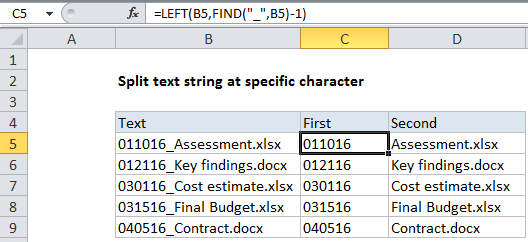
To split a text string at a certain character, you can use a combination of the LEFT, RIGHT, LEN, and FIND functions.

Formula

=LEFT(text,FIND(character,text)-1)
Explanation

In the example shown, the formula in C5 is:

=LEFT(B5,FIND("_",B5)-1)

And the formula in D5 is:

=RIGHT(B5,LEN(B5)-FIND("_",B5))

How these formulas work

The first formula uses the FIND function to locate the underscore(_) in the text, then we subtract 1 to move back to the “character before the special character”.

FIND("_",B5)-1

In this example , FIND returns 7, so we end up with 6.

This result is fed into the LEFT function like as “num_chars” – the number of characters to extract from B5, starting from the left:

=LEFT(B5,6)

The result is the string “011016”.

To get the second part of the text, we use FIND with the right function.

We again use FIND to locate the underscore (7), then subtract this result from the total length of the text in B5 (22), calculated with the LEN function:

LEN(B5)-FIND("_",B5)

This gives us 15 (22-7), which is fed into the RIGHT function as “num_chars” –  – the number of characters to extract from B5, starting from the right:

=RIGHT(B5,15)

Post navigation

Previous Post:

DECIMAL function: Description, Usage, Syntax, Examples and Explanation

Next Post:

AVERAGE function: Description, Usage, Syntax, Examples and Explanation

Leave a Reply Cancel reply

Your email address will not be published. Required fields are marked *

Learn Basic Excel

Ribbon
Workbook
Worksheets
Format Cells
Find & Select
Sort & Filter
Templates
Print
Share
Protect
Keyboard Shortcuts

Categories

  • Charts
  • Data Analysis
  • Data Validation
  • Excel Functions
    • Cube Functions
    • Database Functions
    • Date and Time Functions
    • Engineering Functions
    • Financial Functions
    • Information Functions
    • Logical Functions
    • Lookup and Reference Functions
    • Math and Trig Functions
    • Statistical Functions
    • Text Functions
    • Web Functions
  • Excel VBA
  • Excel Video Tutorials
  • Formatting
  • Grouping
  • Others

Logical Functions

  • How to use Excel AND Function
  • Complete List of Excel Logical Functions, References and Examples
  • How to use Excel TRUE Function
  • OR function: Description, Usage, Syntax, Examples and Explanation
  • IF with wildcards in Excel

Date Time

  • Add decimal hours to time in Excel
  • EOMONTH function: Description, Usage, Syntax, Examples and Explanation
  • Add years to date in Excel
  • How to calculate percent of year complete in Excel
  • Pad week numbers with zeros in Excel

Grouping

  • Map text to numbers in Excel
  • Group arbitrary text values in Excel
  • How to randomly assign people to groups in Excel
  • Group numbers at uneven intervals in Excel
  • If cell contains one of many things in Excel

General

  • How to calculate percent sold in Excel
  • How to create dynamic named range with INDEX in Excel
  • Basic error trapping example in Excel
  • List sheet names with formula in Excel
  • Lock Cells in a Worksheet Excel
© 2026 xlsoffice . All Right Reserved. | Teal Smiles | Abbreviations And Their Meaning