
Skip to content
Free Excel Tutorials
  • Home
  • Excel For Beginners
  • Excel Intermediate
  • Advanced Excel For Experts

Data Analysis

  • How to create running total in an Excel Table
  • Move chart to a separate worksheet in Excel
  • Get column name from index in Excel Table
  • Subtotal function in Excel
  • Managing Conditional Formatting Rules in Excel

References

  • MATCH function: Description, Usage, Syntax, Examples and Explanation
  • Complete List of Excel Lookup and Reference Functions, References and Examples
  • Count rows with at least n matching values
  • How to get first row number in range in Excel
  • How to get relative column numbers in a range in Excel

Data Validations

  • Prevent invalid data entering in specific cells
  • Excel Data validation allow uppercase only
  • Excel Data validation with conditional list
  • Data validation must not exist in list
  • Excel Data validation no punctuation

Series of dates by day

by

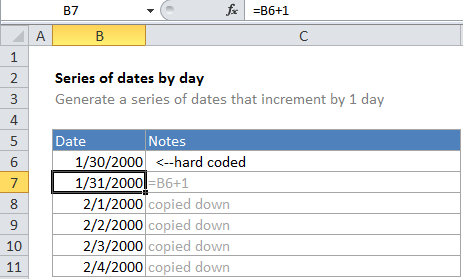
This tutorials shows how to generates Series of dates increment by day from a single start date in Excel.

If you need to generate a dynamic series of dates with a formula that increase by one day from a single start date, you can do so a very simple formula that simply adds 1 to each date.

Formula

=date+1
Explanation


In the example, B6 is the hard-coded start date and the formula in B7 is:

=B6+1

Because dates in Excel are just serial numbers (the first date in the standard Excel date system is January 1, 1900), you can adjust dates just adding or subtracting values. To solve this formula, Excel just adds 1 to the date in B6.  The first formula therefore returns a new date of 1/31/2000, one day later than the starting date.

Once the first formula is entered, it is copied down as far as needed. Each subsequent formula creates a new date incremented by one day. You could easily adjust the formula generate future dates by weeks, by using 7 instead of 1, like so:

=B6+7

Post navigation

Previous Post:

DECIMAL function: Description, Usage, Syntax, Examples and Explanation

Next Post:

AVERAGE function: Description, Usage, Syntax, Examples and Explanation

Leave a Reply Cancel reply

Your email address will not be published. Required fields are marked *

Learn Basic Excel

Ribbon
Workbook
Worksheets
Format Cells
Find & Select
Sort & Filter
Templates
Print
Share
Protect
Keyboard Shortcuts

Categories

  • Charts
  • Data Analysis
  • Data Validation
  • Excel Functions
    • Cube Functions
    • Database Functions
    • Date and Time Functions
    • Engineering Functions
    • Financial Functions
    • Information Functions
    • Logical Functions
    • Lookup and Reference Functions
    • Math and Trig Functions
    • Statistical Functions
    • Text Functions
    • Web Functions
  • Excel VBA
  • Excel Video Tutorials
  • Formatting
  • Grouping
  • Others

Logical Functions

  • NOT function: Description, Usage, Syntax, Examples and Explanation
  • OR function Examples in Excel
  • Check multiple cells are equal in Excel
  • How to use Excel XOR Function
  • TRUE function: Description, Usage, Syntax, Examples and Explanation

Date Time

  • Generate series of dates by weekends in Excel
  • Get month name from date in Excel
  • How to get same date next month or previous month in Excel
  • Add decimal hours to time in Excel
  • Get fiscal quarter from date in Excel

Grouping

  • Running count group by n size in Excel
  • Group times into unequal buckets in Excel
  • Calculate conditional mode with criteria in Excel
  • How to randomly assign data to groups in Excel
  • Map inputs to arbitrary values in Excel

General

  • Excel Ribbon Quick Overview For Beginners
  • Cell References: Relative, Absolute and Mixed Referencing Examples
  • How to make excel worksheets print on one page?
  • List worksheet index numbers in Excel
  • How to calculate percent change in Excel
© 2025 xlsoffice . All Right Reserved. | Teal Smiles | Abbreviations And Their Meaning