
Skip to content
Free Excel Tutorials
  • Home
  • Excel For Beginners
  • Excel Intermediate
  • Advanced Excel For Experts

Data Analysis

  • Reverse List in Excel
  • Conditional Formatting Color Scales Examples in Excel
  • How to create a Histogram in Excel
  • Randomize/ Shuffle List in Excel
  • Get column name from index in Excel Table

References

  • How to use Excel INDIRECT Function
  • How to use Excel MATCH Function
  • How to use Excel MMULT Function
  • How to reference named range different sheet in Excel
  • How to get address of last cell in range in Excel

Data Validations

  • Excel Data validation no punctuation
  • Excel Data validation don’t exceed total
  • Prevent invalid data entering in specific cells
  • Excel Data validation date in specific year
  • Excel Data validation require unique number

Get nth match with INDEX / MATCH in Excel

by

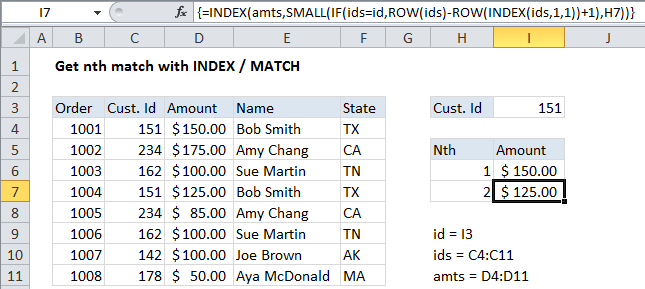
This tutorial shows how to Get nth match with INDEX / MATCH in Excel using the example below;

Formula

{=INDEX(array,SMALL(IF(vals=val,ROW(vals)-ROW(INDEX(vals,1,1))+1),nth))}
Explanation

To retrieve multiple matching values from a set of data with a formula, you can use the IF and SMALL functions to figure out the row number of each match and feed that value back to INDEX. In the example shown, the formula in I7 is:

{=INDEX(amts,SMALL(IF(ids=id,ROW(ids)-ROW(INDEX(ids,1,1))+1),H6))}

Where named ranges are amts (D4:D11), id (I3), and ids (C4:C11).

Note that this is an array formula and must be entered with Control + Shift + Enter.

How this formula works

At the core, this formula is simply an INDEX formula that retrieves the value in an array at a given position. The value for n  is supplied in column H, and all the “heavy” work that the formula does is to figure out the row from which to retrieve a value, where row corresponds to “nth” match.

The IF function does the work of figuring out which rows contain a match, and the SMALL function returns the nth value from that list. Inside of IF, the logical test is:

ids=id

which yields this array:

{TRUE;FALSE;FALSE;TRUE;FALSE;FALSE;FALSE}

Note the customer id matches at the 1st and 4th positions, which appear as TRUE. The “value if true” argument in IF generates a list of relative row numbers with this expression:

ROW(ids)-ROW(INDEX(ids,1,1))+1

which produces this array:

{1;2;3;4;5;6;7}

This array is then “filtered” by the logical test results, and the IF function returns the following array result:

{1;FALSE;FALSE;4;FALSE;FALSE;FALSE}

Note we have valid row numbers for row 1 and row 2.

This array is then processed by SMALL, which is configured to use values in column H to return “nth” values. The SMALL function automatically ignores the logical values TRUE and FALSE in the array. In the end, the formulas reduce to:

=INDEX(amts,1) // I6, returns $150
=INDEX(amts,4) // I7, returns $125

Handling errors

Once there are no more matches for a given id, the SMALL function will return a #NUM error. You can handle this error with the IFERROR function, or by adding logic to count matches and abort processing once the number in column H is greater than the match count. The example here shows one approach.

Post navigation

Previous Post:

COSH function: Description, Usage, Syntax, Examples and Explanation

Next Post:

Excel Data validation require unique number

Leave a Reply Cancel reply

Your email address will not be published. Required fields are marked *

Learn Basic Excel

Ribbon
Workbook
Worksheets
Format Cells
Find & Select
Sort & Filter
Templates
Print
Share
Protect
Keyboard Shortcuts

Categories

  • Charts
  • Data Analysis
  • Data Validation
  • Excel Functions
    • Cube Functions
    • Database Functions
    • Date and Time Functions
    • Engineering Functions
    • Financial Functions
    • Information Functions
    • Logical Functions
    • Lookup and Reference Functions
    • Math and Trig Functions
    • Statistical Functions
    • Text Functions
    • Web Functions
  • Excel VBA
  • Excel Video Tutorials
  • Formatting
  • Grouping
  • Others

Logical Functions

  • How to use Excel OR Function
  • How to use Excel XOR Function
  • Not Equal To ‘<>‘ operator in Excel
  • Complete List of Excel Logical Functions, References and Examples
  • How to use Excel TRUE Function

Date Time

  • Calculate series of dates by workdays in Excel
  • DAY function: Description, Usage, Syntax, Examples and Explanation
  • EDATE function: Description, Usage, Syntax, Examples and Explanation
  • Get first day of previous month in Excel
  • How to calculate workdays per month in Excel

Grouping

  • Group numbers at uneven intervals in Excel
  • Group numbers with VLOOKUP in Excel
  • Calculate conditional mode with criteria in Excel
  • Running count group by n size in Excel
  • If cell contains one of many things in Excel

General

  • Automatically fill series of cells in Excel using AutoFill
  • How to get original number from percent change in Excel
  • AutoRecover file that was never saved in Excel
  • Check if multiple cells have same value in Excel
  • Common Errors in Excel
© 2026 xlsoffice . All Right Reserved. | Teal Smiles | Abbreviations And Their Meaning