
Skip to content
Free Excel Tutorials
  • Home
  • Excel For Beginners
  • Excel Intermediate
  • Advanced Excel For Experts

Data Analysis

  • How to sum a total in multiple Excel tables
  • Use Data Form to input, edit and delete records in Excel
  • Reverse List in Excel
  • Conditional Formatting New Rule with Formulas in Excel
  • How To Sort One Column or Multiple Columns in Excel

References

  • Count rows with at least n matching values
  • Left Lookup in Excel
  • How to get address of first cell in range in Excel
  • Count unique text values with criteria
  • Find Closest Match in Excel Using INDEX, MATCH, ABS and MIN functions

Data Validations

  • Excel Data validation only dates between
  • Excel Data validation must not contain
  • Excel Data validation exists in list
  • Excel Data validation date in specific year
  • Excel Data validation whole percentage only

Extract time from a date and time in Excel

by

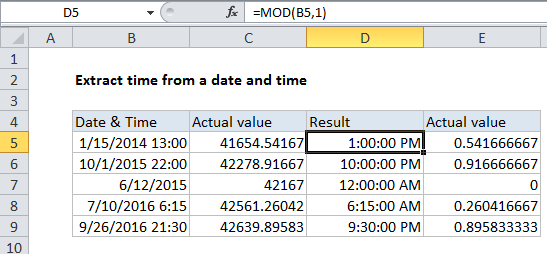
This tutorial show how to Extract time from a date and time in Excel using the example below.

If you have dates with time values and you want to extract only the time portion (the fractional part), you can use a formula that uses the MOD function.

Note: Excel handles dates and time using a scheme in which dates are serial numbers and times are fractional values. For example, June 1, 2000 12:00 PM is represented in Excel as the number 36678.5, where 36678 is the date and .5 is the time.

 Formula

=MOD(date,1)
Explanation of how this formula works

Assuming A1 contains the date and time value June 1, 2000 12:00 PM, the formula below will return just the time portion (.5):

=MOD(A1,1)

The MOD function returns the remainder from division. The first argument is the number and the second is the divisor. Here are a few examples:

=MOD(5,2) // returns 1
=MOD(7,5) // returns 2

So, if you use MOD with a divisor of 1, the result will be the fractional part of the number, if any, because every whole number can be evenly divided by itself. For example:

=MOD(3.125,1) // returns 0.125

In short, =MOD(number,1) returns just the fractional part of a number, discarding the integer portion, so it’s a convenient way to extract time from a date and time.

Note: if you use this formula to strip the time from a date + time, you’ll need to adjust the number format to a suitable time format.

Post navigation

Previous Post:

COSH function: Description, Usage, Syntax, Examples and Explanation

Next Post:

Excel Data validation require unique number

Leave a Reply Cancel reply

Your email address will not be published. Required fields are marked *

Learn Basic Excel

Ribbon
Workbook
Worksheets
Format Cells
Find & Select
Sort & Filter
Templates
Print
Share
Protect
Keyboard Shortcuts

Categories

  • Charts
  • Data Analysis
  • Data Validation
  • Excel Functions
    • Cube Functions
    • Database Functions
    • Date and Time Functions
    • Engineering Functions
    • Financial Functions
    • Information Functions
    • Logical Functions
    • Lookup and Reference Functions
    • Math and Trig Functions
    • Statistical Functions
    • Text Functions
    • Web Functions
  • Excel VBA
  • Excel Video Tutorials
  • Formatting
  • Grouping
  • Others

Logical Functions

  • SWITCH function example in Excel
  • How to use Excel OR Function
  • How to use Excel AND Function
  • How to use Excel FALSE Function
  • How to use IFS function in Excel

Date Time

  • DAYS function: Description, Usage, Syntax, Examples and Explanation
  • How to calculate project start date based on end date in Excel
  • Get last day of month in Excel
  • Add decimal hours to time in Excel
  • How to get Holiday Date from Year in Excel

Grouping

  • Map text to numbers in Excel
  • Categorize text with keywords in Excel
  • Group times into 3 hour buckets in Excel
  • If cell contains one of many things in Excel
  • Group numbers with VLOOKUP in Excel

General

  • How to calculate percentage discount in Excel
  • Count cells that do not contain many strings in Excel
  • Creating and Opening an existing file in Excel
  • How to generate random number weighted probability in Excel
  • How to calculate profit margin percentage in Excel
© 2026 xlsoffice . All Right Reserved. | Teal Smiles | Abbreviations And Their Meaning