

Skip to content
Free Excel Tutorials
  • Home
  • Excel For Beginners
  • Excel Intermediate
  • Advanced Excel For Experts

Data Analysis

  • How to conditionally sum numeric data in an Excel table using SUMIFS
  • Create Scatter Chart in Excel
  • Conditional Formatting Data bars Examples in Excel
  • Number and Text Filters Examples in Excel
  • Error Bars in Excel

References

  • How to use Excel TRANSPOSE Function
  • Two-column Lookup in Excel
  • Get nth match with INDEX / MATCH in Excel
  • Extract data with helper column in Excel
  • How to retrieve first match between two ranges in Excel

Data Validations

  • Excel Data validation must contain specific text
  • Data validation must not exist in list
  • Excel Data validation number multiple 100
  • Prevent invalid data entering in specific cells
  • Excel Data validation must not contain

Working With Tables in Excel

by

Tables allow you to analyze your data in Excel quickly and easily.

Learn how to insert, sort and filter a table, and how to display a total row at the end of a table.

Navigation: Insert Tab → Tables Group – Table

Insert a Table

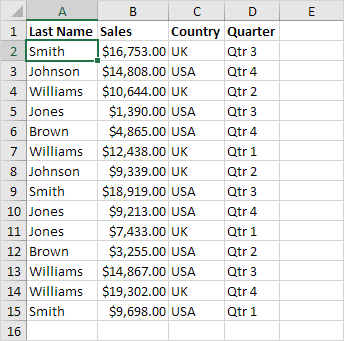
To insert a table, execute the following steps.

1. Click any single cell inside the data set.
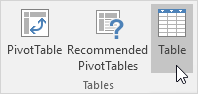
2. On the Insert tab, in the Tables group, click Table.
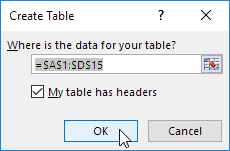
3. Excel automatically selects the data for you. Check ‘My table has headers’ and click on OK.
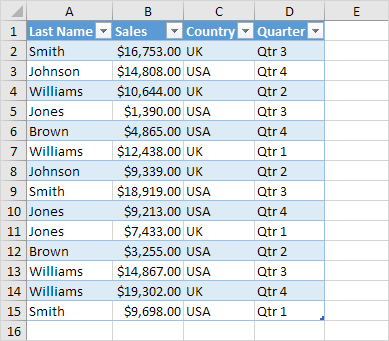
Result. Excel creates a nicely formatted table for you. This may still seem like a normal data range to you but many powerful features are now just a click of a button away.
Sort a Table

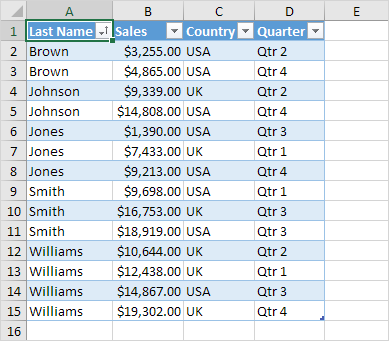
To sort by Last Name first and Sales second, execute the following steps.

1. Click the arrow next to Sales and click Sort Smallest to Largest.

2. Click the arrow next to Last Name and click Sort A to Z.

Result.
Filter a Table

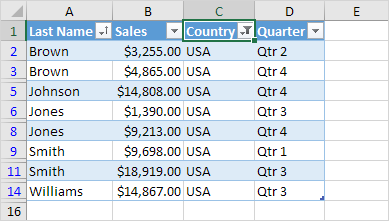
To filter a table, execute the following steps.

1. Click the arrow next to Country and only check USA.

Result.
Total Row

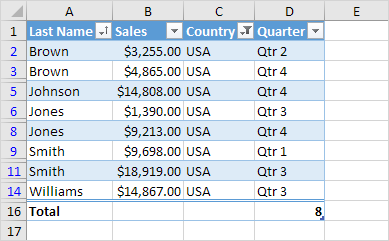
To display a total row at the end of the table, execute the following steps.

1. First, select a cell inside the table. Next, on the Design tab, in the Table Style Options group, check Total Row.

Result.
2. Click any cell in the last row to calculate the Total (Average, Count, Max, Min, Sum etc.) of a column. For example, calculate the sum of the Sales column.
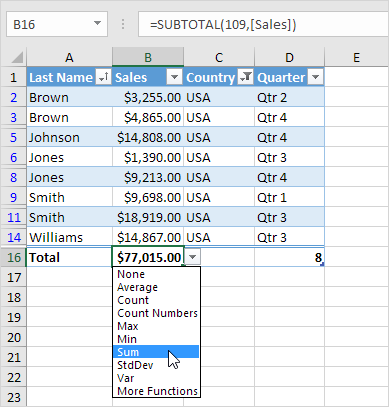
Note: in the formula bar see how Excel uses the SUBTOTAL function to calculate the sum. 109 is the argument for Sum if you use the SUBTOTAL function. Excel uses this function (and not the standard SUM function) to correctly calculate table totals of filtered tables.

Also, Excel tables should not be confused with the data tables (data table: A range of cells that shows the results of substituting different values in one or more formulas. There are two types of data tables: one-input tables and two-input tables.) that are part of a suite of what-if analysis commands.


Post navigation

Previous Post:

TRUE function: Description, Usage, Syntax, Examples and Explanation

Next Post:

Excel Pie Chart

Leave a Reply Cancel reply

Your email address will not be published. Required fields are marked *

Learn Basic Excel

Ribbon
Workbook
Worksheets
Format Cells
Find & Select
Sort & Filter
Templates
Print
Share
Protect
Keyboard Shortcuts

Categories

  • Charts
  • Data Analysis
  • Data Validation
  • Excel Functions
    • Cube Functions
    • Database Functions
    • Date and Time Functions
    • Engineering Functions
    • Financial Functions
    • Information Functions
    • Logical Functions
    • Lookup and Reference Functions
    • Math and Trig Functions
    • Statistical Functions
    • Text Functions
    • Web Functions
  • Excel VBA
  • Excel Video Tutorials
  • Formatting
  • Grouping
  • Others

Logical Functions

  • Excel If, Nested If, And/Or Criteria Examples
  • TRUE function: Description, Usage, Syntax, Examples and Explanation
  • How to use Excel OR Function
  • Check multiple cells are equal in Excel
  • How to return blank in place of #DIV/0! error in Excel

Date Time

  • Convert Excel time to Unix time in Excel
  • How to calculate working days left in month in Excel
  • Get days, hours, and minutes between dates in Excel
  • Generate series of dates by weekends in Excel
  • Display Days until expiration date in Excel

Grouping

  • How to randomly assign people to groups in Excel
  • Group times into unequal buckets in Excel
  • Running count group by n size in Excel
  • How to randomly assign data to groups in Excel
  • Group times into 3 hour buckets in Excel

General

  • Using Existing Templates in Excel
  • Create dynamic workbook reference to another workbook in Excel
  • How to fill cell ranges with random text values in Excel
  • How to Insert Cells, Row and Rows in Excel
  • How to calculate percent sold in Excel
© 2025 xlsoffice . All Right Reserved. | Teal Smiles | Abbreviations And Their Meaning