
Skip to content
Free Excel Tutorials
  • Home
  • Excel For Beginners
  • Excel Intermediate
  • Advanced Excel For Experts

Data Analysis

  • Working With Tables in Excel
  • Data Series in Excel
  • Conflicting Multiple Conditional Formatting Rules in Excel
  • Excel Bar Chart
  • Conditional Formatting New Rule with Formulas in Excel

References

  • How to use Excel ROW Function
  • How to retrieve first match between two ranges in Excel
  • Find Closest Match in Excel Using INDEX, MATCH, ABS and MIN functions
  • How to get last column number in range in Excel
  • Complete List of Excel Lookup and Reference Functions, References and Examples

Data Validations

  • Excel Data validation allow weekday only
  • Excel Data validation specific characters only
  • Data validation must not exist in list
  • Excel Data validation unique values only
  • Excel Data validation don’t exceed total

How to Calculate Tax Rates in Excel

by

This example teaches you how to calculate the tax on an income using the VLOOKUP function in Excel. The following tax rates apply to individuals who are residents of Australia.

Taxable income Tax on this income
0 – $18,200 Nil
$18,201 – $37,000 19c for each $1 over $18,200
$37,001 – $87,000 $3,572 plus 32.5c for each $1 over $37,000
$87,001 – $180,000 $19,822 plus 37c for each $1 over $87,000
$180,001 and over $54,232 plus 45c for each $1 over $180,000

Example: if income is 39000, tax equals 3572 + 0.325 * (39000 – 37000) = 3572 + 650 = $4222

To automatically calculate the tax on an income, execute the following steps.

1. On the second sheet, create the following range and name it Rates.
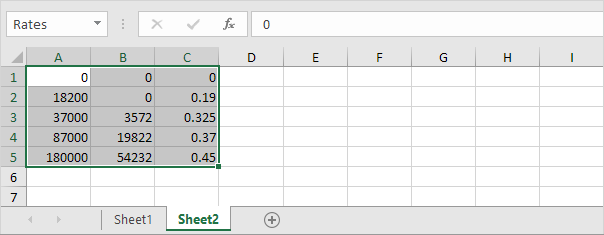
2. When you set the fourth argument of the VLOOKUP function to TRUE, the VLOOKUP function returns an exact match or if not found, it returns the largest value smaller than lookup_value (A2). That’s exactly what we want!
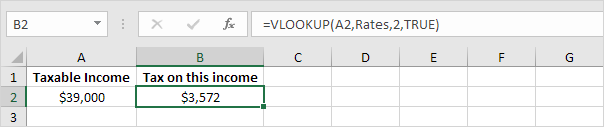
Explanation: Excel cannot find 39000 in the first column of Rates. However, it can find 37000 (the largest value smaller than 39000). As a result, it returns 3572 (col_index_num, the third argument, is set to 2).

3. Now, what’s left is the remainder of the equation, + 0.325 * (39000 – 37000). This is easy. We can return 0.325 by setting col_index_num to 3 and return 37000 by setting col_index_num to 1. The complete formula below does the trick.
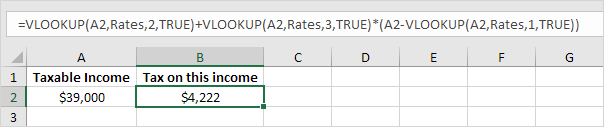
Note: when you set the fourth argument of the VLOOKUP function to TRUE, the first column of the table must be sorted in ascending order.

Post navigation

Previous Post:

VLOOKUP without #N/A error in Excel

Next Post:

Manipulating text strings using Left, Mid, Right, Len, Substitute in Excel

Leave a Reply Cancel reply

Your email address will not be published. Required fields are marked *

Learn Basic Excel

Ribbon
Workbook
Worksheets
Format Cells
Find & Select
Sort & Filter
Templates
Print
Share
Protect
Keyboard Shortcuts

Categories

  • Charts
  • Data Analysis
  • Data Validation
  • Excel Functions
    • Cube Functions
    • Database Functions
    • Date and Time Functions
    • Engineering Functions
    • Financial Functions
    • Information Functions
    • Logical Functions
    • Lookup and Reference Functions
    • Math and Trig Functions
    • Statistical Functions
    • Text Functions
    • Web Functions
  • Excel VBA
  • Excel Video Tutorials
  • Formatting
  • Grouping
  • Others

Logical Functions

  • FALSE function: Description, Usage, Syntax, Examples and Explanation
  • Not Equal To ‘<>‘ operator in Excel
  • NOT function: Description, Usage, Syntax, Examples and Explanation
  • SWITCH function example in Excel
  • IFERROR function: Description, Usage, Syntax, Examples and Explanation

Date Time

  • WORKDAY function: Description, Usage, Syntax, Examples and Explanation
  • How to calculate months between dates in Excel
  • Convert decimal seconds to Excel time
  • How to calculate percent of year complete in Excel
  • How to calculate workdays per month in Excel

Grouping

  • Calculate conditional mode with criteria in Excel
  • Map inputs to arbitrary values in Excel
  • Group numbers with VLOOKUP in Excel
  • How to randomly assign data to groups in Excel
  • Group times into unequal buckets in Excel

General

  • How to calculate project complete percentage in Excel
  • 44 Practical Excel IF function Examples
  • How to generate random number weighted probability in Excel
  • How to get Excel workbook path only
  • Subtotal invoices by age in Excel
© 2025 xlsoffice . All Right Reserved. | Teal Smiles | Abbreviations And Their Meaning