
Skip to content
Free Excel Tutorials
  • Home
  • Excel For Beginners
  • Excel Intermediate
  • Advanced Excel For Experts

Data Analysis

  • How to Sort by Color in Excel
  • Conflicting Multiple Conditional Formatting Rules in Excel
  • How To Sort One Column or Multiple Columns in Excel
  • Example of COUNTIFS with variable table column in Excel
  • How to sum a total in multiple Excel tables

References

  • How to get last row in numeric data in Excel
  • Count rows with at least n matching values
  • Two-column Lookup in Excel
  • Find closest match in Excel
  • How to use Excel ROWS Function

Data Validations

  • Excel Data validation allow uppercase only
  • Excel Data validation must begin with
  • Excel Data validation must contain specific text
  • Excel Data validation exists in list
  • Excel Data validation must not contain

Calculate cumulative loan principal payments in Excel

by

To calculate the cumulative principal paid between any two loan payments, you can use the CUMPRINC function.

Formula

=CUMPRINC(rate,nper,pv,start,end,type)
Explanation

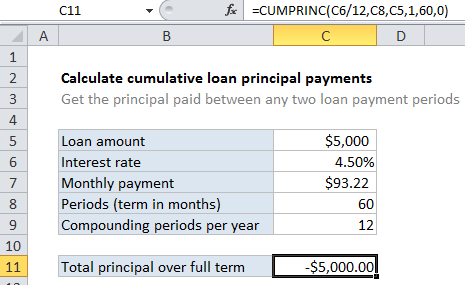
In the example shown, we calculate the total principal paid over the full term of the loan by using the first and last period. The formula in C10 is:

=CUMPRINC(C6/12,C8,C5,1,60,0)

How this formula works

For this example, we want to calculate cumulative principal payments over the full term of a 5-year loan of $5,000 with an interest rate of 4.5%. To do this, we set up CUMPRINC like this:

rate – The interest rate per period. We divide the value in C6 by 12 since 4.5% represents annual interest:

=C6/12

nper – the total number of payment periods for the loan, 60, from cell C8.

pv – The present value, or total value of all payments now, 5000, from cell C5.

start_period – the first period of interest, 1 in this case, since we are calculating principal across the entire loan term.

end_period – the last period of interest, 60 in this case for the full loan term.

With these inputs, the CUMPRINC function returns 5,000, which matches the original loan value as expected.

Post navigation

Previous Post:

DECIMAL function: Description, Usage, Syntax, Examples and Explanation

Next Post:

AVERAGE function: Description, Usage, Syntax, Examples and Explanation

Leave a Reply Cancel reply

Your email address will not be published. Required fields are marked *

Learn Basic Excel

Ribbon
Workbook
Worksheets
Format Cells
Find & Select
Sort & Filter
Templates
Print
Share
Protect
Keyboard Shortcuts

Categories

  • Charts
  • Data Analysis
  • Data Validation
  • Excel Functions
    • Cube Functions
    • Database Functions
    • Date and Time Functions
    • Engineering Functions
    • Financial Functions
    • Information Functions
    • Logical Functions
    • Lookup and Reference Functions
    • Math and Trig Functions
    • Statistical Functions
    • Text Functions
    • Web Functions
  • Excel VBA
  • Excel Video Tutorials
  • Formatting
  • Grouping
  • Others

Logical Functions

  • Complete List of Excel Logical Functions, References and Examples
  • How to use Excel OR Function
  • IF, AND, OR and NOT Functions Examples in Excel
  • IFERROR function: Description, Usage, Syntax, Examples and Explanation
  • How to use IFS function in Excel

Date Time

  • Count holidays between two dates in Excel
  • Calculate expiration date in Excel
  • Convert date to month and year in Excel
  • Count day of week between dates in Excel
  • Add business days to date in Excel

Grouping

  • Group numbers with VLOOKUP in Excel
  • Calculate conditional mode with criteria in Excel
  • How to randomly assign people to groups in Excel
  • Map inputs to arbitrary values in Excel
  • How to randomly assign data to groups in Excel

General

  • How to get original price from percentage discount in Excel
  • How to calculate percent of students absent in Excel
  • Excel Autofill Cell Ranges, Copy, Paste
  • Print Excel Sheet In Landscape Or Portrait
  • How to calculate percentage discount in Excel
© 2026 xlsoffice . All Right Reserved. | Teal Smiles | Abbreviations And Their Meaning