
Skip to content
Free Excel Tutorials
  • Home
  • Excel For Beginners
  • Excel Intermediate
  • Advanced Excel For Experts

Data Analysis

  • Conflicting Multiple Conditional Formatting Rules in Excel
  • Excel Frequency Function Example
  • Conditional Formatting New Rule with Formulas in Excel
  • How to Create Gantt Chart in Excel
  • How To Create Frequency Distribution in Excel

References

  • Complete List of Excel Lookup and Reference Functions, References and Examples
  • How to use Excel TRANSPOSE Function
  • How to retrieve first match between two ranges in Excel
  • Find Closest Match in Excel Using INDEX, MATCH, ABS and MIN functions
  • Vlookup Examples in Excel

Data Validations

  • Excel Data validation date in next 30 days
  • Excel Data validation number multiple 100
  • Excel Data validation only dates between
  • Excel Data validation must not contain
  • Excel Data validation require unique number

How to extract multiple lines from a cell in Excel

by

To extract lines from a multi-line cell, you can use  a clever (and intimidating) formula that combines 5 Excel functions: SUBSTITUTE, REPT, TRIM, MID,  and LEN.

Formula

=TRIM(MID(SUBSTITUTE(A1,delim,REPT
(" ",LEN(A1))), (N-1)*LEN(A1)+1, LEN(A1)))
Explanation

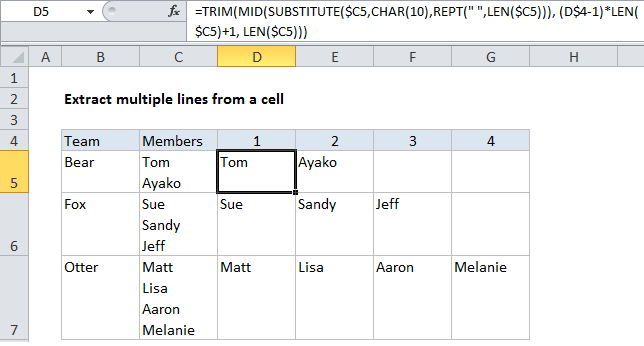
In the example shown, the formula in D5 is:

=TRIM(MID(SUBSTITUTE($C5,CHAR(10),REPT
(" ",LEN($C5))), (D$4-1)*LEN($C5)+1, LEN($C5)))

How this formula works

At the core, this formula looks for a line delimiter (“delim”) and replaces it with a large number of spaces using the SUBSTITUTE and REPT functions.

Note: For the new line delimiter on Windows, you’ll want to use CHAR(10). On Excel for Mac, use CHAR(13). The CHAR function returns a character based on it’s numeric code.

The number of spaces used to replace the line delimiter is based on the total length the text in the cell. The formula then uses the MID function to extract the desired line. The starting point is worked out with:

(N-1)*LEN(A1)+1 // start_num

Where “N” stands for “nth line”, which is picked up from row 4 with the D$4 reference.

The total characters extracted is equal to the length of the full text string:

LEN(A1) // num_chars

At this point, we have the “nth line”, surrounded by spaces.

Finally, the TRIM function slices off all preceding extra space characters and returns just the line text.

Post navigation

Next Post:

Create One-dimensional and Two-dimensional Array

Leave a Reply Cancel reply

Your email address will not be published. Required fields are marked *

Learn Basic Excel

Ribbon
Workbook
Worksheets
Format Cells
Find & Select
Sort & Filter
Templates
Print
Share
Protect
Keyboard Shortcuts

Categories

  • Charts
  • Data Analysis
  • Data Validation
  • Excel Functions
    • Cube Functions
    • Database Functions
    • Date and Time Functions
    • Engineering Functions
    • Financial Functions
    • Information Functions
    • Logical Functions
    • Lookup and Reference Functions
    • Math and Trig Functions
    • Statistical Functions
    • Text Functions
    • Web Functions
  • Excel VBA
  • Excel Video Tutorials
  • Formatting
  • Grouping
  • Others

Logical Functions

  • IF function: Description, Usage, Syntax, Examples and Explanation
  • IF, AND, OR and NOT Functions Examples in Excel
  • Not Equal To ‘<>‘ operator in Excel
  • Invoice status with nested if in Excel
  • IFERROR function: Description, Usage, Syntax, Examples and Explanation

Date Time

  • Add business days to date in Excel
  • Count dates in current month in Excel
  • Convert Excel time to decimal minutes
  • Convert time to time zone in Excel
  • EOMONTH function: Description, Usage, Syntax, Examples and Explanation

Grouping

  • How to randomly assign people to groups in Excel
  • Group numbers at uneven intervals in Excel
  • Map text to numbers in Excel
  • Group times into unequal buckets in Excel
  • Calculate conditional mode with criteria in Excel

General

  • Check if multiple cells have same value in Excel
  • How to generate random times at specific intervals in Excel
  • Subtotal invoices by age in Excel
  • Creating and Opening an existing file in Excel
  • Mark Workbook as Final in Excel
© 2026 xlsoffice . All Right Reserved. | Teal Smiles | Abbreviations And Their Meaning