
Skip to content
Free Excel Tutorials
  • Home
  • Excel For Beginners
  • Excel Intermediate
  • Advanced Excel For Experts

Data Analysis

  • How to Create Column Chart in Excel
  • How to count table rows in Excel
  • Get column index in Excel Table
  • How To Insert and Customize Sparklines in Excel
  • Calculate Conditional Percentile ‘IF’ in table in Excel

References

  • CHOOSE function: Description, Usage, Syntax, Examples and Explanation
  • How to get address of first cell in range in Excel
  • MATCH function: Description, Usage, Syntax, Examples and Explanation
  • How to get address of last cell in range in Excel
  • VLOOKUP function: Description, Usage, Syntax, Examples and Explanation

Data Validations

  • Excel Data validation only dates between
  • Excel Data validation exists in list
  • Excel Data validation allow weekday only
  • Excel Data validation allow uppercase only
  • Excel Data validation unique values only

Round a number up in Excel

by

This tutorials shows how to Round a number up in Excel.

If you need to round a number up, regardless of the value of the digits being rounded (i.e. you want to force any number to round up, regardless of value) you can use the ROUNDUP function with a specified number of digits.

Formula

=ROUNDUP(number,digits)
Explanation

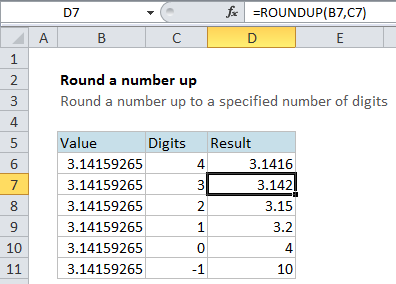
In the example, the formula in cell D7 is

=ROUNDUP(B7,C7)

This tells Excel to take the value in B7 (PI) and round it to the number of digits in cell C7 (3) with a result of 3.142

Notice that even though the number in the 4th position to the right of the decimal is 1, it is still rounded up to 2.

In the table, the ROUNDUP function is used to round the same number (PI) to a decreasing number of digits, starting at 4 and moving down past zero to -1.

Note that positive numbers round to the right of the decimal point, while digits specified less than or equal to zero round to the left.

You can see that ROUNDUP is a rather heavy-handed function, so use with care.

Post navigation

Previous Post:

COSH function: Description, Usage, Syntax, Examples and Explanation

Next Post:

Excel Data validation require unique number

Leave a Reply Cancel reply

Your email address will not be published. Required fields are marked *

Learn Basic Excel

Ribbon
Workbook
Worksheets
Format Cells
Find & Select
Sort & Filter
Templates
Print
Share
Protect
Keyboard Shortcuts

Categories

  • Charts
  • Data Analysis
  • Data Validation
  • Excel Functions
    • Cube Functions
    • Database Functions
    • Date and Time Functions
    • Engineering Functions
    • Financial Functions
    • Information Functions
    • Logical Functions
    • Lookup and Reference Functions
    • Math and Trig Functions
    • Statistical Functions
    • Text Functions
    • Web Functions
  • Excel VBA
  • Excel Video Tutorials
  • Formatting
  • Grouping
  • Others

Logical Functions

  • Not Equal To ‘<>‘ operator in Excel
  • Check multiple cells are equal in Excel
  • Return blank if in Excel
  • Complete List of Excel Logical Functions, References and Examples
  • OR function: Description, Usage, Syntax, Examples and Explanation

Date Time

  • How to enter Today’s Date or Static Date and Time in Excel
  • How to get workdays between dates in Excel
  • How to calculate most recent day of week in Excel
  • How to calculate future date say 6 months ahead in Excel
  • Count holidays between two dates in Excel

Grouping

  • Group numbers with VLOOKUP in Excel
  • Categorize text with keywords in Excel
  • Map inputs to arbitrary values in Excel
  • How to randomly assign data to groups in Excel
  • Map text to numbers in Excel

General

  • Check if multiple cells have same value in Excel
  • Automatically fill series of cells in Excel using AutoFill
  • Flash Fill in Excel
  • Common Errors in Excel
  • Count cells that contain errors in Excel
© 2026 xlsoffice . All Right Reserved. | Teal Smiles | Abbreviations And Their Meaning