
Skip to content
Free Excel Tutorials
  • Home
  • Excel For Beginners
  • Excel Intermediate
  • Advanced Excel For Experts

Data Analysis

  • Conditional Formatting New Rule with Formulas in Excel
  • Error Bars in Excel
  • How to sum a total in multiple Excel tables
  • How to create dynamic reference table name in Excel
  • How to combine 2 or more chart types in a single chart in Excel

References

  • How to get last row in mixed data with blanks in Excel
  • How to get relative row numbers in a range in Excel
  • How to get first column number in range in Excel
  • MATCH function: Description, Usage, Syntax, Examples and Explanation
  • How to use Excel VLOOKUP Function

Data Validations

  • Excel Data validation whole percentage only
  • Data validation must not exist in list
  • How To Create Drop-down List in Excel
  • Excel Data validation require unique number
  • Excel Data validation with conditional list

How to multiple users can work on a Workbooks at same time

by

If you share a workbook, you can work with other people on the same workbook at the same time. The workbook should be saved to a network location where other people can open it. You can keep track of the changes other people make and accept or reject those changes.

To share a workbook, execute the following steps.

1. Open a workbook.
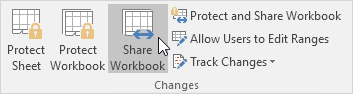
2. On the Review tab, in the Changes group, click Share Workbook.
The Share Workbook dialog box appears.

3. On the Editing tab, click the check box and click OK.
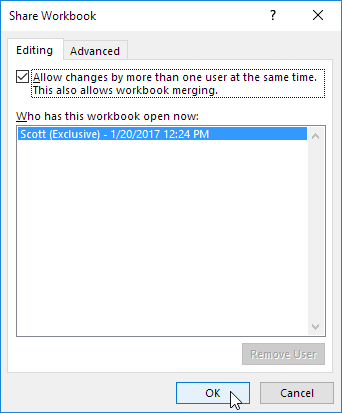
Excel saves the workbook. You can now work with other people on the same workbook at the same time. The screen above shows you who has the workbook open.

Highlight Changes

You can highlight the changes on screen other users has made.

1. On the Review tab, in the Changes group, click Track Changes.
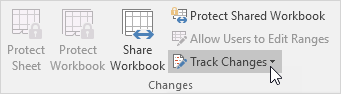
2. Click Highlight Changes.
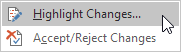
The Highlight Changes dialog box appears.

3. Click OK.
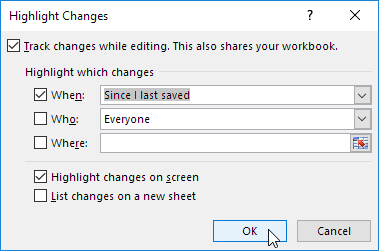
Excel highlights the changes on screen.
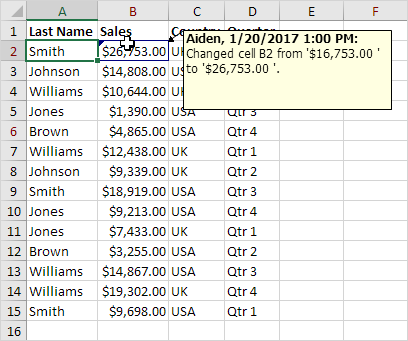
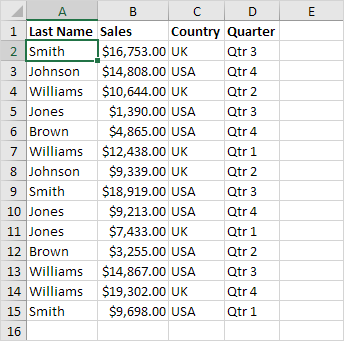
Apparently, Aiden has changed the Sales of Smith from $16,753.00 to $26,753.00.

Accept/Reject Changes

You can now accept or reject this change.

1. On the Review tab, in the Changes group, click Track Changes.

2. Click Accept/Reject Changes.

3. Click OK.
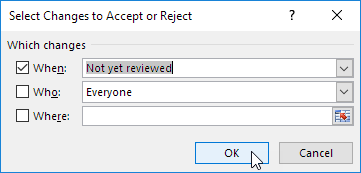
4. Click Accept to accept the change or Reject to reject the change.


Note: not all features are available in a shared workbook.

Post navigation

Previous Post:

TRUE function: Description, Usage, Syntax, Examples and Explanation

Next Post:

Excel Pie Chart

Leave a Reply Cancel reply

Your email address will not be published. Required fields are marked *

Learn Basic Excel

Ribbon
Workbook
Worksheets
Format Cells
Find & Select
Sort & Filter
Templates
Print
Share
Protect
Keyboard Shortcuts

Categories

  • Charts
  • Data Analysis
  • Data Validation
  • Excel Functions
    • Cube Functions
    • Database Functions
    • Date and Time Functions
    • Engineering Functions
    • Financial Functions
    • Information Functions
    • Logical Functions
    • Lookup and Reference Functions
    • Math and Trig Functions
    • Statistical Functions
    • Text Functions
    • Web Functions
  • Excel VBA
  • Excel Video Tutorials
  • Formatting
  • Grouping
  • Others

Logical Functions

  • IFNA function: Description, Usage, Syntax, Examples and Explanation
  • IF, AND, OR and NOT Functions Examples in Excel
  • How to use IFS function in Excel
  • How to use Excel XOR Function
  • IF with boolean logic in Excel

Date Time

  • DAY function: Description, Usage, Syntax, Examples and Explanation
  • Get month name from date in Excel
  • How to calculate next day of week in Excel
  • How to Calculate Age in Excel
  • Convert decimal minutes to Excel time

Grouping

  • If cell contains one of many things in Excel
  • Group numbers at uneven intervals in Excel
  • Group arbitrary text values in Excel
  • Categorize text with keywords in Excel
  • Group times into 3 hour buckets in Excel

General

  • How to generate random number between two numbers in Excel
  • How to calculate percentage of total in Excel
  • How to calculate total from percentage in Excel
  • Basic error trapping example in Excel
  • Cell References: Relative, Absolute and Mixed Referencing Examples
© 2025 xlsoffice . All Right Reserved. | Teal Smiles | Abbreviations And Their Meaning