
Skip to content
Free Excel Tutorials
  • Home
  • Excel For Beginners
  • Excel Intermediate
  • Advanced Excel For Experts

Data Analysis

  • Working With Tables in Excel
  • How to create a Histogram in Excel
  • How to add Trendline to a chart in Excel
  • How to conditionally sum numeric data in an Excel table using SUMIFS
  • How To Filter Data in Excel

References

  • How to use Excel VLOOKUP Function
  • Excel Advanced Lookup using Index and Match Functions
  • How to get relative row numbers in a range in Excel
  • How to create dynamic named range with OFFSET in Excel
  • Count rows that contain specific values in Excel

Data Validations

  • Excel Data validation date in specific year
  • Excel Data validation whole percentage only
  • Excel Data validation date in next 30 days
  • Excel Data validation exists in list
  • Prevent invalid data entering in specific cells

How to Create Running Total (Cumulative Sum) in Excel

by

A running total changes each time new data is added to a list. This example teaches you how to create a running total (cumulative sum) in Excel.

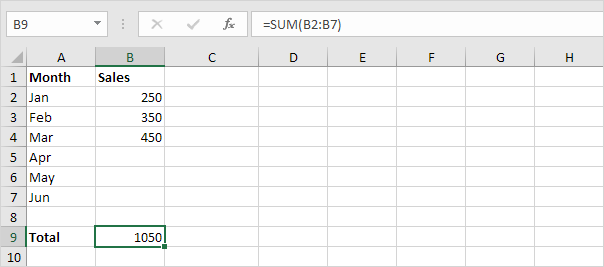
1. Select cell B9 and enter a simple SUM function.
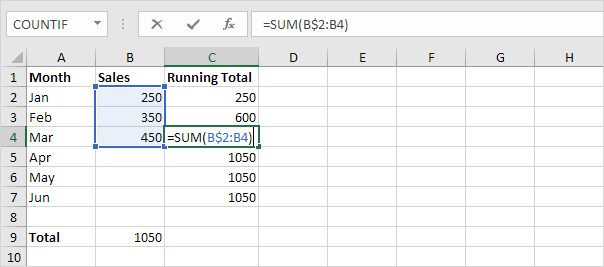
2. Select cell C2 and enter the SUM function shown below.
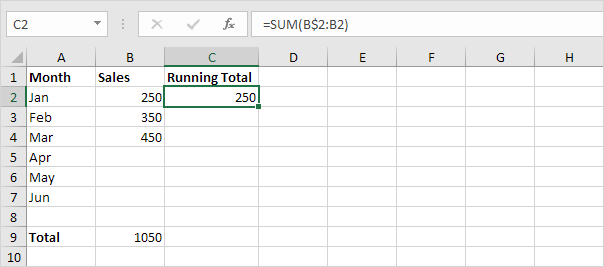
Explanation: the first cell (B$2) in the range reference is a mixed reference. We fixed the reference to row 2 by adding a $ symbol in front of the row number. The second cell (B2) in the range reference is a normal relative reference.

3. Select cell C2, click on the lower right corner of cell C2 and drag it down to cell C7.
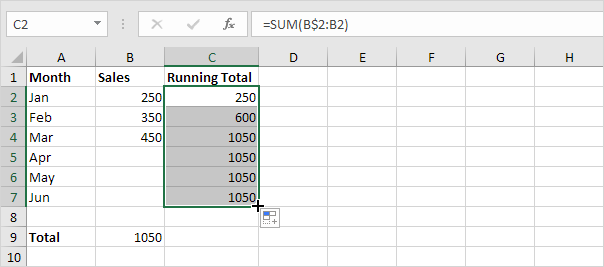
Explanation: when we drag the formula down, the mixed reference (B$2) stays the same, while the relative reference (B2) changes to B3, B4, B5, etc.

4. For example, take a look at the formula in cell C3.
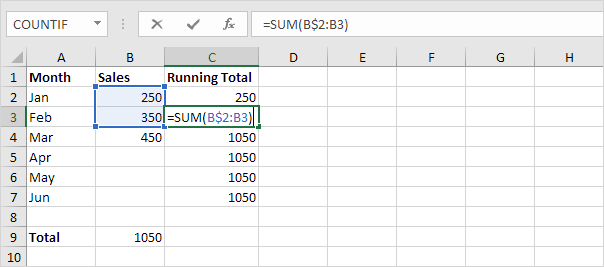
5. For example, take a look at the formula in cell C4.
6. At step 2, enter the IF function shown below (and drag it down to cell C7) to only display a cumulative sum if data has been entered.
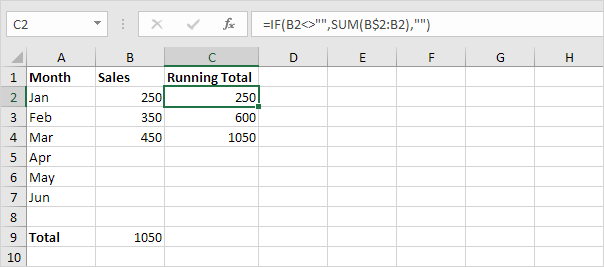
Explanation: if cell B2 is not empty (<> means not equal to), the IF function in cell C2 displays a cumulative sum, else it displays an empty string.

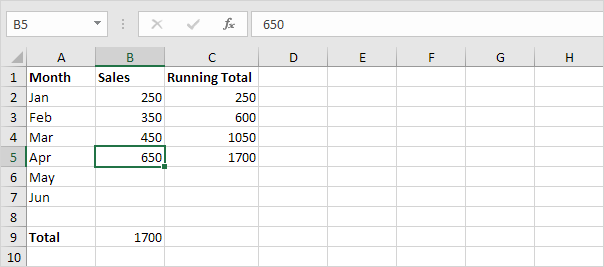
7. Enter the sales in April.
Post navigation

Previous Post:

VLOOKUP without #N/A error in Excel

Next Post:

Manipulating text strings using Left, Mid, Right, Len, Substitute in Excel

Leave a Reply Cancel reply

Your email address will not be published. Required fields are marked *

Learn Basic Excel

Ribbon
Workbook
Worksheets
Format Cells
Find & Select
Sort & Filter
Templates
Print
Share
Protect
Keyboard Shortcuts

Categories

  • Charts
  • Data Analysis
  • Data Validation
  • Excel Functions
    • Cube Functions
    • Database Functions
    • Date and Time Functions
    • Engineering Functions
    • Financial Functions
    • Information Functions
    • Logical Functions
    • Lookup and Reference Functions
    • Math and Trig Functions
    • Statistical Functions
    • Text Functions
    • Web Functions
  • Excel VBA
  • Excel Video Tutorials
  • Formatting
  • Grouping
  • Others

Logical Functions

  • Invoice status with nested if in Excel
  • IF with boolean logic in Excel
  • How to use Excel AND Function
  • How to use IFS function in Excel
  • How to use Excel TRUE Function

Date Time

  • Get first day of month in Excel
  • Convert Excel time to decimal hours in Excel
  • NETWORKDAYS.INTL function: Description, Usage, Syntax, Examples and Explanation
  • How to calculate nth day of year in Excel
  • Get days, months, and years between dates in Excel

Grouping

  • Group numbers with VLOOKUP in Excel
  • Group arbitrary text values in Excel
  • Running count group by n size in Excel
  • Map inputs to arbitrary values in Excel
  • Group times into 3 hour buckets in Excel

General

  • How to increase by percentage in Excel
  • Currency vs Accounting Format in Excel
  • Subtotal by invoice number in Excel
  • How to calculate percentage of total in Excel
  • Subtotal invoices by age in Excel
© 2025 xlsoffice . All Right Reserved. | Teal Smiles | Abbreviations And Their Meaning