
Skip to content
Free Excel Tutorials
  • Home
  • Excel For Beginners
  • Excel Intermediate
  • Advanced Excel For Experts

Data Analysis

  • How To Create Pareto Chart in Excel
  • Move chart to a separate worksheet in Excel
  • How to sum a total in multiple Excel tables
  • Conditional Formatting Color Scales Examples in Excel
  • Conditional Formatting New Rule with Formulas in Excel

References

  • Count rows with at least n matching values
  • How to use Excel INDIRECT Function
  • Extract data with helper column in Excel
  • Offset in Excel
  • Count rows that contain specific values in Excel

Data Validations

  • Excel Data validation must contain specific text
  • Excel Data validation allow weekday only
  • Excel Data validation must not contain
  • Excel Data validation date in specific year
  • Excel Data validation don’t exceed total

Find missing values in Excel

by

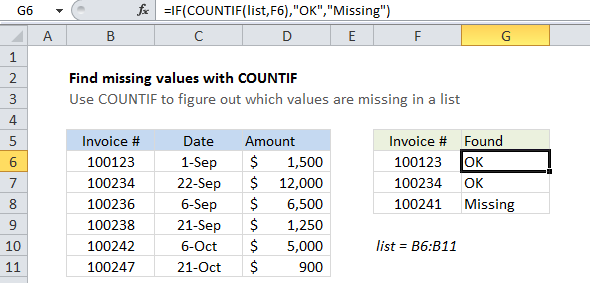
This tutorial shows how to Find missing values in Excel using the example below;

Formula

=IF(COUNTIF(list,value),"OK","Missing")
Explanation

If you want to find out what values in one list are missing from another list, you can use a  simple formula based on the COUNTIF function.

The COUNTIF function counts cells that meet supplied criteria, returning the number of occurrences found. If no cells that meet criteria are found, COUNTIF returns zero. You can use behavior directly inside an IF statement to identify values that have a zero count (i.e. values that are missing).

In the example shown, the formula in G6 is:

=IF(COUNTIF(list,F6),"OK","Missing")

where “list” is a named range that corresponds to the range B6:B11.

The IF function requires a logical test to return TRUE or FALSE. In this case, if a value is found, a positive number is returned by COUNTIF, which evaluates to TRUE, causing IF to return “OK”. If no value is found, zero is returned, which evaluates to FALSE, and IF returns “Missing”.

Alternative with MATCH

You can also test for missing values using the MATCH function. MATCH finds the position of an item in a list and will return the #N/A error when a value is not found. You can use this behavior to build a formula that returns “Missing” or “OK” by testting the result of MATCH using another function called ISNA. ISNA returns true only when it receives the #N/A error.

To use MATCH as shown in the example above, the formula is:

=IF(ISNA(MATCH(F6,list,0)),"Missing","OK")

Post navigation

Previous Post:

COSH function: Description, Usage, Syntax, Examples and Explanation

Next Post:

Excel Data validation require unique number

Leave a Reply Cancel reply

Your email address will not be published. Required fields are marked *

Learn Basic Excel

Ribbon
Workbook
Worksheets
Format Cells
Find & Select
Sort & Filter
Templates
Print
Share
Protect
Keyboard Shortcuts

Categories

  • Charts
  • Data Analysis
  • Data Validation
  • Excel Functions
    • Cube Functions
    • Database Functions
    • Date and Time Functions
    • Engineering Functions
    • Financial Functions
    • Information Functions
    • Logical Functions
    • Lookup and Reference Functions
    • Math and Trig Functions
    • Statistical Functions
    • Text Functions
    • Web Functions
  • Excel VBA
  • Excel Video Tutorials
  • Formatting
  • Grouping
  • Others

Logical Functions

  • How to use Excel XOR Function
  • How to use Excel OR Function
  • How to return blank in place of #DIV/0! error in Excel
  • SWITCH function example in Excel
  • Complete List of Excel Logical Functions, References and Examples

Date Time

  • Find Last Day of the Month in Excel
  • MONTH function: Description, Usage, Syntax, Examples and Explanation
  • How to get number of days, weeks, months or years between two dates in Excel
  • Get work hours between dates custom schedule in Excel
  • Get month name from date in Excel

Grouping

  • Running count group by n size in Excel
  • Group numbers at uneven intervals in Excel
  • Calculate conditional mode with criteria in Excel
  • Group times into unequal buckets in Excel
  • Map inputs to arbitrary values in Excel

General

  • Index and match on multiple columns in Excel
  • How to create dynamic worksheet reference in Excel
  • How to set or clear a print area in Excel Worksheet
  • Currency vs Accounting Format in Excel
  • How to create dynamic named range with INDEX in Excel
© 2026 xlsoffice . All Right Reserved. | Teal Smiles | Abbreviations And Their Meaning