
Skip to content
Free Excel Tutorials
  • Home
  • Excel For Beginners
  • Excel Intermediate
  • Advanced Excel For Experts

Data Analysis

  • Use Data Form to input, edit and delete records in Excel
  • Understanding Anova in Excel
  • How to count table rows in Excel
  • Understanding Pivot Tables in Excel
  • How to add Trendline to a chart in Excel

References

  • Find closest match in Excel
  • To count total rows in a range in Excel
  • How to reference named range different sheet in Excel
  • Get nth match with INDEX / MATCH in Excel
  • How to calculate two-way lookup VLOOKUP in Excel Table

Data Validations

  • Excel Data validation must contain specific text
  • Excel Data validation exists in list
  • Excel Data validation only dates between
  • How To Create Drop-down List in Excel
  • Excel Data validation unique values only

How to count specific words in a cell in Excel

by

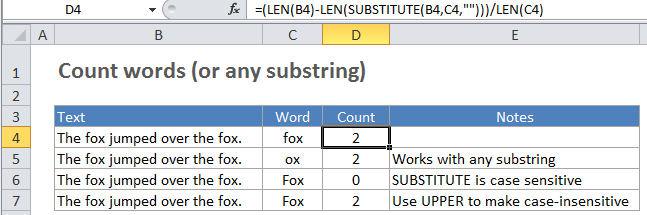
If you need to count how many times a specific a word (or any substring) appears inside a cell, you can use a formula that uses SUBSTITUTE and LEN.

Formula

=(LEN(text)-LEN(SUBSTITUTE(text,word,"")))/LEN(word)
Explanation

In our example, we are using this formula:

=(LEN(B4)-LEN(SUBSTITUTE(B4,C4,"")))/LEN(C4)

How this formula works

B4 is the cell we’re counting words in, and C4 contains the substring (word or any substring) you are counting.

SUBSTITUTE removes the substring from the original text and LEN calculates the length of the text without the substring. This number is then subtracted from the length of the original text. The result is the number of characters that were removed by SUBSTITUTE.

Finally, the number of characters removed is divided by the length of the substring. So, if a substring is 5 characters long, and there are 10 characters missing after it’s been removed from the original text, we know the substring appeared twice in the original text.

Handling problems

Counting words in Excel is tricky because Excel doesn’t support regular expressions. As a result, it’s difficult to build matches that target the words you want to count exactly, while ignoring substrings and other partial matches (look for “fox ” to avoid “foxes”). Punctuation and case variations make this problem quite challenging.

One workaround is to use another formula in a helper column to “normalize text” as a first step. Then use the formula on this page to count words wrapped in space characters to get an accurate count (i.e. you can look for ” fox ” in the normalized text.

Note: this approach is only as good as the normalized text you are able to create, and you might need to adjust the normalizing formula many times to get the result you need.

Handling case

SUBSTITUTE is a case-sensitive function, so it will match case when running a substitution. If you need to count both upper and lower case occurrences of a word or substring, use the UPPER function inside SUBSTITUTE to convert the text to uppercase before running the substitution:

=(LEN(B4)-LEN(SUBSTITUTE(UPPER(B4),UPPER(C4),"")))/LEN(C4)

Because this formula converts the substring and the text to uppercase before performing the substitution, it will work equally well with text in any case.

Post navigation

Next Post:

Create One-dimensional and Two-dimensional Array

Leave a Reply Cancel reply

Your email address will not be published. Required fields are marked *

Learn Basic Excel

Ribbon
Workbook
Worksheets
Format Cells
Find & Select
Sort & Filter
Templates
Print
Share
Protect
Keyboard Shortcuts

Categories

  • Charts
  • Data Analysis
  • Data Validation
  • Excel Functions
    • Cube Functions
    • Database Functions
    • Date and Time Functions
    • Engineering Functions
    • Financial Functions
    • Information Functions
    • Logical Functions
    • Lookup and Reference Functions
    • Math and Trig Functions
    • Statistical Functions
    • Text Functions
    • Web Functions
  • Excel VBA
  • Excel Video Tutorials
  • Formatting
  • Grouping
  • Others

Logical Functions

  • Excel If, Nested If, And/Or Criteria Examples
  • XOR function: Description, Usage, Syntax, Examples and Explanation
  • Not Equal To ‘<>‘ operator in Excel
  • IF with wildcards in Excel
  • How to use Excel NOT Function

Date Time

  • Add years to date in Excel
  • Display Date is workday in Excel
  • How to determine year is a leap year in Excel
  • WORKDAY.INTL function: Description, Usage, Syntax, Examples and Explanation
  • How to join date and text together in Excel

Grouping

  • Group numbers with VLOOKUP in Excel
  • How to randomly assign people to groups in Excel
  • Map inputs to arbitrary values in Excel
  • Calculate conditional mode with criteria in Excel
  • How to randomly assign data to groups in Excel

General

  • Basic error trapping example in Excel
  • Find Most Frequently Occurring Word in Excel Worksheet
  • Using Existing Templates in Excel
  • How to get random value from list or table in Excel
  • Check if multiple cells have same value in Excel
© 2026 xlsoffice . All Right Reserved. | Teal Smiles | Abbreviations And Their Meaning