
Skip to content
Free Excel Tutorials
  • Home
  • Excel For Beginners
  • Excel Intermediate
  • Advanced Excel For Experts

Data Analysis

  • How to create a Histogram in Excel
  • How to sum a total in multiple Excel tables
  • Everything about Charts in Excel
  • How to create Gauge Chart in Excel
  • How to count table rows in Excel

References

  • How to calculate two-way lookup VLOOKUP in Excel Table
  • Convert text string to valid reference in Excel using Indirect function
  • Count rows with at least n matching values
  • Lookup entire row in Excel
  • How to use Excel MMULT Function

Data Validations

  • Excel Data validation require unique number
  • Excel Data validation unique values only
  • Excel Data validation allow uppercase only
  • Prevent invalid data entering in specific cells
  • Excel Data validation must not contain

How to get last row in mixed data with no blanks in Excel

by

To get the last relative position (i.e. last row, last column) for mixed data that contains no empty cells, you can use the COUNTA function. See example below:

Formula

=COUNTA(range)
Explanation

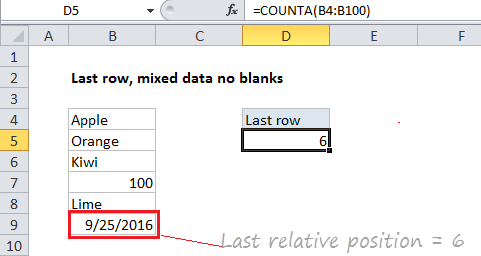
In the example shown, the formula in D5 is:

=COUNTA(B4:B100)

Last *relative* position

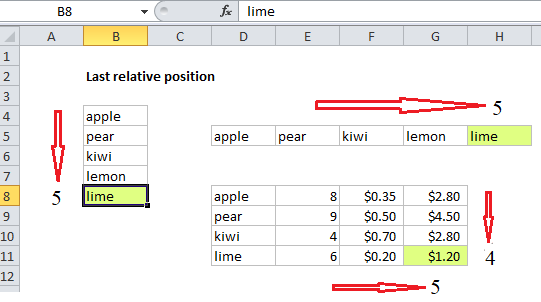
When constructing more advanced formulas, it’s often necessary to figure out the last location of data in a list. Depending on the data, this could be the last row with data, the last column with data, or the intersection of both. It’s important to understand that we are after the last *relative position* inside a given range not the row number on the worksheet:
How this formula works

This formula uses the COUNTA function to count values in a range. COUNTA counts both numbers and text to so works well with mixed data.

The range B4:B8 contains 5 values, so COUNTA returns 5. The number 5 corresponds to the last row (last relative position) of data in the range B4:B100.

Note: This approach will fail if the range contains blank/empty cells.

Post navigation

Previous Post:

How to calculate project complete percentage in Excel

Next Post:

Popularly Used Excel Functions and their examples

Leave a Reply Cancel reply

Your email address will not be published. Required fields are marked *

Learn Basic Excel

Ribbon
Workbook
Worksheets
Format Cells
Find & Select
Sort & Filter
Templates
Print
Share
Protect
Keyboard Shortcuts

Categories

  • Charts
  • Data Analysis
  • Data Validation
  • Excel Functions
    • Cube Functions
    • Database Functions
    • Date and Time Functions
    • Engineering Functions
    • Financial Functions
    • Information Functions
    • Logical Functions
    • Lookup and Reference Functions
    • Math and Trig Functions
    • Statistical Functions
    • Text Functions
    • Web Functions
  • Excel VBA
  • Excel Video Tutorials
  • Formatting
  • Grouping
  • Others

Logical Functions

  • FALSE function: Description, Usage, Syntax, Examples and Explanation
  • How to use Excel XOR Function
  • How to use Excel OR Function
  • How to return blank in place of #DIV/0! error in Excel
  • IFNA function: Description, Usage, Syntax, Examples and Explanation

Date Time

  • Steps to create Dynamic calendar grid in Excel
  • Two ways to sum time over 30 minutes in Excel
  • Create date range from two dates in Excel
  • WORKDAY function: Description, Usage, Syntax, Examples and Explanation
  • Get days between dates in Excel

Grouping

  • Group times into 3 hour buckets in Excel
  • Calculate conditional mode with criteria in Excel
  • Categorize text with keywords in Excel
  • How to randomly assign data to groups in Excel
  • Map inputs to arbitrary values in Excel

General

  • Currency vs Accounting Format in Excel
  • Creating and Opening an existing file in Excel
  • How to add sequential row numbers to a set of data in Excel
  • Create dynamic workbook reference to another workbook in Excel
  • Subtotal by color in Excel
© 2026 xlsoffice . All Right Reserved. | Teal Smiles | Abbreviations And Their Meaning