
Skip to content
Free Excel Tutorials
  • Home
  • Excel For Beginners
  • Excel Intermediate
  • Advanced Excel For Experts

Data Analysis

  • How to do a t-Test in Excel?
  • How to calculate correlation coefficient Correlation in Excel
  • Conditional Formatting New Rule with Formulas in Excel
  • How to Create Gantt Chart in Excel
  • Calculate Conditional Percentile ‘IF’ in table in Excel

References

  • How to create dynamic named range with OFFSET in Excel
  • To count total rows in a range in Excel
  • Perform case-sensitive Lookup in Excel
  • Two-column Lookup in Excel
  • How to use Excel OFFSET function

Data Validations

  • Excel Data validation don’t exceed total
  • Prevent invalid data entering in specific cells
  • Excel Data validation allow weekday only
  • Excel Data validation unique values only
  • Excel Data validation date in next 30 days

Compound Annual Growth Rate CAGR formula examples in Excel

by

To calculate Compound Annual Growth Rate (CAGR) in Excel, the average rate of return for an investment over a period of time, you can use several approaches.

Formula

=(end/start)^(1/periods)-1
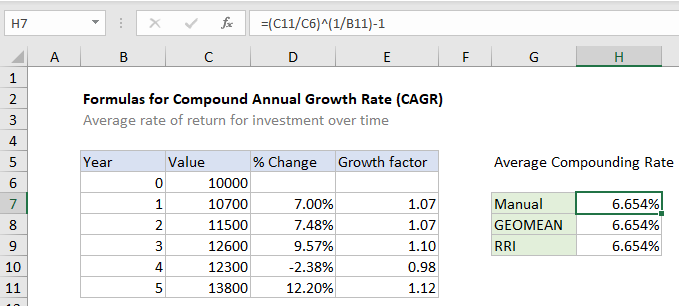

Note that unlike most other financial functions in Excel, future value (FV) does not need to be entered as a negative number.

Explanation

In the example shown, the formula in H7 is:

=(C11/C6)^(1/B11)-1

CAGR with a manual formula

CAGR stands for Compound Annual Growth Rate, which is the annual average rate of return for an investment over a period of time. The formula for calculating CAGR manually is:

=(end/start)^(1/periods)-1

The first part of the formula is a measure of total return, the second part of the formula annualizes the return over the life of the investment. The formula in H7 is:

=(C11/C6)^(1/B11)-1

where C11 is the ending value in year 5, C6 is the starting value or initial investment, and B11 is the total number of periods.

CAGR with the GEOMEAN function

The GEOMEAN calculates geometric mean, and can be used to calculate CAGR. To calculate CAGR with GEOMEAN, we need to use relative changes (percentage change + 1), sometimes called a growth factor. We have these values already in column E so we can use them directly in GEOMEAN the function. The formula in H8 is:

=GEOMEAN(E7:E11)-1

CAGR with the RRI function

In Excel 2013 and later, you can use the IRR function to calculate CAGR with a simple formula. The formula in H9 is:

=RRI(B11,C6,C11)

Post navigation

Previous Post:

DECIMAL function: Description, Usage, Syntax, Examples and Explanation

Next Post:

AVERAGE function: Description, Usage, Syntax, Examples and Explanation

Leave a Reply Cancel reply

Your email address will not be published. Required fields are marked *

Learn Basic Excel

Ribbon
Workbook
Worksheets
Format Cells
Find & Select
Sort & Filter
Templates
Print
Share
Protect
Keyboard Shortcuts

Categories

  • Charts
  • Data Analysis
  • Data Validation
  • Excel Functions
    • Cube Functions
    • Database Functions
    • Date and Time Functions
    • Engineering Functions
    • Financial Functions
    • Information Functions
    • Logical Functions
    • Lookup and Reference Functions
    • Math and Trig Functions
    • Statistical Functions
    • Text Functions
    • Web Functions
  • Excel VBA
  • Excel Video Tutorials
  • Formatting
  • Grouping
  • Others

Logical Functions

  • How to use Excel XOR Function
  • IF with wildcards in Excel
  • How to use IFS function in Excel
  • Invoice status with nested if in Excel
  • IF with boolean logic in Excel

Date Time

  • Get fiscal year from date in Excel
  • Get date from day number in Excel
  • Calculate number of hours between two times in Excel
  • Basic timesheet formula with breaks in Excel
  • WORKDAY.INTL function: Description, Usage, Syntax, Examples and Explanation

Grouping

  • Running count group by n size in Excel
  • Categorize text with keywords in Excel
  • Map text to numbers in Excel
  • How to randomly assign data to groups in Excel
  • How to randomly assign people to groups in Excel

General

  • Split Cell Content Using Text to Columns in Excel
  • 3D SUMIF for multiple worksheets in Excel
  • Creating and Opening an existing file in Excel
  • How to test a range for numbers in Excel
  • Index and match on multiple columns in Excel
© 2026 xlsoffice . All Right Reserved. | Teal Smiles | Abbreviations And Their Meaning