
Skip to content
Free Excel Tutorials
  • Home
  • Excel For Beginners
  • Excel Intermediate
  • Advanced Excel For Experts

Data Analysis

  • How to count table rows in Excel
  • Conditional Formatting Color Scales Examples in Excel
  • How To Sort One Column or Multiple Columns in Excel
  • How to calculate correlation coefficient Correlation in Excel
  • How to conditionally sum numeric data in an Excel table using SUMIFS

References

  • How to get relative row numbers in a range in Excel
  • How to use Excel MMULT Function
  • Perform case-sensitive Lookup in Excel
  • Count rows that contain specific values in Excel
  • How to get address of first cell in range in Excel

Data Validations

  • Excel Data validation no punctuation
  • Excel Data validation whole percentage only
  • Excel Data validation allow uppercase only
  • Excel Data validation only dates between
  • Excel Data validation allow weekday only

Use Data Form to input, edit and delete records in Excel

by

The data form in Excel allows you to add, edit and delete records (rows) and display only those records that meet certain criteria. Especially when you have wide rows and you want to avoid repeated scrolling to the right and left, the data form can be useful.

1. Open the downloadable Excel file.
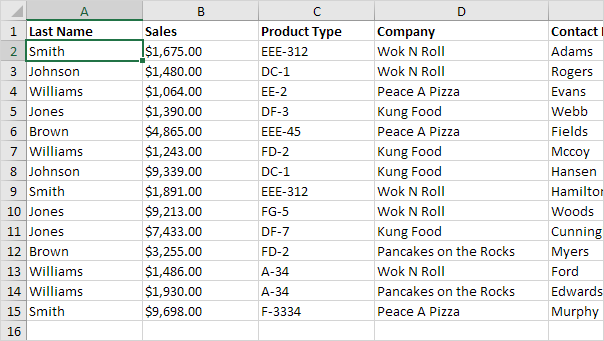
2. Add the Form command to the Quick Access Toolbar.

3. Click the Form command.

4. Use the Find Prev and Find Next buttons to easily switch from one record (row) to another.
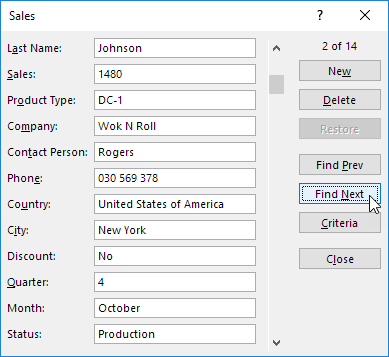
Note: use the New or Delete button to add or delete records. Once you start editing a record, you can use the Restore button to undo any changes you make.

5. To display only those records that meet certain criteria, click the Criteria button.

6. Enter the criteria and click the Form button.
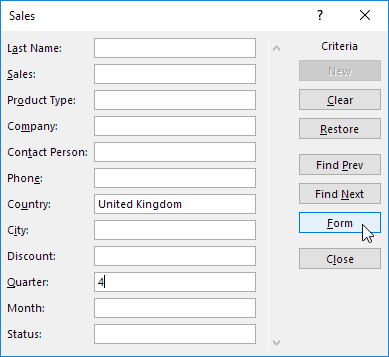
7. Now, when you use the Find Prev and Find Next buttons, you will only see those records that meet these criteria. In our example, only record 13.
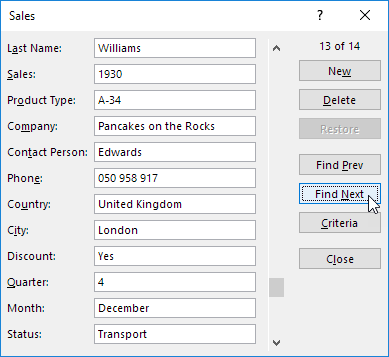
Note: to edit the criteria, click the Criteria button again. To close the data form, click the Close button.

Post navigation

Previous Post:

COSH function: Description, Usage, Syntax, Examples and Explanation

Next Post:

Excel Data validation require unique number

Leave a Reply Cancel reply

Your email address will not be published. Required fields are marked *

Learn Basic Excel

Ribbon
Workbook
Worksheets
Format Cells
Find & Select
Sort & Filter
Templates
Print
Share
Protect
Keyboard Shortcuts

Categories

  • Charts
  • Data Analysis
  • Data Validation
  • Excel Functions
    • Cube Functions
    • Database Functions
    • Date and Time Functions
    • Engineering Functions
    • Financial Functions
    • Information Functions
    • Logical Functions
    • Lookup and Reference Functions
    • Math and Trig Functions
    • Statistical Functions
    • Text Functions
    • Web Functions
  • Excel VBA
  • Excel Video Tutorials
  • Formatting
  • Grouping
  • Others

Logical Functions

  • FALSE function: Description, Usage, Syntax, Examples and Explanation
  • How to return blank in place of #DIV/0! error in Excel
  • IF function: Description, Usage, Syntax, Examples and Explanation
  • Nested IF function example in Excel
  • How to use Excel NOT Function

Date Time

  • WORKDAY.INTL function: Description, Usage, Syntax, Examples and Explanation
  • How to calculate nth day of year in Excel
  • Add workdays to date custom weekends in Excel
  • Add business days to date in Excel
  • MINUTE function: Description, Usage, Syntax, Examples and Explanation

Grouping

  • If cell contains one of many things in Excel
  • Calculate conditional mode with criteria in Excel
  • Map inputs to arbitrary values in Excel
  • Group numbers at uneven intervals in Excel
  • How to randomly assign people to groups in Excel

General

  • Print Excel Sheet In Landscape Or Portrait
  • Mark Workbook as Final in Excel
  • How to get original price from percentage discount in Excel
  • Subtotal invoices by age in Excel
  • How to add sequential row numbers to a set of data in Excel
© 2026 xlsoffice . All Right Reserved. | Teal Smiles | Abbreviations And Their Meaning