

Skip to content
Free Excel Tutorials
  • Home
  • Excel For Beginners
  • Excel Intermediate
  • Advanced Excel For Experts

Data Analysis

  • Excel Line Chart
  • Get column name from index in Excel Table
  • Calculate Conditional Percentile ‘IF’ in table in Excel
  • Get column index in Excel Table
  • How to conditionally sum numeric data in an Excel table using SUMIFS

References

  • How to create dynamic named range with OFFSET in Excel
  • How to get address of first cell in range in Excel
  • INDEX function: Description, Usage, Syntax, Examples and Explanation
  • How to get last row in mixed data with blanks in Excel
  • Multi-criteria lookup and transpose in Excel

Data Validations

  • Excel Data validation must begin with
  • Excel Data validation allow weekday only
  • Data validation must not exist in list
  • Excel Data validation require unique number
  • Excel Data validation allow uppercase only

Understanding Pivot Tables in Excel

by

How to insert pivot table / pivot chart in excel?

  • Insert a Pivot Table
  • Drag fields
  • Sort and Filter
  • Change Summary Calculation
  • Two-dimensional Pivot Table

Pivot tables are one of Excel’s most powerful features. A pivot table allows you to extract the significance from a large, detailed data set.

Our data set consists of 213 records and 6 fields. Order ID, Product, Category, Amount, Date and Country.
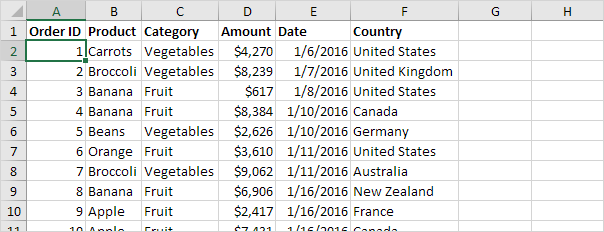
Insert a Pivot Table

To insert a pivot table, execute the following steps.

1. Click any single cell inside the data set.

2. On the Insert tab, in the Tables group, click PivotTable.
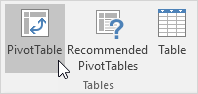
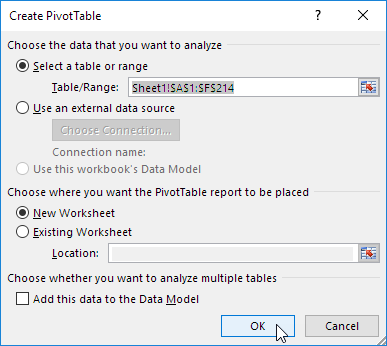
The following dialog box appears. Excel automatically selects the data for you. The default location for a new pivot table is New Worksheet.

3. Click OK.
Drag fields

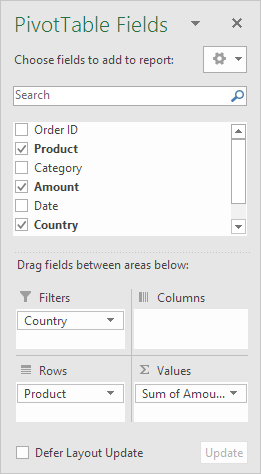
The PivotTable Fields pane appears. To get the total amount exported of each product, drag the following fields to the different areas.

1. Product field to the Rows area.

2. Amount field to the Values area.

3. Country field to the Filters area.
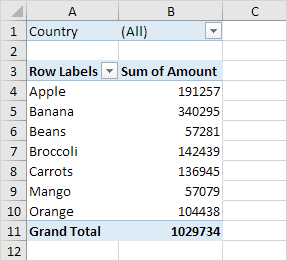
Below you can find the pivot table. Bananas are our main export product. That’s how easy pivot tables can be!
Sort

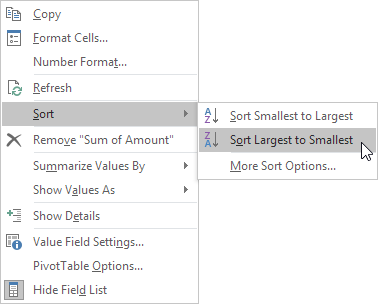
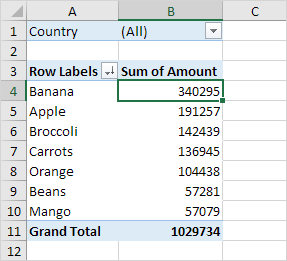
To get Banana at the top of the list, sort the pivot table.

1. Click any cell inside the Sum of Amount column.

2. Right click and click on Sort, Sort Largest to Smallest.
Result.
Filter

Because we added the Country field to the Filters area, we can filter this pivot table by Country. For example, which products do we export the most to France?

1. Click the filter drop-down and select France.

Result. Apples are our main export product to France.

Note: you can use the standard filter (triangle next to Row Labels) to only show the amounts of specific products.

Change Summary Calculation

By default, Excel summarizes your data by either summing or counting the items. To change the type of calculation that you want to use, execute the following steps.

1. Click any cell inside the Sum of Amount column.

2. Right click and click on Value Field Settings.
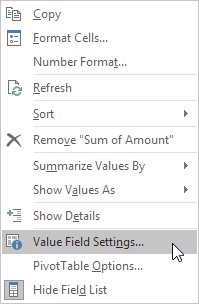
3. Choose the type of calculation you want to use. For example, click Count.
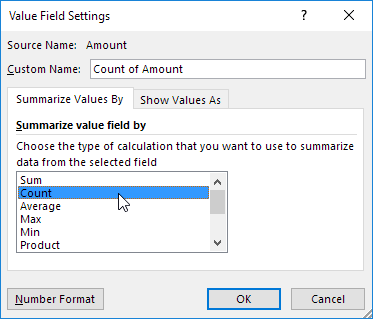
4. Click OK.

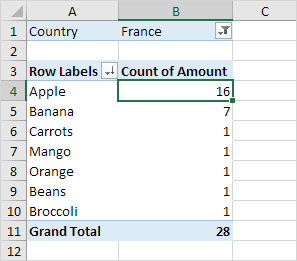
Result. 16 out of the 28 orders to France were ‘Apple’ orders.
Two-dimensional Pivot Table

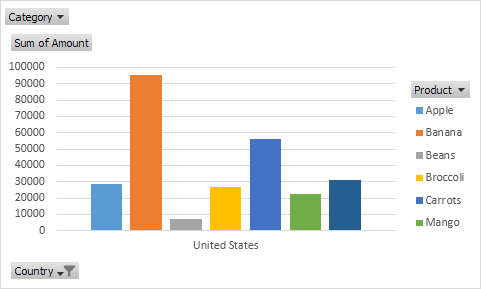
If you drag a field to the Rows area and Columns area, you can create a two-dimensional pivot table. First, insert a pivot table. Next, to get the total amount exported to each country, of each product, drag the following fields to the different areas.

1. Country field to the Rows area.

2. Product field to the Columns area.

3. Amount field to the Values area.

4. Category field to the Filters area.
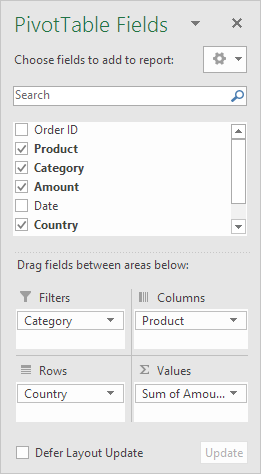
Below you can find the two-dimensional pivot table.
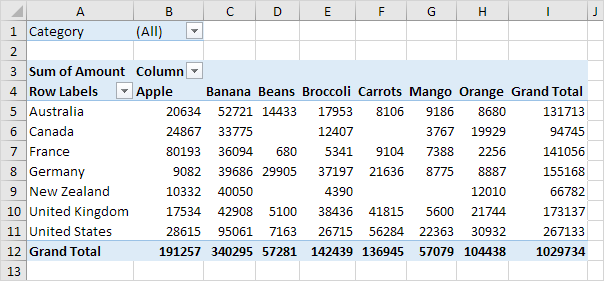
To easily compare these numbers, create a pivot chart and apply a filter. Maybe this is one step too far for you at this stage, but it shows you one of the many other powerful pivot table features Excel has to offer.
Post navigation

Previous Post:

TRUE function: Description, Usage, Syntax, Examples and Explanation

Next Post:

Excel Pie Chart

Leave a Reply Cancel reply

Your email address will not be published. Required fields are marked *

Learn Basic Excel

Ribbon
Workbook
Worksheets
Format Cells
Find & Select
Sort & Filter
Templates
Print
Share
Protect
Keyboard Shortcuts

Categories

  • Charts
  • Data Analysis
  • Data Validation
  • Excel Functions
    • Cube Functions
    • Database Functions
    • Date and Time Functions
    • Engineering Functions
    • Financial Functions
    • Information Functions
    • Logical Functions
    • Lookup and Reference Functions
    • Math and Trig Functions
    • Statistical Functions
    • Text Functions
    • Web Functions
  • Excel VBA
  • Excel Video Tutorials
  • Formatting
  • Grouping
  • Others

Logical Functions

  • Not Equal To ‘<>‘ operator in Excel
  • How to return blank in place of #DIV/0! error in Excel
  • IFERROR function: Description, Usage, Syntax, Examples and Explanation
  • How to use Excel NOT Function
  • IFS function: Description, Usage, Syntax, Examples and Explanation

Date Time

  • Get date from day number in Excel
  • Excel Date & Time Functions Example
  • How to show last updated date stamp in Excel
  • How to calculate next scheduled event in Excel
  • Display the current date and time in Excel

Grouping

  • Running count group by n size in Excel
  • Group times into 3 hour buckets in Excel
  • Map inputs to arbitrary values in Excel
  • Group numbers with VLOOKUP in Excel
  • How to randomly assign data to groups in Excel

General

  • How to get random value from list or table in Excel
  • How to calculate total from percentage in Excel
  • How to count total number of cells in a rectangular range in Excel
  • Find, Trace and Correct Errors in Excel Formulas using ‘Formula Auditing’
  • How to count total columns in range in Excel
© 2025 xlsoffice . All Right Reserved. | Teal Smiles | Abbreviations And Their Meaning