
Skip to content
Free Excel Tutorials
  • Home
  • Excel For Beginners
  • Excel Intermediate
  • Advanced Excel For Experts

Data Analysis

  • How To Filter Data in Excel
  • Create Scatter Chart in Excel
  • How to Create One and Two Variable Data Tables in Excel
  • How to Use Solver Tool in Excel
  • Conditional Formatting Rules in Excel

References

  • Count rows with at least n matching values
  • How to get relative column numbers in a range in Excel
  • How to get relative row numbers in a range in Excel
  • How to get address of named range in Excel
  • Complete List of Excel Lookup and Reference Functions, References and Examples

Data Validations

  • Excel Data validation must not contain
  • Excel Data validation allow uppercase only
  • Excel Data validation exists in list
  • Excel Data validation only dates between
  • Excel Data validation allow weekday only

Conflicting Multiple Conditional Formatting Rules in Excel

by

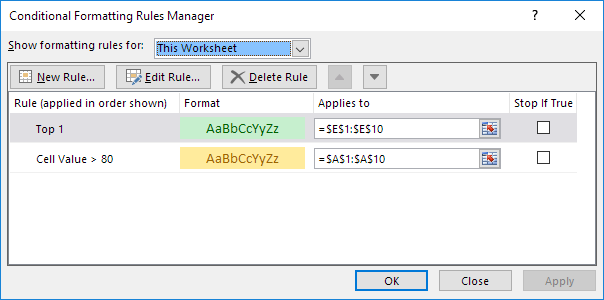
A higher rule always wins when working with  multiple conditional formatting rules in Excel . This example illustrates two different results.

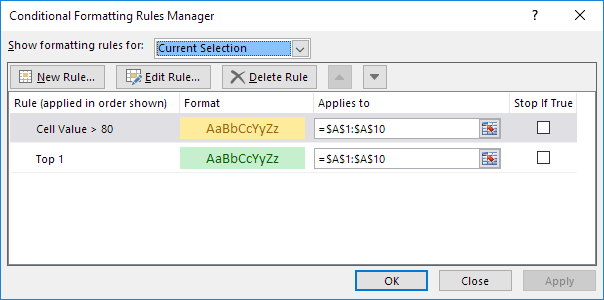
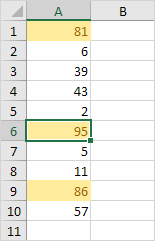
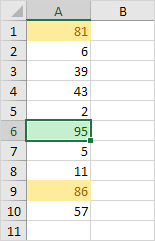
1. The value 95 is higher than 80 but is also the highest value (Top 1). The formats (yellow fill vs green fill and yellow text color vs green text color) conflict. A higher rule always wins. As a result, the value 95 is colored yellow.

Result:
2. Move the second rule up. The value 95 is the highest value (Top 1) but is also higher than 80. The formats (green fill vs yellow fill and green text color vs yellow text color) conflict. A higher rule always wins. As a result, the value 95 is colored green.
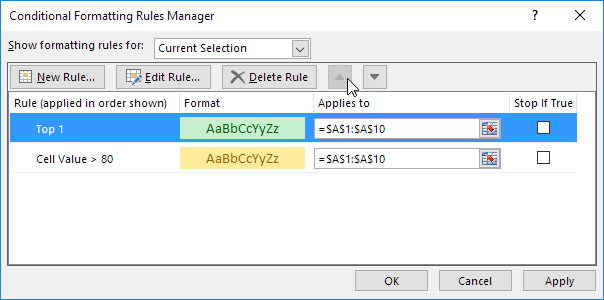
Result:
Note: only use the Stop If True check boxes for backwards compatibility with earlier versions of Microsoft Excel.

Post navigation

Previous Post:

VLOOKUP without #N/A error in Excel

Next Post:

Manipulating text strings using Left, Mid, Right, Len, Substitute in Excel

Leave a Reply Cancel reply

Your email address will not be published. Required fields are marked *

Learn Basic Excel

Ribbon
Workbook
Worksheets
Format Cells
Find & Select
Sort & Filter
Templates
Print
Share
Protect
Keyboard Shortcuts

Categories

  • Charts
  • Data Analysis
  • Data Validation
  • Excel Functions
    • Cube Functions
    • Database Functions
    • Date and Time Functions
    • Engineering Functions
    • Financial Functions
    • Information Functions
    • Logical Functions
    • Lookup and Reference Functions
    • Math and Trig Functions
    • Statistical Functions
    • Text Functions
    • Web Functions
  • Excel VBA
  • Excel Video Tutorials
  • Formatting
  • Grouping
  • Others

Logical Functions

  • Not Equal To ‘<>‘ operator in Excel
  • How to return blank in place of #DIV/0! error in Excel
  • TRUE function: Description, Usage, Syntax, Examples and Explanation
  • AND function: Description, Usage, Syntax, Examples and Explanation
  • FALSE function: Description, Usage, Syntax, Examples and Explanation

Date Time

  • ISOWEEKNUM function: Description, Usage, Syntax, Examples and Explanation
  • Convert Excel time to Unix time in Excel
  • Add days exclude certain days of week in Excel
  • Convert time to time zone in Excel
  • How to get year from date in Excel

Grouping

  • Running count group by n size in Excel
  • Group numbers at uneven intervals in Excel
  • How to randomly assign people to groups in Excel
  • Group numbers with VLOOKUP in Excel
  • How to randomly assign data to groups in Excel

General

  • With vs Without Array Formula in Excel
  • How to generate random times at specific intervals in Excel
  • Count cells that do not contain errors in Excel
  • How to create dynamic worksheet reference in Excel
  • Customize Ribbon In Excel
© 2026 xlsoffice . All Right Reserved. | Teal Smiles | Abbreviations And Their Meaning