
Skip to content
Free Excel Tutorials
  • Home
  • Excel For Beginners
  • Excel Intermediate
  • Advanced Excel For Experts

Data Analysis

  • How to combine 2 or more chart types in a single chart in Excel
  • How to count table rows in Excel
  • Chart Axes in Excel
  • Conditional Formatting Data bars Examples in Excel
  • Excel Bar Chart

References

  • How to use Excel OFFSET function
  • Count unique text values with criteria
  • Extract all partial matches in Excel
  • VLOOKUP function: Description, Usage, Syntax, Examples and Explanation
  • Perform case-sensitive Lookup in Excel

Data Validations

  • Excel Data validation only dates between
  • Excel Data validation allow weekday only
  • Excel Data validation must contain specific text
  • Excel Data validation date in next 30 days
  • Excel Data validation must begin with

How to extract domain name from URL in Excel

by

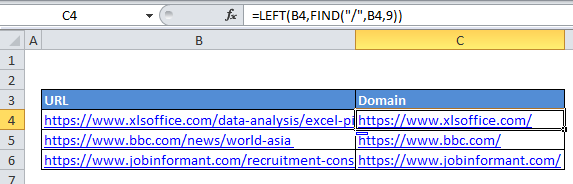
If you want to extract the domain name from a complete URL, you can do so with a formula that uses  the LEFT and FIND functions. See example: In the formula below, url is the the URL you are working with.

Formula

=LEFT(url,FIND("/",url,9))
Explanation

In the example, we are using this formula:

=LEFT(B4,FIND("/",B4,9))

Here’s how the formula works:

B4 contains the URL: “ https://www.xlsoffice.com/data-analysis/excel-pie-chart/”

At the core, this formula is extracting characters from the URL, starting from the left, and using the FIND function to figure out how many characters to extract.

First, FIND locates the “/” character in the URL, starting at the 9th character. This is the “clever” part of the formula. URLs begin with something called a “protocol” which looks like this:

ftp://
sftp://
http://
https://

and so on. By starting at the 9th character, the protocol is skipped, and the FIND function will return the location of the 3rd instance of “/” (the first instance after the double slash in the protocol).

In this case, the third instance of “/” is the 21st character in the URL, so FIND returns the number 21.

The LEFT function then extracts 21 characters from the URL, starting at the left. The result is the domain name with a trailing slash.

If you want to get the domain name without a trailing slash, just subtract the number 1 from the the result of FIND like so:

=LEFT(B4,FIND("/",B4,9)-1)

Post navigation

Previous Post:

DECIMAL function: Description, Usage, Syntax, Examples and Explanation

Next Post:

AVERAGE function: Description, Usage, Syntax, Examples and Explanation

Leave a Reply Cancel reply

Your email address will not be published. Required fields are marked *

Learn Basic Excel

Ribbon
Workbook
Worksheets
Format Cells
Find & Select
Sort & Filter
Templates
Print
Share
Protect
Keyboard Shortcuts

Categories

  • Charts
  • Data Analysis
  • Data Validation
  • Excel Functions
    • Cube Functions
    • Database Functions
    • Date and Time Functions
    • Engineering Functions
    • Financial Functions
    • Information Functions
    • Logical Functions
    • Lookup and Reference Functions
    • Math and Trig Functions
    • Statistical Functions
    • Text Functions
    • Web Functions
  • Excel VBA
  • Excel Video Tutorials
  • Formatting
  • Grouping
  • Others

Logical Functions

  • How to use Excel NOT Function
  • Return blank if in Excel
  • How to use Excel FALSE Function
  • Nested IF function example in Excel
  • IF with wildcards in Excel

Date Time

  • How to show last updated date stamp in Excel
  • Get first Monday before any date in Excel
  • Series of dates by day
  • DAY function: Description, Usage, Syntax, Examples and Explanation
  • Get last working day in month in Excel

Grouping

  • Calculate conditional mode with criteria in Excel
  • Group numbers at uneven intervals in Excel
  • Map inputs to arbitrary values in Excel
  • Group times into unequal buckets in Excel
  • Map text to numbers in Excel

General

  • Using Existing Templates in Excel
  • Share Excel data with Word documents
  • Find, Select, Replace and Go To Special in Excel
  • Lock Cells in a Worksheet Excel
  • How to fill cell ranges with random number from fixed set of options in Excel
© 2025 xlsoffice . All Right Reserved. | Teal Smiles | Abbreviations And Their Meaning