
Skip to content
Free Excel Tutorials
  • Home
  • Excel For Beginners
  • Excel Intermediate
  • Advanced Excel For Experts

Data Analysis

  • Get column name from index in Excel Table
  • Excel Pie Chart
  • Example of COUNTIFS with variable table column in Excel
  • Conditional Formatting Color Scales Examples in Excel
  • What-If Analysis: Scenarios and Goal Seek in Excel

References

  • How to calculate two-way lookup VLOOKUP in Excel Table
  • How to reference named range different sheet in Excel
  • How to get last row in text data in Excel
  • Find closest match in Excel
  • Lookup entire row in Excel

Data Validations

  • Excel Data validation allow uppercase only
  • Excel Data validation must not contain
  • Excel Data validation exists in list
  • Excel Data validation no punctuation
  • Excel Data validation number multiple 100

Split Worksheet Window in Excel

by

To view multiple distant parts on worksheet at once, you will need to split your worksheet. To split your worksheet (window) into an upper and lower part (pane), execute the following steps.

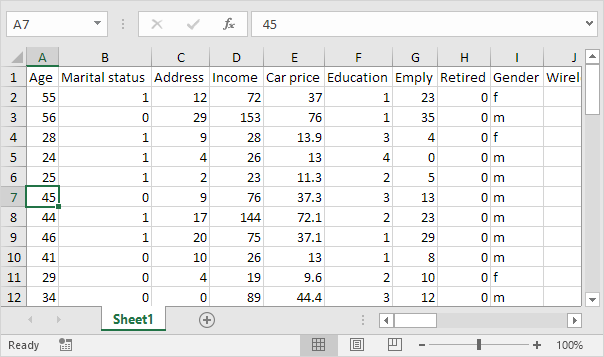
1. First, select a cell in column A.
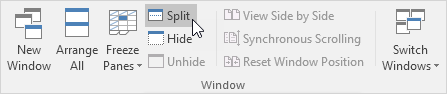
2. On the View tab, in the Window group, click Split.
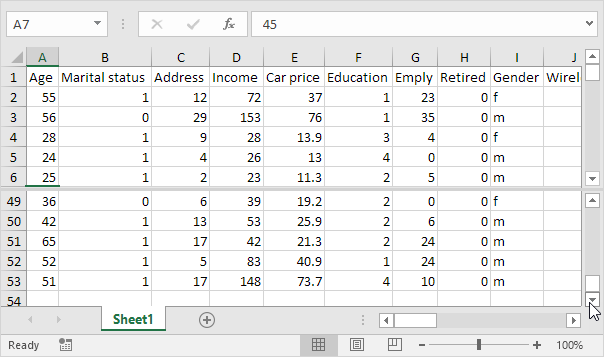
3. Notice the two vertical scroll bars. For example, use the lower vertical scroll bar to move to row 49. As you can see, the first 6 rows remain visible.
4. To change the window layout, use the horizontal split bar that divides the panes.
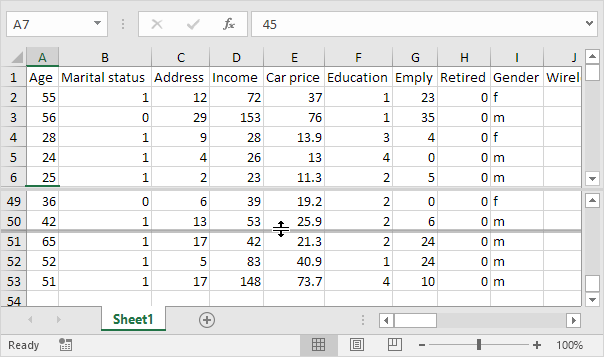
5. To remove the split, simply double click the split bar.

Note: in a similar way, you can split your window into a left and right pane by selecting a cell in row 1 before you click View, Split. You can even split your window into four panes by selecting a cell that is not column A or row 1. Any changes you make to one pane are immediately reflected in the other ones.

Post navigation

Previous Post:

VLOOKUP without #N/A error in Excel

Next Post:

Manipulating text strings using Left, Mid, Right, Len, Substitute in Excel

Leave a Reply Cancel reply

Your email address will not be published. Required fields are marked *

Learn Basic Excel

Ribbon
Workbook
Worksheets
Format Cells
Find & Select
Sort & Filter
Templates
Print
Share
Protect
Keyboard Shortcuts

Categories

  • Charts
  • Data Analysis
  • Data Validation
  • Excel Functions
    • Cube Functions
    • Database Functions
    • Date and Time Functions
    • Engineering Functions
    • Financial Functions
    • Information Functions
    • Logical Functions
    • Lookup and Reference Functions
    • Math and Trig Functions
    • Statistical Functions
    • Text Functions
    • Web Functions
  • Excel VBA
  • Excel Video Tutorials
  • Formatting
  • Grouping
  • Others

Logical Functions

  • TRUE function: Description, Usage, Syntax, Examples and Explanation
  • IF with wildcards in Excel
  • Not Equal To ‘<>‘ operator in Excel
  • XOR function: Description, Usage, Syntax, Examples and Explanation
  • IF function: Description, Usage, Syntax, Examples and Explanation

Date Time

  • TIME function: Description, Usage, Syntax, Examples and Explanation
  • NOW function: Description, Usage, Syntax, Examples and Explanation
  • TODAY function: Description, Usage, Syntax, Examples and Explanation
  • Series of dates by day
  • Count times in a specific range in Excel

Grouping

  • Map text to numbers in Excel
  • If cell contains one of many things in Excel
  • Group numbers at uneven intervals in Excel
  • Calculate conditional mode with criteria in Excel
  • Group numbers with VLOOKUP in Excel

General

  • List worksheet index numbers in Excel
  • Find, Trace and Correct Errors in Excel Formulas using ‘Formula Auditing’
  • Convert column number to letter in Excel
  • 3D SUMIF for multiple worksheets in Excel
  • Automatically fill series of cells in Excel using AutoFill
© 2026 xlsoffice . All Right Reserved. | Teal Smiles | Abbreviations And Their Meaning