
Skip to content
Free Excel Tutorials
  • Home
  • Excel For Beginners
  • Excel Intermediate
  • Advanced Excel For Experts

Data Analysis

  • Add Outline to Data in Excel
  • Conditional Formatting Color Scales Examples in Excel
  • How to sum a total in multiple Excel tables
  • How To Filter Data in Excel
  • Use Data Form to input, edit and delete records in Excel

References

  • Create hyperlink with VLOOKUP in Excel
  • How to create dynamic named range with OFFSET in Excel
  • Convert text string to valid reference in Excel using Indirect function
  • CHOOSE function: Description, Usage, Syntax, Examples and Explanation
  • Approximate match with multiple criteria in Excel

Data Validations

  • Excel Data validation date in next 30 days
  • Prevent invalid data entering in specific cells
  • Excel Data validation require unique number
  • Excel Data validation with conditional list
  • Excel Data validation date in specific year

Print Headers and Footers in Excel

by

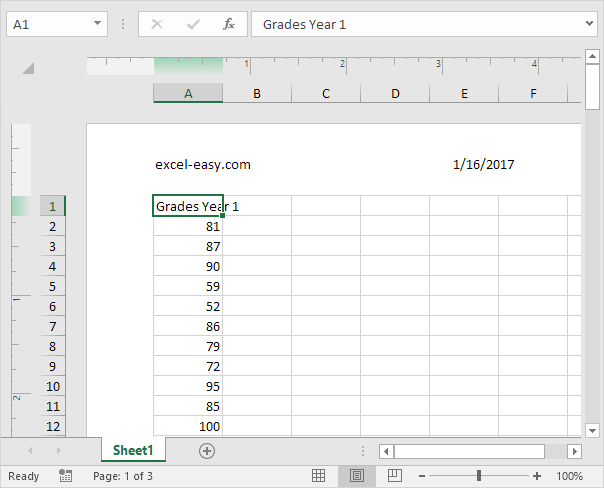
This example teaches you how to add information to the header (top of each printed page) or footer (bottom of each printed page) in Excel.

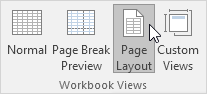
1. On the View tab, in the Workbook Views group, click Page Layout, to switch to Page Layout view.
2. Click Add header.
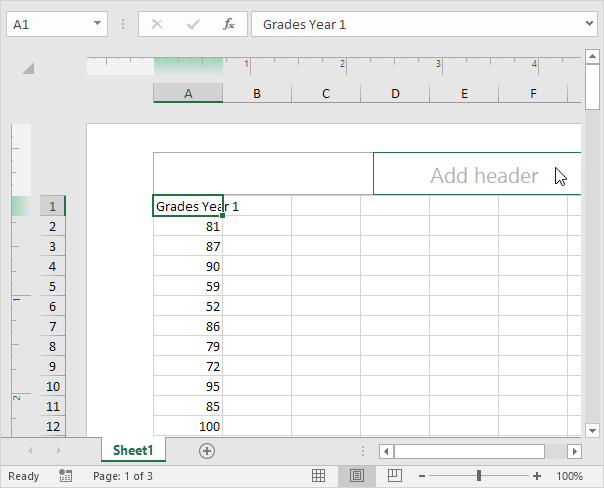
The Header & Footer Tools contextual tab activates.

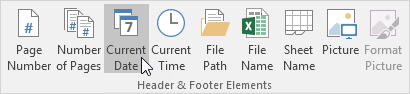
3. On the Design tab, in the Header & Footer Elements group, click Current Date to add the current date (or add the current time, file name, sheet name, etc).
Result:
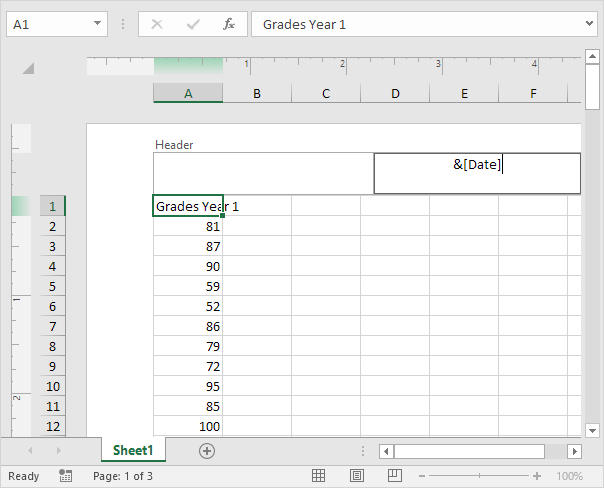
Note: Excel uses codes in order to automatically update the header or footer as you change the workbook.

4. You can also add information to the left and right part of the header. For example, click the left part to add the name of your company.

5. Click somewhere else on the sheet to see the header.
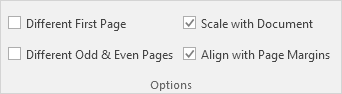
6. On the Design tab, in the Options group, you can add a different first page header/footer and a different header/footer for odd and even pages.
7. On the View tab, in the Workbook Views group, click Normal, to switch back to Normal view.

Post navigation

Previous Post:

VLOOKUP without #N/A error in Excel

Next Post:

Manipulating text strings using Left, Mid, Right, Len, Substitute in Excel

Leave a Reply Cancel reply

Your email address will not be published. Required fields are marked *

Learn Basic Excel

Ribbon
Workbook
Worksheets
Format Cells
Find & Select
Sort & Filter
Templates
Print
Share
Protect
Keyboard Shortcuts

Categories

  • Charts
  • Data Analysis
  • Data Validation
  • Excel Functions
    • Cube Functions
    • Database Functions
    • Date and Time Functions
    • Engineering Functions
    • Financial Functions
    • Information Functions
    • Logical Functions
    • Lookup and Reference Functions
    • Math and Trig Functions
    • Statistical Functions
    • Text Functions
    • Web Functions
  • Excel VBA
  • Excel Video Tutorials
  • Formatting
  • Grouping
  • Others

Logical Functions

  • Extract multiple matches into separate rows in Excel
  • How to use Excel AND Function
  • IF, AND, OR and NOT Functions Examples in Excel
  • How to use Excel TRUE Function
  • Not Equal To ‘<>‘ operator in Excel

Date Time

  • How to calculate project start date based on end date in Excel
  • How to get workdays between dates in Excel
  • Count day of week between dates in Excel
  • Calculate time difference in hours as decimal value in Excel
  • Display the current date in Excel

Grouping

  • Group numbers with VLOOKUP in Excel
  • Group times into unequal buckets in Excel
  • Group times into 3 hour buckets in Excel
  • Categorize text with keywords in Excel
  • Map text to numbers in Excel

General

  • Spell Check in Excel
  • How to create dynamic worksheet reference in Excel
  • Automatically fill series of cells in Excel using AutoFill
  • How to get amount with percentage in Excel
  • How to generate random number weighted probability in Excel
© 2026 xlsoffice . All Right Reserved. | Teal Smiles | Abbreviations And Their Meaning