
Skip to content
Free Excel Tutorials
  • Home
  • Excel For Beginners
  • Excel Intermediate
  • Advanced Excel For Experts

Data Analysis

  • How to create a Histogram in Excel
  • How to Create Gantt Chart in Excel
  • How To Compare Two Lists in Excel
  • How to Create Area Chart in Excel
  • Excel Bar Chart

References

  • Left Lookup in Excel
  • How to get relative column numbers in a range in Excel
  • Merge tables with VLOOKUP in Excel
  • Last row number in range
  • How to get last row in mixed data with blanks in Excel

Data Validations

  • Excel Data validation allow uppercase only
  • Excel Data validation unique values only
  • Excel Data validation exists in list
  • Data validation must not exist in list
  • Excel Data validation with conditional list

Highlight every other row in Excel

by

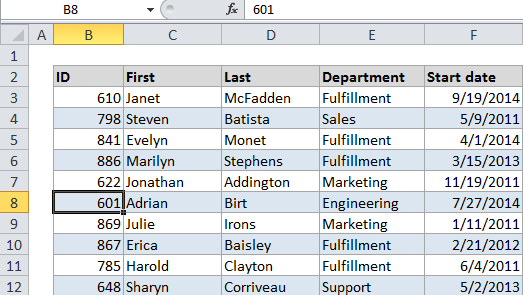
This tutorial shows how to Highlight every other row in Excel using the example below;

Formula

=ISEVEN(ROW())
Explanation

If you want to highlight every other row in a table (sometimes called zebra striping) with conditional formatting you can do so with a simple formula that uses either the ISEVEN or ISODD function. For example, if you want to highlight every other row in the range B3:F102 select the entire range then create a conditional formatting rule that uses this formula:

=ISEVEN(ROW())

How this formula works

When you use a formula to apply conditional formatting, the formula is evaluated for every cell in the selection. In this case, there are no addresses in the formula, so, for every cell in the data, the ROW and ISEVEN functions are run. ROW returns the row number of the cell, and ISEVEN returns TRUE if the row number is even and FALSE if the row number is odd. The rule will trigger on TRUE, so even rows will be shaded.

To shade odd rows, just use ISODD instead:

=ISODD(ROW())

A MOD alternative

If you’re using an older version of Excel (before 2007) you may not have access to ISEVEN and ISODD. In that case, you can use the “classic” formula for shading even or odd rows, which depends on the MOD function:

=MOD(ROW(),2) = 0 // returns true for even rows
=MOD(ROW(),2) = 1 // returns true for odd rows

MOD takes a number and a divisor as arguments, and returns the remainder. The ROW function provides the number, which is divided by 2, so MOD  returns zero when the row is an even number and 1 if not.

Post navigation

Previous Post:

COSH function: Description, Usage, Syntax, Examples and Explanation

Next Post:

Excel Data validation require unique number

Leave a Reply Cancel reply

Your email address will not be published. Required fields are marked *

Learn Basic Excel

Ribbon
Workbook
Worksheets
Format Cells
Find & Select
Sort & Filter
Templates
Print
Share
Protect
Keyboard Shortcuts

Categories

  • Charts
  • Data Analysis
  • Data Validation
  • Excel Functions
    • Cube Functions
    • Database Functions
    • Date and Time Functions
    • Engineering Functions
    • Financial Functions
    • Information Functions
    • Logical Functions
    • Lookup and Reference Functions
    • Math and Trig Functions
    • Statistical Functions
    • Text Functions
    • Web Functions
  • Excel VBA
  • Excel Video Tutorials
  • Formatting
  • Grouping
  • Others

Logical Functions

  • IFNA function: Description, Usage, Syntax, Examples and Explanation
  • OR function Examples in Excel
  • How to use Excel FALSE Function
  • How to use Excel XOR Function
  • NOT function: Description, Usage, Syntax, Examples and Explanation

Date Time

  • How to calculate project start date based on end date in Excel
  • MONTH function: Description, Usage, Syntax, Examples and Explanation
  • Calculate retirement date in Excel
  • How to calculate quarter from date in Excel
  • Get day from date in Excel

Grouping

  • How to randomly assign data to groups in Excel
  • Group numbers with VLOOKUP in Excel
  • Group numbers at uneven intervals in Excel
  • Group times into 3 hour buckets in Excel
  • Calculate conditional mode with criteria in Excel

General

  • Automatically fill series of cells in Excel using AutoFill
  • Spell Check in Excel
  • How to create dynamic named range with INDEX in Excel
  • AutoRecover file that was never saved in Excel
  • 3D SUMIF for multiple worksheets in Excel
© 2026 xlsoffice . All Right Reserved. | Teal Smiles | Abbreviations And Their Meaning