
Skip to content
Free Excel Tutorials
  • Home
  • Excel For Beginners
  • Excel Intermediate
  • Advanced Excel For Experts

Data Analysis

  • Working With Tables in Excel
  • Calculate Conditional Percentile ‘IF’ in table in Excel
  • How to Create Gantt Chart in Excel
  • Number and Text Filters Examples in Excel
  • Filter Data Based on Date in Excel

References

  • Count rows that contain specific values in Excel
  • Get nth match with INDEX / MATCH in Excel
  • Lookup entire row in Excel
  • How to use Excel FORMULATEXT function
  • How to get first row number in range in Excel

Data Validations

  • Excel Data validation must begin with
  • Excel Data validation whole percentage only
  • Excel Data validation require unique number
  • Excel Data validation with conditional list
  • Excel Data validation allow uppercase only

Highlight approximate match lookup conditional formatting in Excel

by

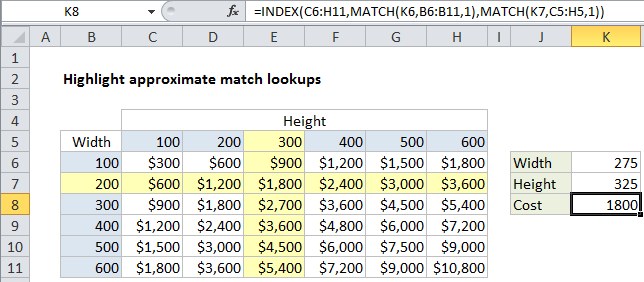
This tutorial shows how to Highlight approximate match lookup conditional formatting in Excel using the example below;

Formula

=OR($B5=LOOKUP(width,widths),B$5=LOOKUP(height,heights))
Explanation

To highlight rows and columns associated with an approximate match, you can use conditional formatting with a formula based on the LOOKUP function together with with a logical function like OR or AND. In the example shown, the formula used to apply conditional formatting is:

=OR($B5=LOOKUP(width,widths),B$5=LOOKUP(height,heights))

How this formula works

This formula uses 4 named ranges, defined as follows:

width=K6
height=K7
widths=B6:B11
heights=C5:H5

Conditional formatting is evaluated relative to every cell it is applied to, starting with the active cell in the selection, which is cell B5 in this case. To highlight the matching row, we use this logical expression:

$B5=LOOKUP(width,widths)

The reference to B5 is mixed, with the column locked and row unlocked, so that only values in column B (widths) are compared to the value in K6 (width). In the example shown, this logical expression will return TRUE for every cell in a row where width is 200, based on an approximate match of the value in K6 (width, 275) against all values in K6:B11 (widths). This is done with LOOKUP function:

LOOKUP(width,widths)

Like the MATCH function, LOOKUP will run through sorted values until a greater value is found, then “step back” to the previous value, which is 200 in this case.

To highlight the matching column, we use this logical expression:

B$5=LOOKUP(height,heights)

The reference to B5 is mixed, with the column relative and row absolute, so that only values in row 5 (heights) are compared to the value in K7 (height). In the example shown, this logical expression will return TRUE for every cell in a row where height is 300, based on an approximate match of the value in K7 (height, 325) against all values in C5:H5 (heights). This is done with LOOKUP function:

LOOKUP(height,heights)

As above, LOOKUP will run through sorted values until a greater value is found, then “step back” to the previous value, which is 300 in this case.

Highlight intersection only

To highlight the intersection only, just replace the OR function with the AND function:

=AND($B5=LOOKUP(width,widths),B$5=LOOKUP(height,heights))

Post navigation

Previous Post:

COSH function: Description, Usage, Syntax, Examples and Explanation

Next Post:

Excel Data validation require unique number

Leave a Reply Cancel reply

Your email address will not be published. Required fields are marked *

Learn Basic Excel

Ribbon
Workbook
Worksheets
Format Cells
Find & Select
Sort & Filter
Templates
Print
Share
Protect
Keyboard Shortcuts

Categories

  • Charts
  • Data Analysis
  • Data Validation
  • Excel Functions
    • Cube Functions
    • Database Functions
    • Date and Time Functions
    • Engineering Functions
    • Financial Functions
    • Information Functions
    • Logical Functions
    • Lookup and Reference Functions
    • Math and Trig Functions
    • Statistical Functions
    • Text Functions
    • Web Functions
  • Excel VBA
  • Excel Video Tutorials
  • Formatting
  • Grouping
  • Others

Logical Functions

  • How to use Excel FALSE Function
  • How to use IFS function in Excel
  • OR function Examples in Excel
  • Not Equal To ‘<>‘ operator in Excel
  • How to use Excel OR Function

Date Time

  • Get days, hours, and minutes between dates in Excel
  • Get work hours between dates and times in Excel
  • Two ways to sum time over 30 minutes in Excel
  • How to calculate next scheduled event in Excel
  • Get fiscal quarter from date in Excel

Grouping

  • How to randomly assign people to groups in Excel
  • Calculate conditional mode with criteria in Excel
  • Categorize text with keywords in Excel
  • Map text to numbers in Excel
  • Group times into 3 hour buckets in Excel

General

  • Select, Insert, Rename, Move, Delete Worksheets in Excel
  • Subtotal by color in Excel
  • Spell Check in Excel
  • Subtotal invoices by age in Excel
  • How to create dynamic named range with INDEX in Excel
© 2025 xlsoffice . All Right Reserved. | Teal Smiles | Abbreviations And Their Meaning