
Skip to content
Free Excel Tutorials
  • Home
  • Excel For Beginners
  • Excel Intermediate
  • Advanced Excel For Experts

Data Analysis

  • How to Use Solver Tool in Excel
  • How to create Checklist in Excel
  • How to Create Gantt Chart in Excel
  • Conflicting Multiple Conditional Formatting Rules in Excel
  • Managing Conditional Formatting Rules in Excel

References

  • Multi-criteria lookup and transpose in Excel
  • Find Closest Match in Excel Using INDEX, MATCH, ABS and MIN functions
  • Convert text string to valid reference in Excel using Indirect function
  • Lookup entire row in Excel
  • CHOOSE function: Description, Usage, Syntax, Examples and Explanation

Data Validations

  • Excel Data validation require unique number
  • Excel Data validation specific characters only
  • How To Create Drop-down List in Excel
  • Excel Data validation unique values only
  • Prevent invalid data entering in specific cells

Clean and reformat telephone numbers using SUBSTITUTE function in Excel

by

One way to clean up and reformat telephone numbers is to strip out all extraneous characters, then apply Excel’s built-in telephone number format.

Formula

=SUBSTITUTE(SUBSTITUTE(SUBSTITUTE
(SUBSTITUTE(SUBSTITUTE(A1,"(",""),
")",""),"-","")," ",""),".","")+0
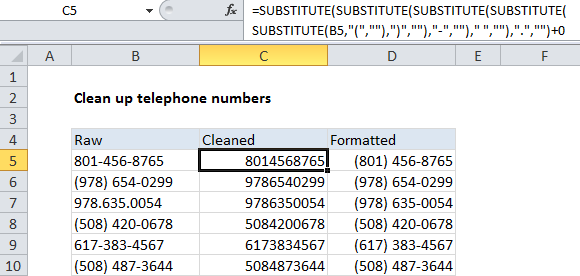
Note that the cell appears in the middle, with function names above and substitutions below. Not only does this make the formula easier to read, it also makes it easier to add and remove

Explanation

This formula above uses a series of nested SUBSTITUTE functions to strip out spaces, hyphens, periods, parentheses, and commas.

You’ll need to adjust the actual replacements to suit your data.

How this formula works

The formula runs from the inside out, with each SUBSTITUTE removing one character.

The inner most SUBSTITUTE removes the left parentheses, and the result is handed to the next SUBSTITUTE, which removes the right parentheses, and so on.

Whenever you use the SUBSTITUTE function, the result will be text. Because you can’t apply a number format to text, we need to convert the text to a number. One way to do that is to add zero (+0), which automatically converts numbers in text format to numbers in numeric format.

Finally, the “Special” telephone number format is applied (column D).

This page explains custom number formats and with many examples.

White space trick for better readability

When nesting multiple functions, it can be difficult to read the formula and keep all parentheses balanced. Excel doesn’t care about extra white space in a formula, so you can add line breaks in the formula to make the formula more readable. For example, the formula above can be written as follows:

=
SUBSTITUTE(
SUBSTITUTE(
SUBSTITUTE(
SUBSTITUTE(
SUBSTITUTE(
A1,
"(",""),
")",""),
"-",""),
" ",""),
".","")

Post navigation

Previous Post:

DECIMAL function: Description, Usage, Syntax, Examples and Explanation

Next Post:

AVERAGE function: Description, Usage, Syntax, Examples and Explanation

Leave a Reply Cancel reply

Your email address will not be published. Required fields are marked *

Learn Basic Excel

Ribbon
Workbook
Worksheets
Format Cells
Find & Select
Sort & Filter
Templates
Print
Share
Protect
Keyboard Shortcuts

Categories

  • Charts
  • Data Analysis
  • Data Validation
  • Excel Functions
    • Cube Functions
    • Database Functions
    • Date and Time Functions
    • Engineering Functions
    • Financial Functions
    • Information Functions
    • Logical Functions
    • Lookup and Reference Functions
    • Math and Trig Functions
    • Statistical Functions
    • Text Functions
    • Web Functions
  • Excel VBA
  • Excel Video Tutorials
  • Formatting
  • Grouping
  • Others

Logical Functions

  • Check multiple cells are equal in Excel
  • How to use Excel FALSE Function
  • Nested IF function example in Excel
  • IF with boolean logic in Excel
  • IF with wildcards in Excel

Date Time

  • List holidays between two dates in Excel
  • Calculate days remaining in Excel
  • How to calculate next anniversary date or birthday in Excel
  • WEEKDAY function: Description, Usage, Syntax, Examples and Explanation
  • TODAY function: Description, Usage, Syntax, Examples and Explanation

Grouping

  • Map text to numbers in Excel
  • Group numbers with VLOOKUP in Excel
  • If cell contains one of many things in Excel
  • Calculate conditional mode with criteria in Excel
  • How to randomly assign data to groups in Excel

General

  • How to get amount with percentage in Excel
  • How to create dynamic named range with INDEX in Excel
  • Count cells less than in Excel
  • Automatically fill series of cells in Excel using AutoFill
  • Currency vs Accounting Format in Excel
© 2026 xlsoffice . All Right Reserved. | Teal Smiles | Abbreviations And Their Meaning