
Skip to content
Free Excel Tutorials
  • Home
  • Excel For Beginners
  • Excel Intermediate
  • Advanced Excel For Experts

Data Analysis

  • How to Use Solver Tool in Excel
  • How to count table columns in Excel
  • Remove Duplicates Example in Excel
  • How to create Gauge Chart in Excel
  • Understanding Pivot Tables in Excel

References

  • Extract all partial matches in Excel
  • To count total rows in a range in Excel
  • How to use Excel LOOKUP Function
  • Convert text string to valid reference in Excel using Indirect function
  • MATCH function: Description, Usage, Syntax, Examples and Explanation

Data Validations

  • How To Create Drop-down List in Excel
  • Excel Data validation whole percentage only
  • Prevent invalid data entering in specific cells
  • Excel Data validation unique values only
  • Excel Data validation require unique number

Round a number up to nearest multiple in Excel

by

This tutorials shows how to Round a number up to nearest multiple in Excel.

If you need to round a number up to the nearest specified multiple (i.e. round a number up to the nearest dollar, up to the nearest $.25, up to the nearest multiple of 5, etc.) you can use the CEILING function.

Formula

=CEILING(number,multiple)
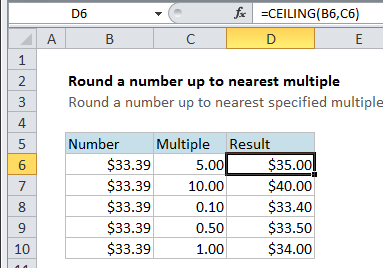
Explanation

In the example, the formula in cell D6 is

=CEILING(B6,C6)

This tells Excel to take the value in B6 ($33.39 ) and round it to the nearest multiple of the value in C6 (5). The result is $35.00, since 35 is the next multiple of 5 after 33.39. In cell D10, we are rounding the same number, 33.39 up to the nearest multiple of 1 and get 34.00.

You can use CEILING to round prices, times, instrument readings or any other numeric value.

Note that CEILING rounds up using the multiple supplied. You can use the MROUND function to round to the nearest multiple and the FLOOR function to round down to the nearest multiple.

Post navigation

Previous Post:

COSH function: Description, Usage, Syntax, Examples and Explanation

Next Post:

Excel Data validation require unique number

Leave a Reply Cancel reply

Your email address will not be published. Required fields are marked *

Learn Basic Excel

Ribbon
Workbook
Worksheets
Format Cells
Find & Select
Sort & Filter
Templates
Print
Share
Protect
Keyboard Shortcuts

Categories

  • Charts
  • Data Analysis
  • Data Validation
  • Excel Functions
    • Cube Functions
    • Database Functions
    • Date and Time Functions
    • Engineering Functions
    • Financial Functions
    • Information Functions
    • Logical Functions
    • Lookup and Reference Functions
    • Math and Trig Functions
    • Statistical Functions
    • Text Functions
    • Web Functions
  • Excel VBA
  • Excel Video Tutorials
  • Formatting
  • Grouping
  • Others

Logical Functions

  • How to use Excel NOT Function
  • IF with boolean logic in Excel
  • SWITCH function: Description, Usage, Syntax, Examples and Explanation
  • XOR function: Description, Usage, Syntax, Examples and Explanation
  • OR function: Description, Usage, Syntax, Examples and Explanation

Date Time

  • Get fiscal year from date in Excel
  • How to calculate nth day of week in month in Excel
  • Get days between dates ignoring years in Excel
  • Pad week numbers with zeros in Excel
  • How to show last updated date stamp in Excel

Grouping

  • Group times into unequal buckets in Excel
  • Categorize text with keywords in Excel
  • Running count group by n size in Excel
  • Calculate conditional mode with criteria in Excel
  • Group numbers with VLOOKUP in Excel

General

  • Split Cell Content Using Text to Columns in Excel
  • Creating and Opening an existing file in Excel
  • How to get original number from percent change in Excel
  • How to create dynamic worksheet reference in Excel
  • How to calculate decrease by percentage in Excel
© 2026 xlsoffice . All Right Reserved. | Teal Smiles | Abbreviations And Their Meaning