
Skip to content
Free Excel Tutorials
  • Home
  • Excel For Beginners
  • Excel Intermediate
  • Advanced Excel For Experts

Data Analysis

  • Conditional Formatting New Rule with Formulas in Excel
  • Create Scatter Chart in Excel
  • Conditional Formatting Data bars Examples in Excel
  • Number and Text Filters Examples in Excel
  • How to Create Gantt Chart in Excel

References

  • How to get address of named range in Excel
  • Left Lookup in Excel
  • Get nth match with INDEX / MATCH in Excel
  • VLOOKUP function: Description, Usage, Syntax, Examples and Explanation
  • Find Closest Match in Excel Using INDEX, MATCH, ABS and MIN functions

Data Validations

  • Excel Data validation no punctuation
  • Excel Data validation must not contain
  • Excel Data validation specific characters only
  • Excel Data validation must begin with
  • Excel Data validation whole percentage only

How to use Excel TRANSPOSE Function

by

This Excel tutorial explains how to use the TRANSPOSE function with syntax and examples.

Excel TRANSPOSE Function Description

Microsoft Excel TRANSPOSE function returns a transposed range of cells. For example, a horizontal range of cells is returned if a vertical range is entered as a parameter. Or a vertical range of cells is returned if a horizontal range of cells is entered as a parameter.

TRANSPOSE function is a built-in function in Excel that is categorized as a Lookup/Reference Function. The TRANSPOSE function can be entered as part of a formula in a cell of a worksheet.
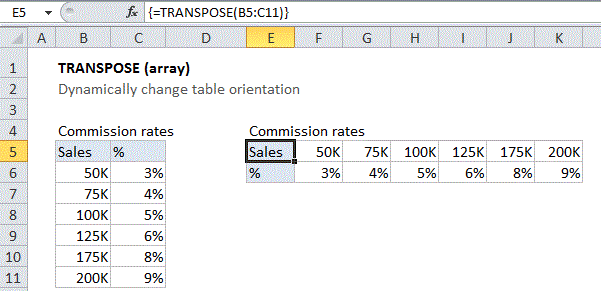
Explanation:  The TRANSPOSE function converts a vertical range of cells to a horizontal range of cells, or a horizontal range of cells to a vertical range of cells. Use it to “flip” a range of cells from one orientation to another.

Syntax

The syntax for the TRANSPOSE function in Microsoft Excel is:

TRANSPOSE( range )

Arguments

range
The range of cells that you want to transpose.

Returns

The TRANSPOSE function returns a transposed range of cells.

Note: The range value in the TRANSPOSE function must be entered as an array. For a one-off conversion, you can use paste special > transpose. To enter an array, enter the value and then press Ctrl+Shift+Enter. This will place {} brackets around the formula, indicating that it is an array.

Post navigation

Previous Post:

VLOOKUP without #N/A error in Excel

Next Post:

Manipulating text strings using Left, Mid, Right, Len, Substitute in Excel

Leave a Reply Cancel reply

Your email address will not be published. Required fields are marked *

Learn Basic Excel

Ribbon
Workbook
Worksheets
Format Cells
Find & Select
Sort & Filter
Templates
Print
Share
Protect
Keyboard Shortcuts

Categories

  • Charts
  • Data Analysis
  • Data Validation
  • Excel Functions
    • Cube Functions
    • Database Functions
    • Date and Time Functions
    • Engineering Functions
    • Financial Functions
    • Information Functions
    • Logical Functions
    • Lookup and Reference Functions
    • Math and Trig Functions
    • Statistical Functions
    • Text Functions
    • Web Functions
  • Excel VBA
  • Excel Video Tutorials
  • Formatting
  • Grouping
  • Others

Logical Functions

  • Not Equal To ‘<>‘ operator in Excel
  • Nested IF function example in Excel
  • How to use Excel XOR Function
  • How to use IFS function in Excel
  • XOR function: Description, Usage, Syntax, Examples and Explanation

Date Time

  • Add business days to date in Excel
  • How to calculate working days left in month in Excel
  • How to get year from date in Excel
  • Calculate number of hours between two times in Excel
  • How to calculate Next working/business day in Excel

Grouping

  • Group times into unequal buckets in Excel
  • Group numbers at uneven intervals in Excel
  • How to randomly assign data to groups in Excel
  • How to randomly assign people to groups in Excel
  • Group arbitrary text values in Excel

General

  • Lock Cells in a Worksheet Excel
  • How to calculate percentage of total in Excel
  • How to create dynamic worksheet reference in Excel
  • Select, Insert, Rename, Move, Delete Worksheets in Excel
  • How to get Excel workbook path only
© 2025 xlsoffice . All Right Reserved. | Teal Smiles | Abbreviations And Their Meaning