
Skip to content
Free Excel Tutorials
  • Home
  • Excel For Beginners
  • Excel Intermediate
  • Advanced Excel For Experts

Data Analysis

  • How to create a Histogram in Excel
  • Subtotal function in Excel
  • Use Data Form to input, edit and delete records in Excel
  • How To Create Frequency Distribution in Excel
  • How to create Checklist in Excel

References

  • How to get first column number in range in Excel
  • Find Closest Match in Excel Using INDEX, MATCH, ABS and MIN functions
  • Left Lookup in Excel
  • Count unique text values with criteria
  • Two-way lookup with VLOOKUP in Excel

Data Validations

  • Excel Data validation require unique number
  • Excel Data validation no punctuation
  • Excel Data validation must contain specific text
  • Prevent invalid data entering in specific cells
  • Excel Data validation with conditional list

Convert text to date in Excel

by

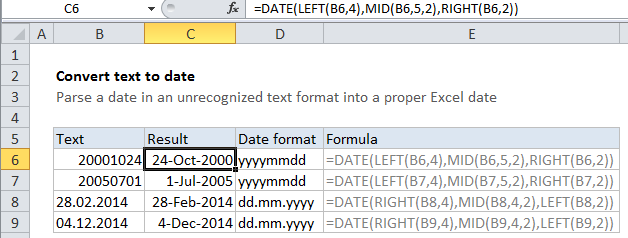
This tutorial show how to Convert text to date in Excel using the example below.

To convert text in an unrecognized date format to a proper Excel date, you can parse the text and assemble a proper date with a formula based on several functions: DATE, LEFT, MID, and RIGHT.

Note: Before you go the formula route, see below for other ways you might be able to get Excel to recognize text as dates without formulas.

Formula

=DATE(LEFT(text,4),MID(text,5,2),RIGHT(text,2))
Explanation of how this formula works


In the example shown, the formula in C6 is:

=DATE(LEFT(B6,4),MID(B6,5,2),RIGHT(B6,2))

This formula extract the year, month, and day values separately, and uses the DATE function to assemble them into the date October 24, 2000.

Background

When you’re working with data from another system, you might run into text values that represent dates, but are not understood as dates in Excel. For example, you might have text values like this:

Text Date represented
20001024 October 24, 2000
20050701 July 1, 20115
19980424 April 24, 1998
28.02.2014 February 28, 2014

Excel won’t recognize these text values as a date, so in order to create a proper date, you’ll need parse the text into it’s components (year, month, day) and use these to make a date with the DATE function.

The DATE function takes three arguments: year, month, and day. The LEFT function extracts the leftmost 4 characters and supplies this to DATE as the year. The MID function extracts characters 5-6 and supplies this to DATE as the month, and the RIGHT function extracts the rightmost 2 characters and supplies these to DATE as the day. The final result is a proper Excel date that can be formatted any way you like.

Another example

In row 8, the (unrecognized) date format is dd.mm.yyyy and the formula in C8 is:

=DATE(RIGHT(B8,4),MID(B8,4,2),LEFT(B8,2))

Text to columns to fix dates

Another way to get Excel to recognize dates is to use the Text to Columns Feature:

Select the column of dates, then try Data > Text to columns > Fixed > finish

This can sometimes fix everything at once.

Add zero to fix dates

Sometimes, you’ll encounter dates in a text format that Excel should recognize. In this case, you might be able to force Excel to convert the text values into dates by adding zero to the value. When you add zero, Excel will try to coerce text values to numbers. Since dates are just numbers, this trick is a great way to convert dates in text format that Excel really should understand.

To convert dates in place by adding zero, try Paste Special:

  1. Add a zero to an unused cell and copy to the clipboard
  2. Select the problematic dates
  3. Paste Special > Values > Add

To convert dates by adding zero in a formula, use:

=A1+0

where A1 contains an unrecognized date.

Post navigation

Previous Post:

COSH function: Description, Usage, Syntax, Examples and Explanation

Next Post:

Excel Data validation require unique number

Leave a Reply Cancel reply

Your email address will not be published. Required fields are marked *

Learn Basic Excel

Ribbon
Workbook
Worksheets
Format Cells
Find & Select
Sort & Filter
Templates
Print
Share
Protect
Keyboard Shortcuts

Categories

  • Charts
  • Data Analysis
  • Data Validation
  • Excel Functions
    • Cube Functions
    • Database Functions
    • Date and Time Functions
    • Engineering Functions
    • Financial Functions
    • Information Functions
    • Logical Functions
    • Lookup and Reference Functions
    • Math and Trig Functions
    • Statistical Functions
    • Text Functions
    • Web Functions
  • Excel VBA
  • Excel Video Tutorials
  • Formatting
  • Grouping
  • Others

Logical Functions

  • IFNA function: Description, Usage, Syntax, Examples and Explanation
  • How to return blank in place of #DIV/0! error in Excel
  • How to use Excel XOR Function
  • TRUE function: Description, Usage, Syntax, Examples and Explanation
  • Not Equal To ‘<>‘ operator in Excel

Date Time

  • Pad week numbers with zeros in Excel
  • How to get Weekdays, Working days between Two Dates in Excel
  • MINUTE function: Description, Usage, Syntax, Examples and Explanation
  • Display Date is same month in Excel
  • MONTH function: Description, Usage, Syntax, Examples and Explanation

Grouping

  • Map inputs to arbitrary values in Excel
  • If cell contains one of many things in Excel
  • Running count group by n size in Excel
  • Group arbitrary text values in Excel
  • Group numbers with VLOOKUP in Excel

General

  • Print Excel Sheet In Landscape Or Portrait
  • Basic numeric sort formula in Excel
  • Check if multiple cells have same value with case sensitive in Excel
  • Convert column number to letter in Excel
  • Check if range contains a value not in another range in Excel
© 2026 xlsoffice . All Right Reserved. | Teal Smiles | Abbreviations And Their Meaning