

Skip to content
Free Excel Tutorials
  • Home
  • Excel For Beginners
  • Excel Intermediate
  • Advanced Excel For Experts

Data Analysis

  • How to add Trendline to a chart in Excel
  • How to do a t-Test in Excel?
  • Conditional Formatting Rules in Excel
  • Conditional Formatting New Rule with Formulas in Excel
  • Example of COUNTIFS with variable table column in Excel

References

  • Excel Advanced Lookup using Index and Match Functions
  • How to get last row in text data in Excel
  • Find closest match in Excel
  • How to get first column number in range in Excel
  • How to calculate two-way lookup VLOOKUP in Excel Table

Data Validations

  • Excel Data validation exists in list
  • Excel Data validation date in specific year
  • Excel Data validation number multiple 100
  • Excel Data validation whole percentage only
  • Excel Data validation unique values only

How To Multiply Numbers in Excel

by

Learn how to multiply columns and how to multiply a column by a constant.

To multiply numbers in Excel, use the asterisk symbol (*) or the PRODUCT function.

1. The formula below multiplies numbers in a cell. Simply use the asterisk symbol (*) as the multiplication operator.

Don’t forget, always start a formula with an equal sign (=).

2. The formula below multiplies the values in cells A1, A2 and A3.
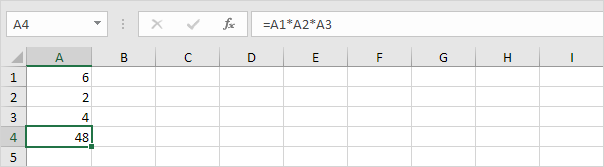
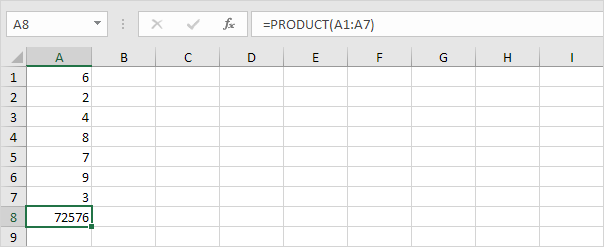
3. As you can imagine, this formula can get quite long. Use the PRODUCT function to shorten your formula. For example, the PRODUCT function below multiplies the values in the range A1:A7.
4. Here’s another example.
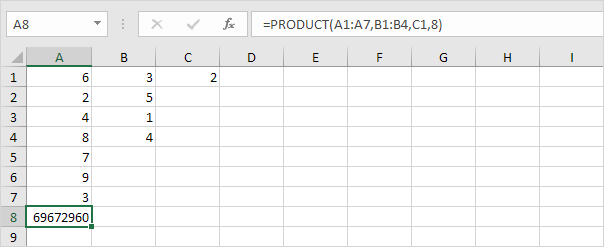
Explanation: =A1*A2*A3*A4*A5*A6*A7*B1*B2*B3*B4*C1*8 produces the exact same result.

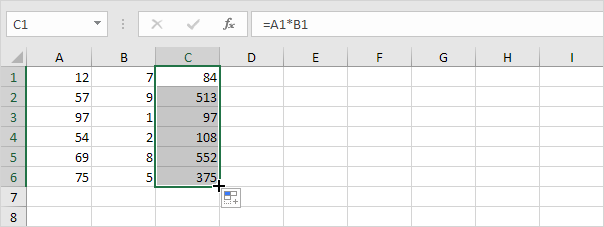
Take a look at the screenshot below. To multiply two columns, execute the following steps.

5a. First, multiply the value in cell A1 by the value in cell B1.
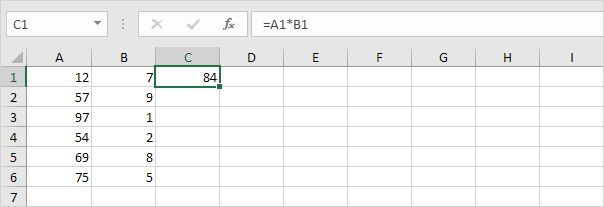
5b. Next, select cell C1, click on the lower right corner of cell C1 and drag it down to cell C6.
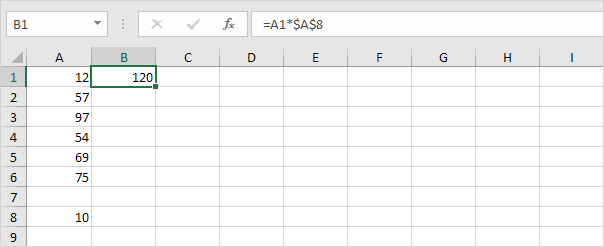
Take a look at the screenshot below. To multiply a column of numbers by a constant number, execute the following steps.

6a. First, multiply the value in cell A1 by the value in cell A8. Fix the reference to cell A8 by placing a $ symbol in front of the column letter and row number ($A$8).
6b. Next, select cell B1, click on the lower right corner of cell B1 and drag it down to cell B6.
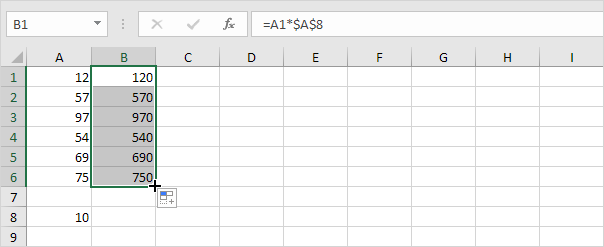
Explanation: when we drag the formula down, the absolute reference ($A$8) stays the same, while the relative reference (A1) changes to A2, A3, A4, etc. You can also use Paste Special to quickly multiply a range of cells by a constant number.

Post navigation

Previous Post:

TRUE function: Description, Usage, Syntax, Examples and Explanation

Next Post:

Excel Pie Chart

Leave a Reply Cancel reply

Your email address will not be published. Required fields are marked *

Learn Basic Excel

Ribbon
Workbook
Worksheets
Format Cells
Find & Select
Sort & Filter
Templates
Print
Share
Protect
Keyboard Shortcuts

Categories

  • Charts
  • Data Analysis
  • Data Validation
  • Excel Functions
    • Cube Functions
    • Database Functions
    • Date and Time Functions
    • Engineering Functions
    • Financial Functions
    • Information Functions
    • Logical Functions
    • Lookup and Reference Functions
    • Math and Trig Functions
    • Statistical Functions
    • Text Functions
    • Web Functions
  • Excel VBA
  • Excel Video Tutorials
  • Formatting
  • Grouping
  • Others

Logical Functions

  • Not Equal To ‘<>‘ operator in Excel
  • How to return blank in place of #DIV/0! error in Excel
  • IFERROR function: Description, Usage, Syntax, Examples and Explanation
  • SWITCH function: Description, Usage, Syntax, Examples and Explanation
  • IF function: Description, Usage, Syntax, Examples and Explanation

Date Time

  • How to enter Today’s Date or Static Date and Time in Excel
  • WORKDAY.INTL function: Description, Usage, Syntax, Examples and Explanation
  • Custom weekday abbreviation in Excel
  • Add decimal hours to time in Excel
  • Add workdays to date custom weekends in Excel

Grouping

  • Group numbers with VLOOKUP in Excel
  • If cell contains one of many things in Excel
  • Running count group by n size in Excel
  • Calculate conditional mode with criteria in Excel
  • Map text to numbers in Excel

General

  • Excel Operators
  • How to get original number from percent change in Excel
  • Count cells that do not contain many strings in Excel
  • Convert column number to letter in Excel
  • How to count total columns in range in Excel
© 2026 xlsoffice . All Right Reserved. | Teal Smiles | Abbreviations And Their Meaning