
Skip to content
Free Excel Tutorials
  • Home
  • Excel For Beginners
  • Excel Intermediate
  • Advanced Excel For Experts

Data Analysis

  • Number and Text Filters Examples in Excel
  • Working With Tables in Excel
  • How To Compare Two Lists in Excel
  • Filter Data Based on Date in Excel
  • Move chart to a separate worksheet in Excel

References

  • Two-way lookup with VLOOKUP in Excel
  • How to use Excel OFFSET function
  • How to use Excel ROWS Function
  • Multi-criteria lookup and transpose in Excel
  • How to use Excel FORMULATEXT function

Data Validations

  • Excel Data validation date in specific year
  • Excel Data validation unique values only
  • Data validation must not exist in list
  • Excel Data validation must begin with
  • Excel Data validation whole percentage only

How to get address of last cell in range in Excel

by

To get the address of the first cell in a named range, you can use the ADDRESS function together with ROW and COLUMN functions.

Formula

=ADDRESS(ROW(range)+ROWS(range)-1,COLUMN(range)+COLUMNS(range)-1)
Explanation

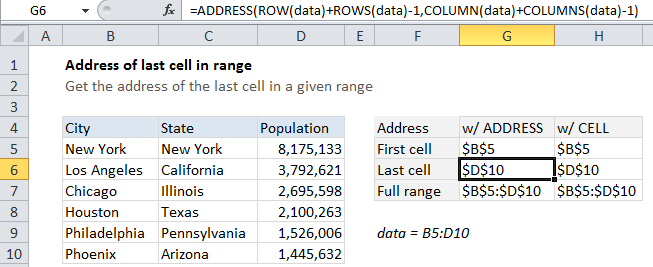
In the example shown, the formula in G6 is:

=ADDRESS(ROW(data)+ROWS(data)-1,COLUMN(data)+COLUMNS(data)-1)

How this formula works

The ADDRESS function builds an address based on a row and column number.

Working from the inside out, we use the ROW function to generate a list of row numbers, which are then shifted by adding ROWS(data)-1,  so that the first item in the array is the last row number:

ROW(data)+ROWS(data)-1

Then we do the same thing with COLUMN and COLUMNS:

COLUMN(data)+COLUMNS(data)-1

The ADDRESS function then assembles and returns an array of addresses. When entered in a single cell, just the item from the array is displayed, which is the address corresponding to the last cell in a range.

CELL function alternative

You can also use the CELL function to get the address of the last cell in a range with this formula:

=CELL("address",INDEX(data,ROWS(data),COLUMNS(data)))

In this case, we use INDEX to get a reference to the last cell in the range, which we determine by passing total rows and total columns into INDEX. The reference returned by INDEX is then handled by the CELL function, using “address”, to return the address.

Note that the the CELL function can be volatile. If you add it to a worksheet, you’ll notice that you are prompted to save even when you’ve made no changes.

Post navigation

Previous Post:

How to calculate project complete percentage in Excel

Next Post:

Popularly Used Excel Functions and their examples

Leave a Reply Cancel reply

Your email address will not be published. Required fields are marked *

Learn Basic Excel

Ribbon
Workbook
Worksheets
Format Cells
Find & Select
Sort & Filter
Templates
Print
Share
Protect
Keyboard Shortcuts

Categories

  • Charts
  • Data Analysis
  • Data Validation
  • Excel Functions
    • Cube Functions
    • Database Functions
    • Date and Time Functions
    • Engineering Functions
    • Financial Functions
    • Information Functions
    • Logical Functions
    • Lookup and Reference Functions
    • Math and Trig Functions
    • Statistical Functions
    • Text Functions
    • Web Functions
  • Excel VBA
  • Excel Video Tutorials
  • Formatting
  • Grouping
  • Others

Logical Functions

  • How to return blank in place of #DIV/0! error in Excel
  • SWITCH function example in Excel
  • How to use IFS function in Excel
  • Check multiple cells are equal in Excel
  • Invoice status with nested if in Excel

Date Time

  • TODAY function: Description, Usage, Syntax, Examples and Explanation
  • How to calculate next day of week in Excel
  • Count birthdays by month in Excel
  • WORKDAY function: Description, Usage, Syntax, Examples and Explanation
  • Get last weekday in month in Excel

Grouping

  • How to randomly assign people to groups in Excel
  • How to randomly assign data to groups in Excel
  • Group times into unequal buckets in Excel
  • Group numbers at uneven intervals in Excel
  • Calculate conditional mode with criteria in Excel

General

  • How to get original number from percent change in Excel
  • How to get original price from percentage discount in Excel
  • Convert column letter to number in Excel
  • Count cells that do not contain errors in Excel
  • Create dynamic workbook reference to another workbook in Excel
© 2026 xlsoffice . All Right Reserved. | Teal Smiles | Abbreviations And Their Meaning